
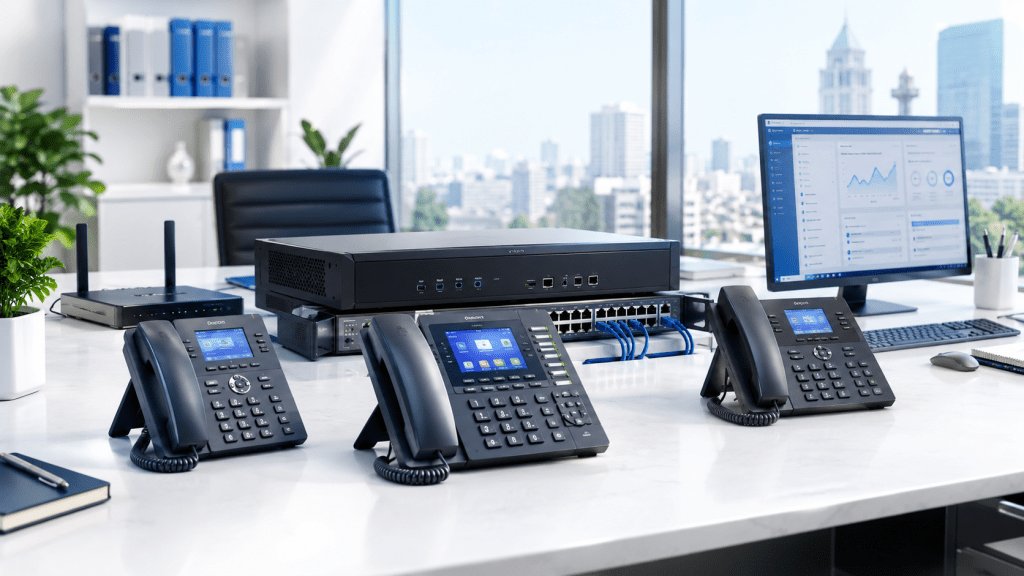

When a business starts missing calls, struggling with customer support, or paying too much for separate phone lines, the problem is usually bigger than the telephone itself. The right communication infrastructure can change how a company handles customers, employees, sales, and remote teams.
That is where IPPBX for businesses becomes valuable.
An IP PBX connects business phones through an IP network and can provide features such as IVR, call routing, extensions, call recording, call queues, SIP trunking, CRM integration, remote extensions, and reporting. In Pakistan, businesses can choose from on-premise appliances, software-based IP PBX servers, cloud PBX, or hybrid deployments.
If you’re comparing IPPBX price in Pakistan, PBX System price in Pakistan, VoIP phones, or complete business communication solutions, this guide explains what you actually need to know before buying.
What Is IPPBX for Businesses?
An IPPBX, or Internet Protocol Private Branch Exchange, is a business telephone system that manages voice communication over an IP network.
Instead of giving every employee a separate traditional telephone line, an IP PBX lets a company create extensions and manage calls centrally.
For example:
Main business number → IVR → Department → Employee extension
A customer could press:
- 1 for Sales
- 2 for Support
- 3 for Accounts
- 4 for Operator
The call can then be routed automatically.
Modern IP PBX platforms can also support remote employees, SIP trunks, IP phones, mobile applications, call recording, call queues, and CRM integrations.
This makes IPPBX for businesses particularly useful for offices, call centers, hospitals, educational institutions, hotels, e-commerce companies, financial services, and organizations with multiple branches.
IPPBX Pakistan: Why Businesses Are Moving to IP Telephony
Traditional PBX systems can become expensive and difficult to expand as a company grows.
Imagine a business with 10 employees that grows to 50. With an older telephone infrastructure, adding extensions and managing separate lines can become complicated.
An IP PBX takes a more scalable approach.
Key advantages include:
- Centralized extension management
- IVR and auto attendant
- Call forwarding
- Call transfer
- Call queues
- Call recording
- Conference calling
- SIP trunk support
- Remote extensions
- Mobile and softphone support
- CRM integration
- Call reporting and analytics
- Multi-branch communication
For growing Pakistani businesses, the biggest advantage is often scalability. You can design the system around today’s requirements while leaving room for additional users and locations.
IPPBX Price in Pakistan: How Much Does It Cost?
There is no single IPPBX price in Pakistan because the total cost depends on the number of users, concurrent calls, features, phones, gateways, installation, networking, and whether you choose cloud or on-premise deployment.
A current Pakistan-focused IP PBX pricing guide places approximate complete setup costs around:
| Business size | Approximate setup range |
|---|---|
| Small business, 5–15 users | PKR 35,000–100,000 |
| Medium business, 20–50 users | PKR 100,000–300,000 |
| Enterprise deployment | PKR 300,000–1,000,000+ |
These are planning ranges rather than fixed quotations; the actual price depends heavily on hardware and implementation requirements.
Hardware-only prices can also vary considerably. For example, current listings on IPPBX.com.pk show Grandstream UCM6202 at about PKR 101,000, UCM6301 at PKR 103,000, UCM6302 at PKR 130,000, UCM6302A at PKR 120,000, and UCM6304 at PKR 270,000 at the time checked.
So, when someone asks, “What is the IP PBX price?” the better question is:
How much will my complete business communication system cost?
That includes the PBX, phones, SIP connectivity, networking, configuration, installation, and support.
PBX System Price in Pakistan: Hardware vs Complete Setup
The PBX System price in Pakistan can look very different depending on what is included.
A basic PBX appliance is only one component.
A complete deployment may include:
- IP PBX server or appliance
- IP phones
- PoE network switch
- Router/firewall
- SIP trunk or VoIP service
- UPS or backup power
- Cabling
- PBX configuration
- IVR and call routing
- Call recording storage
- CRM integration
- Technical support
For example, an organization might purchase an IP PBX for PKR 100,000 but eventually spend significantly more after adding 20 or 30 IP phones, network infrastructure, installation, and SIP services.
This is why businesses should compare total deployment cost, not just the PBX appliance price.
Cloud PBX for Businesses in Pakistan
Cloud PBX is an increasingly attractive option for businesses that do not want to maintain physical PBX hardware.
With a cloud-based system, the PBX infrastructure is hosted remotely and employees connect using IP phones, computers, or supported mobile applications.
Cloud PBX can be useful for:
- Remote employees
- Startups
- Multi-city businesses
- Distributed sales teams
- Call centers
- Companies with frequent expansion
- Businesses that want predictable infrastructure costs
A cloud deployment can also simplify maintenance because the organization does not have to manage every component of an on-premise server.
However, internet quality becomes extremely important. Poor connectivity can affect voice quality, so businesses should evaluate bandwidth, latency, jitter, network security, and redundancy before deployment.
VoIP Business Phone System Pakistan: How It Works
A VoIP business phone system in Pakistan converts voice communication into digital data and transmits it through an IP network.
The basic architecture can look like this:
SIP Trunk → IP PBX → Network Switch → IP Phones
For remote workers:
SIP Trunk → IP PBX → Secure Internet Connection → Softphone/Mobile/IP Phone
This architecture gives businesses much more control over their telephone environment.
An employee can have an extension such as 201, while another employee uses 202. Calls can be transferred between them without requiring separate physical telephone lines for every internal conversation.
IP PBX Server: What Does a Business Need?
An IP PBX server can be physical hardware, a virtual machine, or cloud-hosted software.
The correct option depends on business requirements.
On-Premise IP PBX Server
A physical appliance is installed at the company’s location.
Best for:
- Businesses requiring local infrastructure
- Organizations with dedicated IT staff
- Companies wanting direct hardware control
- Larger offices and call centers
Software IP PBX Server
Software such as Asterisk or FreePBX can run on compatible server infrastructure.
Advantages:
- Flexible
- Highly customizable
- Can run on virtual infrastructure
- Suitable for advanced technical teams
However, configuration and security require proper expertise.
Cloud IP PBX
The infrastructure is hosted remotely.
Best for:
- Startups
- Remote teams
- Multi-branch organizations
- Businesses wanting easier scalability
VoIP Phone Pakistan: What Should You Buy?
The IP phone is the device employees actually use to make and receive calls.
Popular brands in the Pakistan business market include Yealink, Grandstream, Fanvil, Cisco, Poly, and Avaya. IPPBX.com.pk currently lists these brands among its business communication ecosystem.
Entry-level IP phones can be relatively affordable, while executive and advanced multimedia models cost considerably more.
For example, current Pakistan listings show:
- Fanvil V50P — around PKR 12,900
- Fanvil V60P — around PKR 14,200
- Fanvil X301G — around PKR 12,980
- Grandstream GXP2135 — around PKR 32,500
- Fanvil X6U — around PKR 72,240
Prices vary according to supplier, availability, specifications, and exchange rates.
For a small office, an entry-level SIP phone may be enough. A receptionist, manager, or call-center supervisor may benefit from a model with more programmable keys, larger displays, Bluetooth, Wi-Fi, or additional SIP accounts.
IP PBX Installation Pakistan: What Does Setup Involve?
Buying equipment is only the first step.
Professional IP PBX installation in Pakistan generally involves configuring the entire communication environment.
A typical deployment includes:
1. Network Preparation
The network should be capable of handling voice traffic reliably.
2. PBX Installation
The PBX appliance, server, virtual machine, or cloud platform is prepared.
3. Extension Creation
Each employee receives an extension and appropriate permissions.
4. SIP Configuration
SIP trunks and telephone accounts are connected.
5. IVR Setup
The business greeting and menu structure are configured.
6. Call Routing
Incoming and outgoing calls are assigned appropriate routes.
7. IP Phone Configuration
Each handset is registered with the PBX.
8. Security
Firewall rules, strong passwords, access controls, encryption options, and secure remote access should be configured.
9. Testing
Test calls should verify inbound, outbound, transfer, voicemail, IVR, recording, and emergency procedures.
Professional installation can reduce configuration mistakes and make future troubleshooting easier. IPPBX.com.pk currently offers IP phone installation, SIP configuration, extension setup, IP PBX deployment, cloud migration, and technical support services.
SIP Trunking for Businesses: The Connection Behind VoIP
SIP trunking connects an IP PBX to external telephone networks through SIP.
Think of the PBX as the company’s internal communication brain. SIP trunks provide the connection to the outside world.
A business may use SIP connectivity for:
- Incoming business numbers
- Outgoing calls
- Multiple simultaneous calls
- DID numbers
- Call center traffic
- Multi-branch communication
The number of simultaneous calls required should be considered when selecting a SIP service.
For example, a small office with five employees has very different requirements from a 100-agent call center.
IPPBX for Businesses: Which Companies Need It Most?
Almost any organization handling regular business calls can benefit from IPPBX for businesses.
Small Businesses
A small company can use extensions, IVR, call forwarding, and professional business numbers without building an overly complicated telephone infrastructure.
Call Centers
Call centers need more advanced capabilities such as queues, monitoring, recording, dialers, agent management, and analytics.
Healthcare
Clinics and hospitals can use departmental extensions, call routing, reception systems, and internal communication.
Hotels
Hotels often need reception, reservations, housekeeping, and room extensions.
Educational Institutions
Schools, colleges, universities, and training centers can create departments and extensions across offices.
Multi-Branch Companies
An IP PBX can connect branches through IP-based communication rather than maintaining isolated telephone systems.
IPPBX vs Traditional PBX
| Feature | Traditional PBX | IP PBX |
|---|---|---|
| Internet calling | Limited | Yes |
| SIP support | Usually limited | Yes |
| Remote extensions | Difficult | Easy |
| Scalability | Lower | High |
| CRM integration | Limited | Strong |
| Call analytics | Basic | Advanced |
| Mobile/softphone support | Limited | Available |
| Multi-branch connectivity | More complex | Easier |
| IVR | Available | Advanced options |
| Call recording | Model-dependent | Widely available |
The exact capabilities depend on the manufacturer and configuration, but IP PBX generally offers greater flexibility for modern organizations.
Buy and Sell Pakistan: Should You Buy Used IP PBX Equipment?
Some businesses search Buy and sell Pakistan marketplaces when trying to reduce communication equipment costs.
Used IP phones and PBX hardware can sometimes be less expensive, but buyers should be careful.
Before purchasing used equipment, check:
- Hardware condition
- Firmware support
- Warranty
- Power adapter availability
- MAC address status
- Previous configuration
- Licensing requirements
- Compatibility with your SIP platform
- Availability of replacement parts
For mission-critical business communication, new equipment with proper support can be a better long-term investment than choosing hardware solely because it has a lower upfront price.
IPPBX for Businesses: AIDA-Based Business Case
Attention: Stop Treating Your Phone System as Just a Phone
Your business phone is often the first interaction a customer has with your company.
A professional IVR, clear routing, and fast response can create a better first impression.
Interest: Centralize Communication
Instead of managing disconnected phones and separate communication channels, an IP PBX creates a centralized platform.
Desire: Give Employees Better Tools
Employees can transfer calls, use extensions, access voicemail, work remotely, and collaborate more efficiently.
Action: Build the System Around Your Business
The right IP PBX should be selected based on users, concurrent calls, locations, integrations, and growth—not simply the cheapest appliance.
The PAS Problem: What Happens Without a Proper PBX?
Problem: Calls are missed, customers wait, and employees struggle to transfer or track calls.
Agitation: As call volume grows, these small problems become lost leads, slower support, poor customer experiences, and inefficient teams.
Solution: IPPBX for businesses provides structured call routing, extensions, queues, IVR, recording, reporting, and scalable communication.
FAB: Why IPPBX Is Valuable for Growing Businesses
Feature: Call recording.
Advantage: Managers can review conversations and monitor service quality.
Benefit: Better employee training and customer support.
The same logic applies to IVR, call queues, CRM integration, remote extensions, and analytics.
How to Choose the Best IPPBX for Your Business
Before purchasing, answer these questions:
How many employees need extensions?
A five-user office doesn’t need the same PBX capacity as a 200-agent call center.
How many simultaneous calls do you handle?
Concurrent calls are often more important than simply counting employees.
Do you need remote workers?
If yes, consider cloud PBX, secure remote extensions, VPN, and softphone support.
Do you need call recording?
Call centers and customer service teams often benefit from recording and reporting.
Do you need CRM integration?
Sales teams can benefit significantly from connecting their telephone system with customer records.
Do you operate multiple branches?
Choose a system capable of multi-site connectivity.
What is your budget?
Consider the complete cost:
PBX + phones + networking + SIP + installation + support
rather than the PBX hardware alone.
Best IP PBX Brands in Pakistan
Several international brands are commonly used in business VoIP environments.
Grandstream
Grandstream offers PBX appliances, IP phones, gateways, and unified communication products. Current Pakistani listings include several UCM-series systems.
Yeastar
Yeastar is well known for business PBX and unified communication deployments and is particularly relevant for small and medium-sized organizations.
Yealink
Yealink is widely recognized for SIP/IP phones, including entry-level, mid-range, executive, and video models.
Fanvil
Fanvil provides a broad range of SIP phones suitable for offices, reception areas, call centers, and specialized environments.
Cisco
Cisco remains relevant for organizations with more complex enterprise networking and communication environments.
The best brand depends on compatibility, budget, support, features, and deployment requirements—not simply brand popularity.
Where to Get IPPBX Solutions in Pakistan
Businesses can compare systems, phones, gateways, and deployment services through specialist providers.
IPPBX.com.pk — IP PBX, VoIP Phones & Business Communication Solutions provides IP PBX systems, VoIP phones, installation, cloud PBX deployment, SIP integration, and support services in Pakistan.
For organizations researching digital marketing and online business visibility alongside technology services, GuestPost.com.pk provides article submission and guest-posting opportunities, including technology-focused content.
Key Takeaways
- IPPBX for businesses provides centralized and scalable business communication.
- IP PBX can support IVR, call queues, recording, routing, SIP trunks, remote extensions, and analytics.
- IPPBX price in Pakistan depends on users, concurrent calls, hardware, features, and deployment.
- Complete small-business deployments may start around PKR 35,000–100,000, while medium and enterprise systems can cost considerably more.
- Current hardware examples range from entry-level PBX appliances to enterprise systems costing hundreds of thousands of rupees.
- Yealink, Grandstream, Fanvil, Cisco, Poly, and Avaya are among the brands used in IP communication environments.
- Cloud PBX can be particularly useful for remote and multi-location businesses.
- Always calculate the total cost of ownership, not just the PBX hardware price.
Frequently Asked Questions About IPPBX for Businesses
1. What is IPPBX for businesses?
IPPBX for businesses is an IP-based telephone system that manages internal and external business calls through IP networks. It can provide extensions, IVR, call routing, recording, queues, SIP connectivity, and remote communication.
2. How much does an IP PBX cost in Pakistan?
A small-business setup may fall around PKR 35,000–100,000, while medium deployments can range from approximately PKR 100,000–300,000. Enterprise deployments can exceed PKR 1 million depending on capacity and integrations.
3. Is IP PBX suitable for a small business?
Yes. IP PBX can be scaled for small teams and expanded as the company grows. Small businesses can start with basic extensions, IVR and SIP connectivity and add advanced features later.
4. Can I use Yealink, Fanvil, Grandstream or Cisco phones with an IP PBX?
Yes, many IP PBX systems support standards-based SIP phones. Compatibility should still be confirmed for the specific PBX, phone model, firmware, and required features before purchasing.
5. What is better: Cloud PBX or an on-premise IP PBX?
It depends on the business. Cloud PBX can simplify infrastructure and support remote teams, while on-premise systems provide greater local control. Businesses with IT resources and specific infrastructure requirements may prefer on-premise or hybrid deployment.
Final Verdict: Is IPPBX Worth It for Businesses in Pakistan?
For businesses that depend on telephone communication, IPPBX for businesses is no longer simply a replacement for a traditional telephone exchange. It can become the central communication platform connecting employees, customers, branches, call centers, CRM systems, and remote teams.
The most important decision is not finding the cheapest PBX System price in Pakistan.
It is finding a system that matches your number of users, call volume, phone requirements, connectivity, security needs, integrations, and future growth.
Whether you need a small office IP PBX, a cloud communication platform, an IP PBX server, or a complete call-center deployment, choosing the right architecture today can prevent expensive upgrades later.
Ready to modernize your business communication? Explore professional IP PBX, VoIP phone, SIP, cloud PBX, and installation solutions through IPPBX.com.pk and request a solution based on your actual business requirements.