

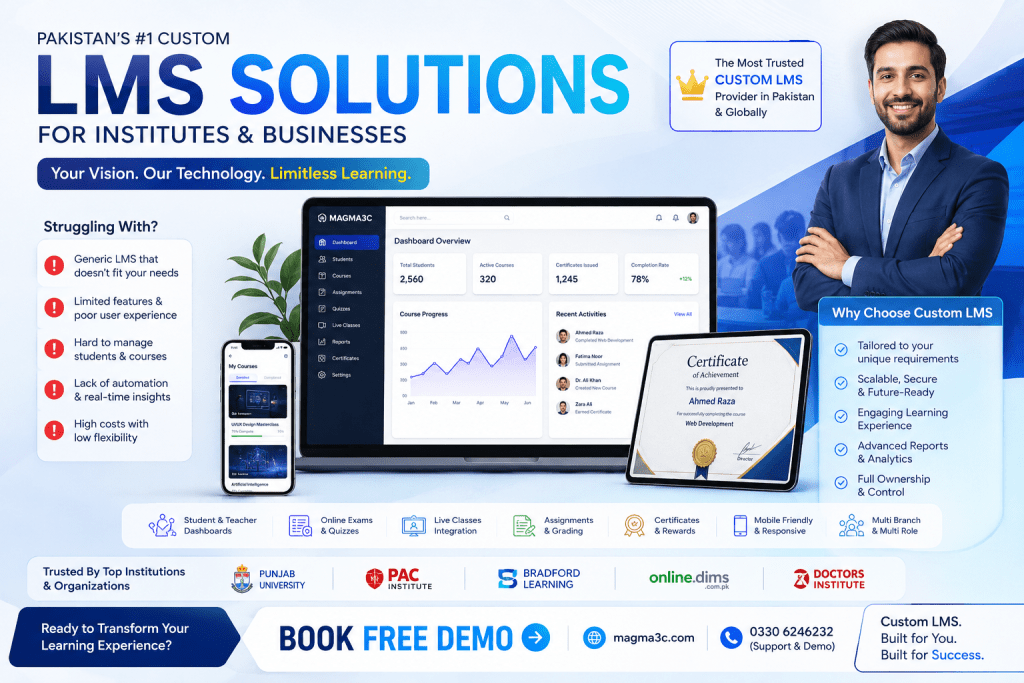

Choosing an LMS for universities is no longer just about uploading lecture notes and creating online quizzes. A modern university needs a learning platform that can support thousands of students, multiple departments, online examinations, assignments, attendance, grading, video lectures, faculty workflows, and mobile learning—all without becoming difficult to manage.
For universities in Pakistan, the decision becomes even more important. Institutions often need a flexible LMS for colleges and universities in Pakistan that works with existing academic systems, supports local requirements, and can scale as enrollment grows.
This guide compares the best LMS for universities, including Moodle LMS, virtual LMS solutions, open-source platforms, and commercial learning management systems.
What Is an LMS for Universities?
An LMS for universities is software used to manage teaching, learning, courses, students, instructors, assessments, and academic content from one centralized platform.
Instead of relying on separate tools for lecture materials, assignments, quizzes, grades, announcements, and online classes, an LMS brings these activities together.
A university LMS can typically manage:
- Course creation and enrollment
- Student and faculty accounts
- Lecture notes and learning resources
- Video lectures
- Online assignments
- Quizzes and examinations
- Gradebooks
- Attendance
- Discussion forums
- Certificates
- Academic calendars
- Notifications
- Mobile learning
- Reports and analytics
The result is a more organized digital learning environment for students, teachers, administrators, and management.
Why Universities Need a Scalable LMS Platform
Imagine a university with 20,000 students, hundreds of faculty members, and thousands of courses.
Managing that environment through spreadsheets, email, messaging apps, and separate examination tools quickly becomes complicated.
A properly designed LMS solves this problem by creating a central academic environment.
The most important benefit is scalability. A university should not have to replace its LMS every time student enrollment increases.
A scalable university LMS should support:
- Thousands of simultaneous users
- Multiple faculties and departments
- Different roles and permissions
- Multiple academic semesters
- Large video and document libraries
- Integration with student information systems
- Online examinations
- APIs and third-party integrations
- Cloud or on-premise deployment
This makes scalable LMS platforms for university campuses particularly valuable for large institutions.
Best LMS for Universities: What Should You Look For?
There is no single LMS that is perfect for every university.
The best choice depends on the institution’s size, budget, IT team, teaching model, security requirements, and integration needs.
However, a strong university LMS should provide these core capabilities.
1. Course and Content Management
Faculty should be able to create courses and organize:
- PDFs
- Presentations
- Videos
- Reading material
- Assignments
- Links
- Interactive activities
A good interface should make content management simple enough that teachers do not need advanced technical skills.
2. Student Management
The platform should allow administrators to manage students by:
- Department
- Program
- Semester
- Section
- Course
- Batch
- Academic year
Bulk enrollment and automated course assignment can save universities significant administrative time.
3. Online Assessments
A university LMS should provide a reliable assessment engine.
Features may include:
- Multiple-choice questions
- Short-answer questions
- Essay questions
- Question banks
- Randomized questions
- Time limits
- Automatic grading
- Manual grading
- Assignment submissions
For institutions conducting large-scale examinations, assessment security and server performance are especially important.
LMS for Universities in Pakistan: Local Requirements Matter
An LMS for universities in Pakistan needs to address more than basic online teaching.
Pakistani universities may require integration with existing student portals, examination systems, ERP platforms, attendance systems, payment systems, and university websites.
A customized solution can also support university-specific workflows.
For example, a university may want:
Admission → Student Account → Course Enrollment → LMS Access → Classes → Assignments → Examination → Grades → Academic Record
Instead of creating isolated systems, these components can communicate through APIs.
Other important considerations in Pakistan
Universities should evaluate:
- Hosting location and server performance
- Internet bandwidth requirements
- Mobile accessibility
- Local IT support
- Data backup
- Security
- Urdu and multilingual support where required
- Integration capabilities
- Total implementation cost
Cloud hosting can reduce infrastructure management, while self-hosting can provide greater control over data and customization.
Top LMS Platforms for Academic Institutions
Several platforms are commonly considered when universities evaluate an LMS.
Moodle LMS
Moodle LMS is one of the best-known open-source learning management systems in higher education.
Its major advantage is flexibility.
Universities can customize Moodle, add plugins, develop integrations, modify themes, and connect it with other academic systems.
It supports features such as:
- Course management
- Assignments
- Quizzes
- Gradebook
- Forums
- Learning activities
- User roles
- Reports
- Mobile access
- Plugin-based extensions
Moodle can be especially attractive for universities that have an internal IT team or technology partner capable of maintaining and customizing the platform.
Canvas
Canvas is a popular cloud-based LMS used by educational institutions worldwide.
It focuses heavily on usability, integrations, course management, and modern digital learning experiences.
It may be suitable for universities looking for a managed commercial platform rather than maintaining their own infrastructure.
Blackboard
Blackboard has a long history in higher education and offers tools for course management, assessment, collaboration, analytics, and institutional learning.
It can be considered by universities looking for enterprise-level academic technology.
Google Classroom
Google Classroom is simpler than many full university LMS platforms.
It can work well for basic classroom management, assignments, communication, and document sharing.
However, large universities with complex academic workflows may need more advanced LMS capabilities.
Free LMS for Universities: Is It Really Free?
Searching for a free LMS for universities often leads institutions toward open-source software.
But there is an important distinction:
Free software does not necessarily mean zero cost.
For example, an open-source LMS may have no software licensing fee, but the university may still need to pay for:
- Hosting
- Server infrastructure
- Installation
- Custom development
- Security
- Backups
- Maintenance
- Technical support
- Updates
- Training
This is why universities should calculate the total cost of ownership, rather than comparing only software license prices.
LMS for Universities Free Download: What Does It Mean?
The phrase LMS for universities free download usually refers to open-source LMS software that can be downloaded and installed on a university’s own server.
Moodle is a strong example of this model.
The software itself can be obtained without a traditional commercial license fee, while implementation and infrastructure remain separate considerations.
This approach gives universities more control over:
- Data
- Hosting
- Customization
- Integrations
- User roles
- Branding
- Infrastructure
However, self-hosted systems require proper technical administration.
Virtual LMS vs Traditional Campus Learning
A Virtual LMS can extend university education beyond the physical campus.
Students can access learning resources from:
- Home
- Hostels
- Libraries
- Remote locations
- Mobile devices
- Computer labs
This became particularly valuable as universities adopted blended and remote learning.
A virtual LMS can support a hybrid model where students attend some activities physically while completing other learning activities online.
A virtual university LMS may include:
Live classes → Recorded lectures → Digital resources → Online assignments → Quizzes → Discussion → Grades
This creates a continuous learning environment instead of limiting education to classroom hours.
Learning Management System Examples for Universities
Understanding learning management system examples makes it easier to compare different approaches.
Example 1: Small University
A smaller institution may need:
- Moodle
- Basic course management
- Assignments
- Quizzes
- Gradebook
- Student accounts
An open-source solution can be cost-effective.
Example 2: Large University
A large university may require:
- Multiple campuses
- Thousands of courses
- Single sign-on
- Student information system integration
- ERP integration
- Advanced reporting
- Online examinations
- Mobile applications
- Dedicated infrastructure
This environment may require a customized enterprise deployment.
Example 3: Hybrid University
A university offering both physical and online education may prioritize:
- Video learning
- Live classes
- Recorded lectures
- Online assignments
- Discussion forums
- Mobile access
- Virtual classrooms
The LMS becomes the central digital campus.
LMS for Colleges vs LMS for Universities
An LMS for colleges and an LMS for a university may have many similar features, but the scale and complexity can differ significantly.
Colleges may have fewer departments, users, courses, and administrative layers.
Universities often require more complex structures.
| Feature | College LMS | University LMS |
|---|---|---|
| Course management | ✓ | ✓ |
| Assignments | ✓ | ✓ |
| Quizzes | ✓ | ✓ |
| Gradebook | ✓ | ✓ |
| Multiple departments | ✓ | ✓ |
| Multi-campus support | Sometimes | Often |
| Enterprise integrations | Sometimes | Usually |
| Advanced analytics | Optional | Important |
| Large-scale examinations | Optional | Important |
| API integrations | Useful | Essential |
The right platform should match the institution rather than simply choosing the most popular product.
How Much Does an LMS for Universities Cost in Pakistan?
The cost of an LMS in Pakistan varies widely because implementation is not just about the software.
A basic deployment may involve a relatively simple setup, while an enterprise university platform can require significant investment in development, infrastructure, integrations, security, and support.
Typical cost factors include:
- LMS software
- Hosting or cloud infrastructure
- UI/UX customization
- University branding
- Server configuration
- Database optimization
- Student portal integration
- ERP/SIS integration
- Mobile app development
- Examination system
- Payment integration
- Data migration
- Technical support
- Staff training
For this reason, universities should request a solution based on their actual number of users, courses, campuses, and integrations instead of relying on a generic LMS price.
How to Choose the Best LMS for Universities in Pakistan
Before selecting a platform, create a requirements checklist.
Step 1: Estimate Your Users
Calculate:
- Students
- Teachers
- Administrators
- External users
Do not design infrastructure only for today’s enrollment.
Step 2: Define Academic Workflows
Map the complete student journey.
For example:
Student Registration → Enrollment → Course Access → Learning → Assignment → Examination → Grading → Results
Your LMS should support these workflows efficiently.
Step 3: Decide Cloud vs Self-Hosted
Cloud hosting can simplify infrastructure management.
Self-hosting provides greater control and customization.
Neither option is automatically better. The right choice depends on the university’s IT capabilities and data requirements.
Step 4: Check Integration Support
Ask whether the LMS can integrate with:
- SIS
- ERP
- HR systems
- Payment gateways
- Video conferencing
- SMS
- Authentication systems
- Mobile applications
APIs can be critical when building a connected university ecosystem.
Why Custom LMS Development Can Be Better for Some Universities
Off-the-shelf LMS platforms are powerful, but universities sometimes have workflows that do not fit standard configurations.
A custom LMS can be designed around the institution’s exact requirements.
For example, a university may need a customized dashboard showing:
Attendance + Courses + Assignments + Examination Schedule + Fees + Results + Announcements
A technology partner can also connect the LMS with existing university software.
If you are evaluating custom software development, Magma3C provides technology and development services that can support education-focused digital platforms.
How to Improve LMS Adoption Among Students and Faculty
Even the best LMS for universities can fail if users find it confusing.
The platform should therefore focus on usability.
For students
Provide:
- Simple dashboards
- Mobile-friendly design
- Clear course navigation
- Assignment reminders
- Grade visibility
- Notifications
For teachers
Provide:
- Easy course creation
- Reusable course templates
- Bulk uploads
- Question banks
- Automated grading
- Attendance tools
- Simple reporting
For administrators
Provide:
- Centralized management
- User controls
- Academic reports
- System monitoring
- Backup controls
- Audit logs
Good UX can significantly improve adoption.
Security Features Every University LMS Should Have
Universities manage sensitive academic information, so security should never be an afterthought.
Important controls include:
- HTTPS
- Strong authentication
- Role-based permissions
- Regular backups
- Secure database configuration
- Access logging
- Software updates
- Malware protection
- Server monitoring
- Disaster recovery planning
For larger institutions, single sign-on and multi-factor authentication can provide additional protection.
How an LMS Supports AI-Driven Education
Modern LMS platforms are also becoming more intelligent.
AI can help universities with tasks such as:
- Personalized learning recommendations
- Automated feedback
- Content recommendations
- Question generation
- Student engagement analysis
- Learning analytics
- Academic support assistants
However, AI should complement teachers rather than replace academic judgment.
Universities should also establish clear policies around AI-generated work, assessment integrity, student privacy, and responsible technology use.
Can a University Start With Moodle and Scale Later?
Yes.
This is one reason Moodle LMS remains attractive to institutions that want flexibility.
A university can start with core features and gradually add:
- Custom plugins
- University branding
- APIs
- Mobile applications
- Advanced reports
- Authentication integrations
- Examination modules
- Third-party services
The key is to design the initial architecture with future growth in mind.
A Practical LMS Comparison
| LMS | Best For | Customization | Cost Model | Scalability |
|---|---|---|---|---|
| Moodle LMS | Flexible higher education | Very high | Open-source + implementation | High |
| Canvas | Managed academic environments | High | Commercial | High |
| Blackboard | Enterprise universities | High | Commercial | High |
| Google Classroom | Basic classroom management | Limited | Free/commercial ecosystem | Moderate |
| Custom LMS | Specialized university workflows | Very high | Project-based | Depends on architecture |
There is no universal winner.
For many institutions, the decision comes down to control vs convenience, customization vs simplicity, and implementation cost vs long-term requirements.
Key Takeaways
- An LMS for universities should manage teaching, assessment, courses, students, and academic workflows from one platform.
- Moodle LMS is a strong option for institutions that value flexibility and customization.
- Free LMS software can still involve hosting, development, security, and maintenance costs.
- Universities in Pakistan should consider integrations, scalability, mobile access, support, and infrastructure.
- LMS for colleges may have simpler requirements than a large multi-campus university.
- A virtual LMS can support blended, remote, and online education.
- Enterprise universities should prioritize scalability, security, APIs, analytics, and reliable infrastructure.
- Custom LMS development can be valuable when standard platforms cannot match institutional workflows.
Frequently Asked Questions About LMS for Universities
1. What is the best LMS for universities?
The best LMS depends on the university’s requirements. Moodle is a strong choice for institutions seeking an open-source and highly customizable platform, while Canvas and Blackboard can suit institutions looking for commercial enterprise solutions.
2. Is Moodle free for universities?
Moodle is open-source software and can be used without a traditional software licensing fee. However, universities may still incur costs for hosting, implementation, customization, maintenance, security, support, and training.
3. What is an LMS used for in universities?
An LMS is used to manage courses, learning materials, assignments, quizzes, examinations, grades, communication, student activities, and online learning.
4. Can an LMS support thousands of university students?
Yes. Properly designed LMS platforms can support large numbers of users. However, performance depends on server architecture, database configuration, caching, bandwidth, application optimization, and concurrent user load.
5. How much does a university LMS cost in Pakistan?
There is no single fixed price. Cost depends on the number of users, hosting infrastructure, customization, integrations, mobile apps, examinations, data migration, security, and ongoing support. A proper requirement-based quotation is more accurate than a generic LMS price.
Build a Modern LMS for Your University
Your LMS should do more than store PDFs.
It should become the digital backbone of your university’s learning environment—connecting students, faculty, administrators, courses, assessments, and academic systems in one place.
Whether you need a Moodle LMS implementation, virtual LMS, customized university LMS, LMS integration, or a scalable learning management platform, start by defining your academic workflows and long-term technology goals.
For technology and LMS development support, visit Magma3C.
You can also explore opportunities to publish education and technology content through GuestPost.com.pk.
Contact Us
Website: magma3c.com
Email: [email protected]
WhatsApp: 03306246232
Key takeaway: The best LMS for universities is not necessarily the platform with the longest feature list. It is the one that fits your academic workflows, scales with your student population, integrates with your existing systems, and remains easy for students and faculty to use.