
In an era defined by global migration and digital connectivity, the way Pakistani families formalize marriages is undergoing a quiet but significant transformation. For decades, the image of a Nikah was intimately tied to physical presence—the gathering of relatives, the signing of the Nikah Nama in the same room, and the communal celebration. Today, a growing number of couples are turning to “Online Nikah” services, a trend driven largely by the diaspora and the logistical realities of modern life.
However, a closer look at the legal landscape reveals a crucial distinction: what is marketed as an “online” ceremony is, in the eyes of Pakistani law, a proxy marriage governed by centuries-old principles of Islamic contract law and strict bureaucratic registration requirements.
The Driving Force: Overseas Pakistanis and Convenience
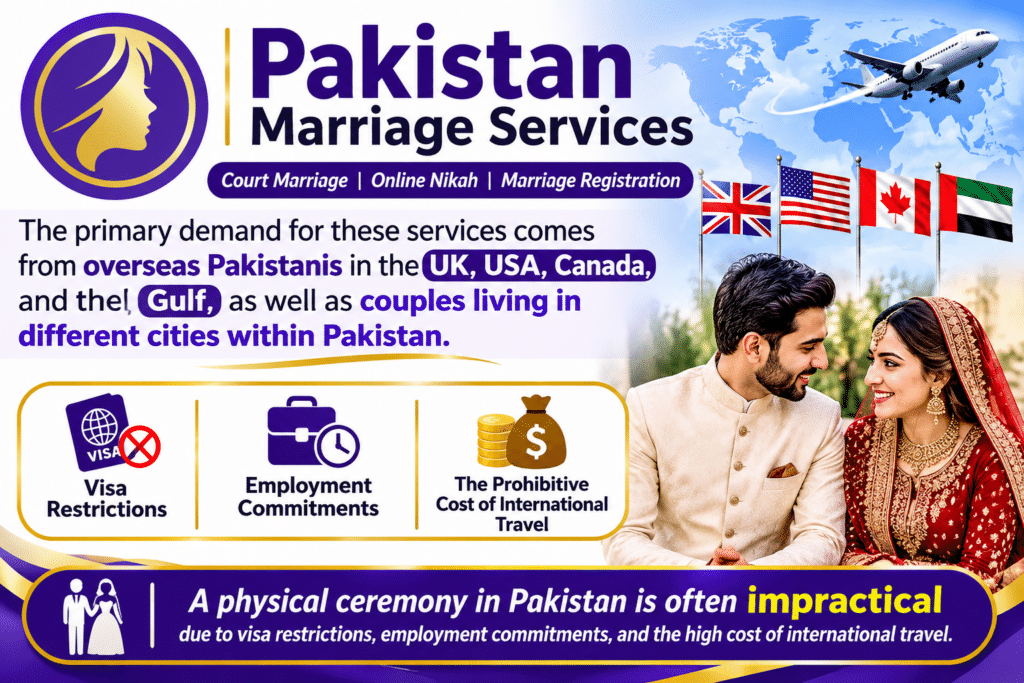
The primary demand for these services comes from overseas Pakistanis in the UK, USA, Canada, and the Gulf, as well as couples living in different cities within Pakistan . Visa restrictions, employment commitments, and the prohibitive cost of international travel often make a physical ceremony in Pakistan impractical.
Service providers, ranging from law associates in Faisalabad to legal firms in Karachi, have stepped in to fill this gap. They advertise streamlined processes that allow a bride or groom abroad to participate via video link while a representative (Wakeel) stands in for them on the ground in Pakistan . For many, this offers a lifeline to formalize a relationship without uprooting their lives.
The Legal Reality: It’s About the Wakeel, Not the Wi-Fi
Despite the marketing terminology, legal experts emphasize that there is no such thing as a purely “online” marriage in Pakistani jurisprudence. The validity of the union does not rest on the quality of the video call, but on the legal authority granted to a representative.
Under Islamic law and Pakistani family law, marriage is a civil contract. If one party cannot attend, they may appoint an attorney (Wakeel) through a Special Power of Attorney . This document, which must detail the parties’ names, CNIC/passport numbers, consent, and the amount of Mehr (dower), must be signed by the overseas party and, crucially, attested by the Pakistani Embassy or Consulate in their country of residence .
Once the attested document reaches Pakistan, the Nikah ceremony can proceed. The Wakeel represents the absent party, two witnesses must be present, and a licensed Nikah Khawan (registrar) conducts the proceedings. While the overseas spouse often joins via video call, their legal standing is derived entirely from the Power of Attorney, not their digital presence .
The Registration Imperative: Where Many Fall Short
The most critical—and often misunderstood—aspect of the online Nikah process is the step that comes after the ceremony: registration with the local Union Council.
Legal advisories consistently warn that a religious ceremony alone, even if perfectly valid under Sharia, is insufficient for practical purposes. Without a registered Nikah Nama and the subsequent Computerized Marriage Registration Certificate (CMRC) from NADRA, the marriage lacks legal protection regarding inheritance, child custody, and spouse visa applications .
This is where the risk of unscrupulous service providers becomes apparent. Some services may offer a “quick online Nikah” but fail to complete the necessary bureaucratic filing. A marriage that is not registered is effectively invisible to the state, creating severe complications if the union is later disputed or if one spouse needs to apply for a visa abroad .
A Note on Age and Identity
The digitization of the process does not bypass the fundamental laws of the land. In Sindh, for instance, the legal age for marriage is strictly 18 for both parties . Recent legislation in provinces like Balochistan has further tightened requirements, mandating that Nikah Khawans and registrars must obtain copies of Computerized National Identity Cards (CNIC) from both parties, with strict penalties for negligence .
For foreign nationals or overseas Pakistanis, the documentation becomes even more layered. Passport details, visa status, and proof of marital status (if previously married) are scrutinized to ensure the marriage does not violate bigamy laws or other legal barriers .
The Bottom Line for Couples
For couples considering an online Nikah, the consensus among legal professionals is clear: treat it with the same seriousness as a traditional court marriage.
-
Verify the Wakeel: Ensure the Power of Attorney is properly drafted and embassy-attested.
-
Confirm the Registrar: The Nikah Khawan must be licensed and authorized to register the marriage with the relevant Union Council.
-
Prioritize Registration: Do not settle for just a ceremonial video. Demand the registered Nikah Nama and the NADRA certificate. This is the document that proves the marriage exists in the eyes of the law and the international community .
While the “online” label may suggest a frictionless, digital transaction, the reality is a complex legal maneuver that bridges international borders. It is a testament to the adaptability of Pakistani families, but also a reminder that in matters of law and marriage, the paperwork remains as important as the vows.