
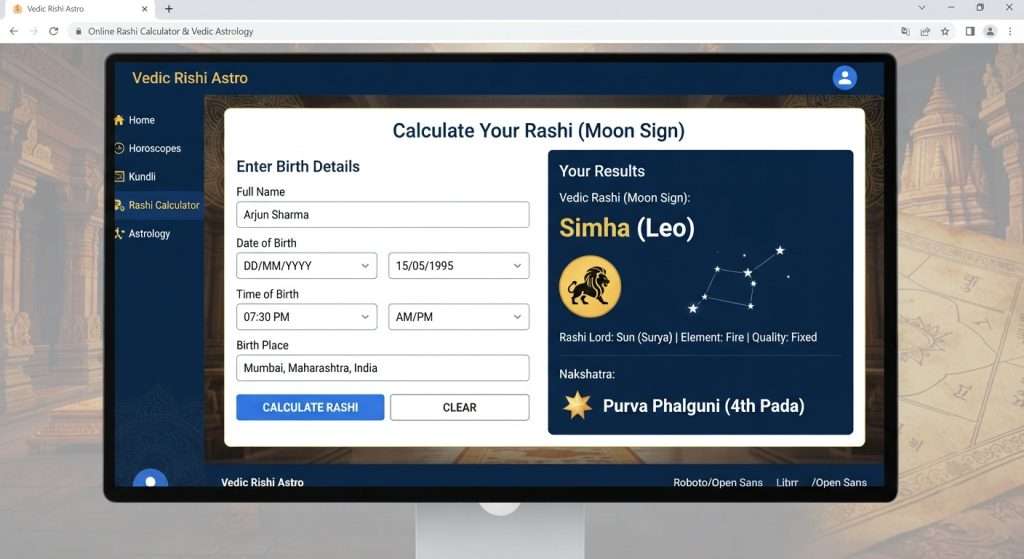

Introduction: The Critical Trio of Vedic Astrology
In the ancient science of Jyotisha, the accuracy of your astrological reading depends entirely on the precision of your birth data. While many people believe that simply knowing their birth date is sufficient to determine their Janma Rashi (Vedic Moon Sign), this is a fundamental misconception that can lead to incorrect astrological guidance. The truth is that Vedic astrology operates on a level of astronomical precision that requires not just your date of birth, but also your exact time and place of birth.
The Moon, which governs your mind and emotions in Vedic astrology, moves through the zodiac at approximately 13 degrees per day. This means it changes signs every 2 to 2.5 days, and within a single 24-hour period, the Moon can move through a significant portion of a Rashi or even transition into an entirely different sign. Without your exact birth time, any rashi by date of birth calculation is incomplete and potentially inaccurate.
This comprehensive guide will explain in detail why birth time and place are absolutely essential for accurate Rashi calculation. We will explore the astronomical science behind the Moon’s motion, the technical process of converting birth data into astrological results, and the real-world implications of using incomplete information. By the end of this article, you will understand why a proper rashi finder requires all three pieces of data—date, time, and place—to deliver reliable results.
The Moon’s Rapid Journey Through the Zodiac
To understand why birth time is so critical, we must first understand the Moon’s motion through the zodiac belt. The zodiac is a 360-degree circle divided into 12 equal segments of 30 degrees each—these are the 12 Rashis. The Moon completes one full circuit of this zodiac belt in approximately 27.3 days, which is known as the sidereal month.
The Mathematics of Lunar Motion
Let us break down the Moon’s motion mathematically:
| Time Period | Degrees Traveled | Rashis Traveled | Nakshatras Traveled |
|---|---|---|---|
| One Day | ~13.2° | ~0.44 Rashi | ~0.99 Nakshatra |
| One Hour | ~0.55° | ~0.018 Rashi | ~0.041 Nakshatra |
| One Minute | ~0.0092° | ~0.0003 Rashi | ~0.0007 Nakshatra |
This means:
-
The Moon spends approximately 2.25 days in each Rashi
-
The Moon spends approximately 24 hours in each Nakshatra
-
The Moon spends approximately 6 hours in each Pada
When you consider that a Rashi spans 30 degrees and the Moon moves at approximately 0.55 degrees per hour, it becomes clear that the Moon can traverse a significant portion of a Rashi within a single day.
Real-World Example: The Moon’s Transition
Imagine a scenario where the Moon enters Mesha (Aries) at 6:00 AM on a particular day and exits into Vrishabha (Taurus) at 6:00 AM two days later. During this 48-hour period:
-
A person born at 8:00 AM on the first day would have their Moon at approximately 1.1° in Mesha
-
A person born at 8:00 PM on the first day would have their Moon at approximately 7.7° in Mesha
-
A person born at 8:00 AM on the second day would have their Moon at approximately 14.3° in Mesha
-
A person born at 8:00 PM on the second day would have their Moon at approximately 20.9° in Mesha
All four individuals would share the same Janma Rashi (Mesha), but their Nakshatra and Pada would differ significantly. Now, imagine if the Moon transitioned from Meena (Pisces) to Mesha at 2:00 PM on the birth date:
-
A person born at 10:00 AM would have their Moon in Meena
-
A person born at 6:00 PM would have their Moon in Mesha
Same date, different Rashi. This is why a date-only calculation is insufficient.
The Nine-Step Calculation Process: How Birth Data Becomes Astrological Insight
When you use a professional rashi finder, the tool performs a complex nine-step calculation process to determine your Janma Rashi accurately. Understanding this process reveals why birth time and place are indispensable.
Step 1: Parse Birth Date and Local Time
The entered date and time are read as the starting input. This is the raw data that will be processed through the subsequent steps.
Step 2: Determine Applicable Time Zone and DST
The birth place identifies the correct historical time zone and daylight saving rules for that location and date. This is crucial because time zones have changed throughout history, and daylight saving rules vary by country, region, and time period.
For example:
-
India has used Indian Standard Time (IST, UTC+5:30) since 1947, but before that, different regions used different local times.
-
The United States has a complex history of time zone changes and daylight saving rules that vary by state and year.
-
Some countries have changed their time zones multiple times due to political changes.
Without the correct birth place, the calculator cannot determine which time zone rules applied at your birth location and date.
Step 3: Convert to UTC
Local birth time is converted to Coordinated Universal Time (UTC) using the time zone and DST rules determined in Step 2. This standardization is essential because astronomical calculations are based on UTC, not local time.
Step 4: Calculate Astronomical Time Parameters
Julian Date and related time-scale values are derived for precise astronomical calculation. The Julian Date is a continuous count of days since noon on January 1, 4713 BC, and it provides a standardized way to specify instants in time for astronomical calculations.
Step 5: Calculate Moon’s Apparent Ecliptic Longitude
The Moon’s position along the ecliptic is determined for the exact UTC moment using an astronomical ephemeris. The ecliptic is the apparent path of the Sun across the sky, and the Moon’s position along this path is its ecliptic longitude.
This step requires a high-precision ephemeris that accounts for:
-
The Moon’s elliptical orbit
-
Gravitational perturbations from the Sun and other planets
-
Relativistic effects
-
Nutation and precession
Step 6: Apply the Selected Ayanamsa
The Ayanamsa correction converts the ecliptic longitude into the sidereal frame used in Jyotisha. The Ayanamsa is the difference between the tropical zodiac (used in Western astrology) and the sidereal zodiac (used in Vedic astrology). This difference is currently approximately 24 degrees due to the precession of the equinoxes.
RashiFinder uses Lahiri Ayanamsa as the default because it is the most widely used system in Indian Jyotisha practice and publications.
Step 7: Obtain Sidereal Longitude
The corrected sidereal longitude is the working value for all subsequent mapping. This is the Moon’s position in the sidereal zodiac, expressed in degrees from 0° to 360°.
Step 8: Map Longitude to Rashi
The sidereal longitude is divided into 30-degree segments to identify the Janma Rashi. For example:
-
0° to 30° = Mesha (Aries)
-
30° to 60° = Vrishabha (Taurus)
-
60° to 90° = Mithuna (Gemini)
-
And so on…
Step 9: Map Longitude to Nakshatra and Pada
The same longitude is divided into 13°20′ segments to identify the Nakshatra, then into 3°20′ segments to identify the Pada. This provides the complete picture of the Moon’s position at your birth.
Why Birth Date Alone is Insufficient
Now that we understand the calculation process, let’s examine why birth date alone is insufficient for accurate Rashi calculation.
The Problem with Date-Only Calculators
Many websites offer “Moon sign by date” calculators that provide generic results. These tools assume a fixed position for the Moon throughout the entire day, which is astronomically inaccurate. Here is why:
Scenario 1: The Moon Changes Rashi on Your Birth Date
If the Moon changes Rashi at 2:00 PM on your birth date, and you were born at 6:00 PM, a date-only calculator would give you the wrong sign. It might assume the Moon was in the previous Rashi for the entire day, when in fact it had already transitioned.
Scenario 2: The Moon is Near a Boundary
If the Moon is near a Rashi boundary (Rashi Sandhi) on your birth date, even a few hours can make a difference. A date-only calculator cannot determine which side of the boundary the Moon was on at your exact birth moment.
Scenario 3: Nakshatra and Pada Precision
Even if the Rashi remains the same throughout the day, the Nakshatra and Pada can change. Since the Moon moves through one Nakshatra in approximately 24 hours and one Pada in approximately 6 hours, your Nakshatra and Pada depend critically on your birth time.
The Rashi Sandhi: The Critical Boundary
The Rashi Sandhi is the transition point between two Rashis. When the Moon is near this point, the accuracy of your birth time becomes paramount.
| Birth Time Accuracy | Rashi Accuracy | Nakshatra Accuracy | Pada Accuracy |
|---|---|---|---|
| Exact time known | High | High | High |
| ±30 minutes | High (most cases) | Medium | Low |
| ±2 hours | Medium | Low | Low |
| Date only | Low | Very Low | Very Low |
As the table shows, the accuracy of your Rashi, Nakshatra, and Pada decreases significantly as the precision of your birth time decreases.
Why Birth Place is Essential
Birth place is the second critical piece of information required for accurate Rashi calculation. Here is why it matters:
Time Zone Determination
The birth place determines the correct time zone for your birth location and date. Time zones are not static—they have changed throughout history due to political, economic, and social factors.
Examples of Time Zone Changes:
-
India: Before 1947, different regions of India used different local times. After independence, Indian Standard Time (IST, UTC+5:30) was adopted nationwide.
-
United States: The Uniform Time Act of 1966 standardized daylight saving time, but states can still opt out. Arizona and Hawaii do not observe DST.
-
China: Despite spanning five geographic time zones, China uses a single time zone (UTC+8) for the entire country.
-
Russia: Russia has changed its time zones multiple times, most recently in 2014.
Without the correct birth place, the calculator cannot determine which time zone rules applied at your birth location and date.
Geographic Coordinates
The birth place also determines the geographic coordinates (latitude and longitude) of your birth location. While these coordinates do not directly affect the Moon’s position in the zodiac, they are used in the calculation of other astrological factors such as the Lagna (Ascendant) and the Bhava (houses).
Historical Daylight Saving Rules
Daylight saving time (DST) rules vary by country, region, and time period. Some countries observe DST, while others do not. Some regions within a country may observe DST while others do not. The rules have also changed over time.
Examples of DST Complexity:
-
United States: DST rules have changed multiple times, most recently in 2007 when the start and end dates were adjusted.
-
European Union: DST rules are standardized across the EU, but individual countries have different histories.
-
India: India does not currently observe DST, but it did during certain periods (e.g., during wars).
Without the correct birth place, the calculator cannot determine whether DST was in effect at your birth location and date, which affects the UTC conversion and, consequently, the Moon’s calculated position.
The Impact of Inaccurate Birth Data
Using inaccurate birth data can lead to incorrect astrological results with real-world implications.
Incorrect Rashi
If your birth time is inaccurate and the Moon was near a Rashi boundary, you may receive the wrong Janma Rashi. This means:
-
Your daily horoscope readings will be for the wrong sign
-
Your compatibility analysis will be based on incorrect data
-
Your understanding of your emotional nature will be misguided
Incorrect Nakshatra
Even if your Rashi is correct, an inaccurate birth time can lead to an incorrect Nakshatra. This affects:
-
Your Nakshatra-based personality reading
-
Your Nakshatra compatibility analysis
-
The first syllable of your name (if calculated for baby naming)
Incorrect Pada
An inaccurate birth time can also lead to an incorrect Pada. This affects:
-
The most refined level of personality analysis
-
The specific syllables for baby naming
-
Certain Nakshatra-based remedies and practices
Real-World Implications
The implications of incorrect astrological data can be significant:
-
Marriage Compatibility: Incorrect Rashi and Nakshatra can lead to incorrect Guna Milan scores, potentially affecting marriage decisions.
-
Career Guidance: Incorrect Moon sign analysis can lead to misguided career advice.
-
Health and Wellness: Incorrect emotional profiling can lead to inappropriate coping strategies.
-
Spiritual Practices: Incorrect Nakshatra can lead to ineffective remedies and mantras.
How to Find Your Accurate Birth Time
If you do not know your exact birth time, here are some strategies to find it:
Check Official Records
-
Birth Certificate: The most reliable source. Check if your birth certificate includes the time of birth.
-
Hospital Records: Hospitals often keep detailed records of births, including the time. Contact the hospital where you were born.
-
Family Records: Some families maintain detailed records of births, including times.
Ask Family Members
-
Parents: Your parents are often the best source of information about your birth time.
-
Grandparents: Older family members may remember details about your birth.
-
Siblings: Older siblings may remember being told about your birth time.
Look for Other Clues
-
Baby Book: Some parents keep a baby book with details about the birth.
-
Photo Albums: Photographs from the day of your birth may have timestamps.
-
Newspaper Announcements: Birth announcements in newspapers sometimes include the time of birth.
What If You Cannot Find Your Birth Time?
If you cannot find your exact birth time, here are your options:
-
Use an Estimated Time: Use the best estimate you can find. Morning, afternoon, evening, or night is better than nothing.
-
Use Noon as Default: Many calculators use noon as a default when birth time is unknown. This produces a reliable result when the Moon does not change Rashi on that date.
-
Check Both Possible Rashis: If the Moon changes Rashi on your birth date, calculate for both possible Rashis and see which one resonates more with your personality.
-
Consult a Professional: A professional astrologer may be able to use other techniques (such as Prashna or horary astrology) to help determine your birth time.
-
Use Birth Time Rectification: This is a complex process where an astrologer uses major life events to work backward and determine the most likely birth time.
The Accuracy of Online Rashi Calculators
When you use a professional rashi by date of birth calculator, you are accessing the same level of astronomical precision that was once available only to professional astrologers with expensive software. However, the accuracy of the final result depends on the accuracy of the input data.
Factors Affecting Calculator Accuracy
| Factor | Impact on Accuracy | How to Optimize |
|---|---|---|
| Birth Date | High | Use exact date from official records |
| Birth Time | High | Use exact time from birth certificate or hospital records |
| Birth Place | High | Use exact city and country of birth |
| Timezone Data | High | Calculator should have comprehensive historical timezone database |
| Ephemeris Precision | High | Calculator should use high-precision ephemeris |
| Ayanamsa Selection | Medium | Calculator should disclose which Ayanamsa is used |
What a Good Rashi Calculator Should Provide
A reliable Rashi calculator should provide:
-
Janma Rashi: The Moon’s zodiac sign at birth
-
Rashi Degree: The precise degree within the 30-degree Rashi
-
Nakshatra: The lunar mansion containing the Moon at birth
-
Nakshatra Pada: The specific quarter within that Nakshatra
-
Rashi Lord: The ruling planet of the Rashi
-
Methodology Disclosure: Information about the ephemeris and Ayanamsa used
Limitations of Online Calculators
No online calculator can produce results more precise than the birth data provided. If your birth time is inaccurate, the calculator’s result will be inaccurate, regardless of how sophisticated the calculation is.
Additionally, traditional associations (lucky number, lucky color, etc.) vary by school and practitioner. These reflect classical Jyotisha attributions and should be understood in that context, separately from the astronomical calculation results.
The Science of Birth Time Rectification
Birth time rectification is the process of determining the most accurate birth time by analyzing major life events. This is a complex technique used by professional astrologers when the exact birth time is unknown.
How Birth Time Rectification Works
The astrologer uses known life events (such as marriage, career changes, accidents, etc.) and works backward to determine which birth time would produce a chart that accurately reflects these events. This involves:
-
Creating Multiple Charts: The astrologer creates charts for a range of possible birth times.
-
Analyzing Dasha Periods: The astrologer analyzes the planetary periods (Dashas) for each chart to see which one aligns with the known life events.
-
Analyzing Transits: The astrologer analyzes planetary transits for each chart to see which one aligns with the known life events.
-
Cross-Referencing: The astrologer cross-references multiple events to narrow down the most likely birth time.
Limitations of Birth Time Rectification
Birth time rectification is not an exact science. It can narrow down the possible birth time, but it cannot determine the exact time with certainty. It is best used as a last resort when no other source of birth time information is available.
Practical Tips for Accurate Rashi Calculation
Here are some practical tips to ensure accurate Rashi calculation:
1. Use the Most Accurate Birth Time Available
Even a 15-minute difference can affect your Nakshatra and Pada. Always use the most precise time available.
2. Verify Your Birth Place
Ensure you enter the correct city and country of birth. If you were born in a small town, use the nearest major city if your specific location is not in the database.
3. Check for Historical Time Zone Changes
If you were born in a country that has changed its time zones, ensure the calculator accounts for this.
4. Understand the Ayanamsa
Different calculators may use different Ayanamsa systems. Understand which one is being used and how it might affect your result.
5. Cross-Verify with Multiple Calculators
If possible, use multiple calculators to cross-verify your results. If they agree, you can be more confident in the accuracy of your Rashi.
6. Consult a Professional Astrologer
For critical decisions (such as marriage compatibility), consult a professional astrologer who can verify your birth data and provide a more comprehensive analysis.
Frequently Asked Questions
Why is birth time important for Rashi calculation?
Birth time is important because the Moon moves approximately 13 degrees per day. Without an accurate birth time, the calculator cannot determine the exact position of the Moon at your moment of birth, which affects your Rashi, Nakshatra, and Pada.
Why is birth place important for Rashi calculation?
Birth place is important because it determines the correct time zone and geographic coordinates for your birth location. Time zones have changed throughout history, and daylight saving rules vary by country and time period. Without the correct birth place, the calculator cannot accurately convert your local birth time to UTC.
Can I calculate my Rashi with just my birth date?
No. A date-only calculation is incomplete and potentially inaccurate. You need your birth date, time, and place for accurate Rashi calculation.
What if I don’t know my birth time?
If you don’t know your birth time, the calculator estimates the Moon’s position using noon as a default. This produces a reliable result when the Moon does not change Rashi on that date. If the Moon changes Rashi on your birth date, the result carries uncertainty that only a confirmed birth time can resolve.
How accurate is an online Rashi calculator?
A calculator using a high-precision astronomical ephemeris can determine the Moon’s position accurately. The reliability of the final Rashi result depends on the accuracy of the entered birth date, birth time, birth location, time-zone rules, and the selected Ayanamsa.
Can twins have different Rashis?
Yes. If the Moon changes Rashi between two birth times, twins born on opposite sides of that transition can have different Janma Rashis. Precise birth times matter in these boundary cases.
What is Rashi Sandhi?
Rashi Sandhi is the transition point between two Rashis. When the Moon is near this point, the accuracy of your birth time becomes paramount for determining which Rashi the Moon was in at your birth.
How can I find my accurate birth time?
Check your birth certificate, hospital records, or ask family members. If you cannot find your exact birth time, use the best estimate available or consult a professional astrologer for birth time rectification.
Conclusion: The Foundation of Accurate Astrology
The accuracy of your Vedic astrological reading depends entirely on the accuracy of your birth data. Your Janma Rashi, Nakshatra, and Pada are calculated from the exact position of the Moon at your moment of birth. Without your exact birth time and place, these calculations are incomplete and potentially inaccurate.
When you use a professional accurate Moon sign calculator, you ensure that your foundational data is as accurate as possible. This is the first and most critical step in Vedic astrology. It provides the emotional context for your entire life and forms the basis for all subsequent astrological analysis.
Remember, your Rashi is not a limitation—it is a map. It shows you the terrain of your mind, but you are the one who chooses how to navigate it. Use the Rashi Calculator tool to calculate your Janma Rashi accurately, and embark on a lifelong journey of understanding, growth, and cosmic connection.