
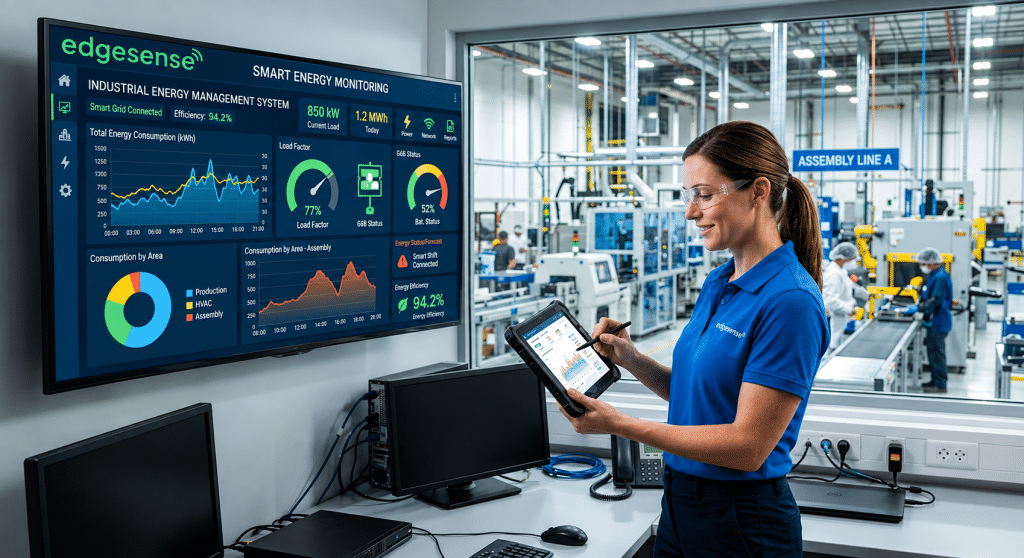

Energy is among the top operating costs in a vast majority of industries. Production plants, warehouses, commercial buildings and process units consume electricity on everything from machines, line processing, HVAC, pumps, compressors and more. Without the aid of automatic data collection, though, it can be hard to detect the many areas where energy is being lost.
This is when an industrial energy management system could help. Integrating smart meters, the internet of things (IoT), data collection, dashboards, and analytics gives industries a more complete picture of their energy consumption – and where efficiencies could be applied.
What Are Energy Management Systems?
Digital Energy Management systems are computer-based systems which have been employed to monitor, optimize, and analyze energy use.
Businesses can track their energy efficiency based on real-time data rather than relying solely on metered deductions and utility costs.
Information like electricity consumption, voltage, current, power factor, frequency, demand and other energy parameters can be recorded and show via a central dashboard.
This helps plant managers, maintenance engineers and energy managers to identify anomalies in the consumption and make the necessary adjustments.
What Is an Industrial Energy Management System?
Typically the industrial energy management system works through a combination of field devices, communication infrastructure, data processing, and analytics.
1. Energy Data Collection
Smart meters and sensors are placed at critical points, including main feeders, distribution panels, machines, and individual production lines.
They monitor these metrics in real time so you can see exactly where your energy is going.
2. Data Transmission
The information gathered is transmitted via appropriate communication technologies and industrial protocols. Depending on the plant, connection may involve Ethernet, Wi-Fi, 4G, RS485, Modbus or other means of communication.
A gateway can take data from a variety of devices and pass it to the portal.
3. Centralized Dashboard
The information is delivered via a digital dashboard where monitoring of live energy consumption is enabled.
Teams can access all key information from a single console instead of having to log into multiple meters.
4. Energy Analytics
Analytics allow organizations to identify consumption trends, make comparisons between locations, and detect anomalies.
Historical information can assist company leaders in defining energy baselines and identifying trends by providing a point of comparison against past performance.
5. Alerts and Action
Automated alerts can inform the teams when a certain level of consumption is exceeded or odd consumption patterns are reported.
This enables teams to look into issues at an earlier stage rather than just react to them when they escalate to operational problems.
Key Benefits of Energy Management Systems
Energy management system can help with:
Real-Time Energy Visibility
One of the greatest benefits is visibility. Managers are now aware of what’s being used to take energy and which piece of machinery or process is using that energy.
Instant observation helps us monitor the changes and find energy misappropriation. The quick feedback can alert us to variations.
Identify Energy Wastage
Energy is also wasted when plant is inefficient, when machines are run when they are not needed, due to losses in the compressed air system, because of bad scheduling or other operational problems.
These are areas that teams can look into with the help of data from continuous monitoring.
Better Energy Cost Management
Seeing when and how much energy teams use is important to help control electricity bills. Teams can look at metrics like peak demand, consumption trends, and equipment-specific use.
Equipment-Level Monitoring
Plant-wide energy number not always a good indication Aspects that don’t speak to problems. Compartmentalizing departments and monitoring at a machine level.
This can support maintenance and production teams in understanding the effects of operating equipment on energy usage.
Improved Decision-Making
Assessing decisions based on real-world data is usually more straightforward than those based on presumption alone. Energy insights-historical and real-time-enable teams to quantify shifts and monitor trends.
Integrating IoT With Energy Management
6.2 IoT Connected Meters, Sensors and Gateways IoT has been incorporated into most aspects of modern industrial energy management. IoT-connected meters, sensors and gateways provide a conduit for energy data between field devices and centralised software applications.
For instance, you might gather data from many electrical panels and machines at an industrial facility with connected meters. An IoT gateway could then pull all the data together and transmit it to a dashboard for analysis.
Energy monitoring thus integrates with larger industrial digitalization programs.
If you are in an industry where a solution like this is required, you could use an IoT solution that offers, realtime tracking, a shared dashboard, analytics, notifications and scalable connectivity.
Check out this Example of IoT-based Energy Management System for industry monitoring & optimization here: Energy Management System for Industries
What Should Industries Monitor?
Details will vary from site to site and will be influenced by the site and its purpose. Typical parameters to be monitored can be:
-Electricity consumption
-Voltage and current
-Power factor
-Frequency
-Peak demand
-Machine-level consumption
-Production-area energy usage
-Historical consumption trends
-Energy intensity
-Power quality parameters
These parameters should be monitored together, to obtain a more comprehensive understanding of the energy performance.
Choosing the Right Energy Management Solution
3.1 Industries need to evaluate their infrastructure and future requirements before adopting an energy management system.
Important factors include:
Scalability
The system must have the ability to grow with the business by being able to add further machines, meters, production lines or locations.
Connectivity
The solution must communicate with the utilities using communication technologies and protocols that are open and supported in the industrial environment today.
Dashboard and Reporting
Allow them to work with well-designed dashboards and reporting rather than unstructured data.
Alerts
The system will allow configurable alerts so teams can respond to abnormal energy conditions immediately.
Integration
Energy data should, when appropriate, be compatible with any existing industrial software applications, automation systems and other digital systems.
Conclusion
Efficiency begins with awareness. There are many sources of data such as manual readings or monthly electricity bills, but they often lack the required visibility for today’s industrial processes.
An industrial energy management system consolidates energy consumption data in one place from a network of smart meters, IoT gateways, centralized dashboards, as well as analytics and alerts. Industries gain visibility on energy use, optimize resource consumption, evaluate equipment efficiencies, and leverage the insights to improve efficiency.
By gaining a clear understanding of your energy costs, you can better focus on the areas where you can make the most significant savings. With digitalisation increasingly spreading across industrial sites, Ecostru is an exciting tool to tackle energy wastage.
A move to real time digital tracking of energy. 100% renewable energy, 70% less emissions, 100% EVs, 25% new tech at 62% lower price compared to 2008. For any industry shifting from manual to digital energy tracking, it can be a catalyst for more intelligent and connected energy systems.