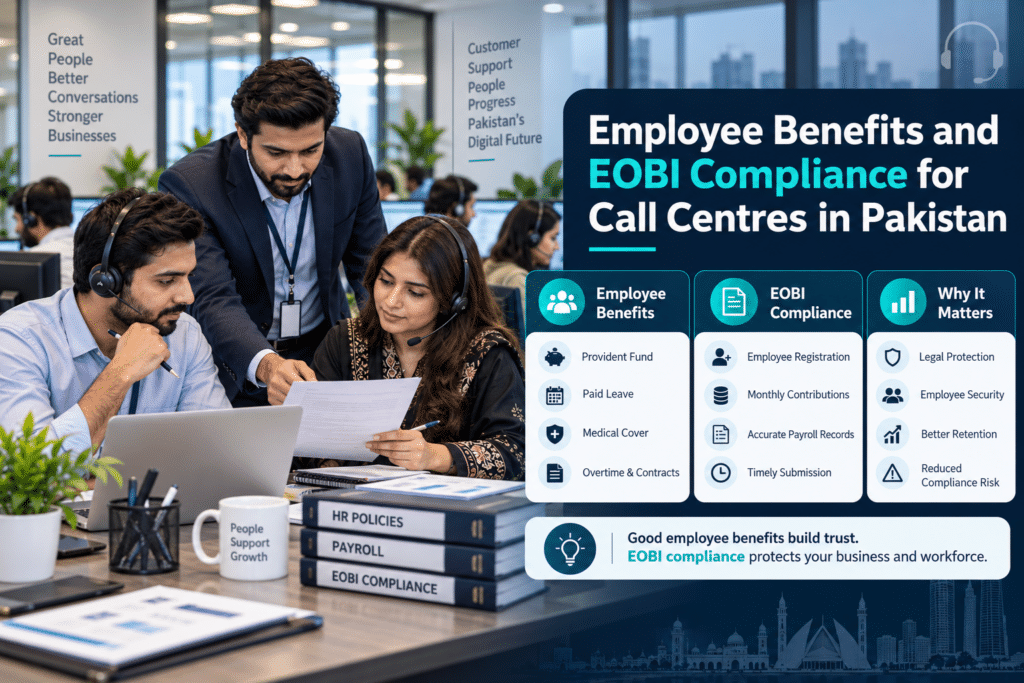

Employee Benefits and EOBI Compliance for Call Centres in Pakistan
Call centre success depends on more than meeting client targets and keeping agents productive. Employers must also maintain dependable payroll systems and understand the employee benefits obligations that apply to their workforce. Strong employee benefits compliance EOBI practices help call centres protect workers while keeping business operations organised.
In Pakistan, employee benefits administration can involve statutory social insurance, payroll records, salary deductions, and workplace policies. The exact obligations depend on the business, its workforce, the applicable federal and provincial rules, and current notifications.
What Is EOBI and Why Does It Matter?
The Employees’ Old-Age Benefits Institution, commonly known as EOBI, administers a contributory social insurance scheme under Pakistan’s Employees’ Old-Age Benefits framework. Subject to the relevant legal conditions, benefits may include old-age pension, invalidity pension, survivor’s pension, and an old-age grant.
For a call centre, EOBI is not merely another form to file. It connects accurate employee information with contributions and future benefit eligibility.
How Employee Benefits Compliance Works
A sound employee benefits compliance process begins by identifying which laws and schemes apply to the organisation. Employers should review their establishment details, number and categories of workers, work locations, and any relevant registration status.
Once applicability is established, the employer should maintain accurate employee particulars, submit required registration information, calculate contributions using the applicable rules, and preserve proof of payment. Payroll records should match employee records and accounting entries.
Understanding EOBI Contributions
Employers need a verified process for calculating and depositing contributions. The Ministry of Overseas Pakistanis and Human Resource Development publishes guidance describing a contribution structure based on notified minimum wages, with an employer share and an employee share. However, legal coverage, contribution bases, rates, and thresholds must be checked against current law and notifications before payroll is finalised, especially when proposed changes or differing interpretations are reported.
Never calculate a contribution using an old spreadsheet simply because it was accepted last year.
Why Call Centres Need a Reliable EOBI Process
Call centres may recruit large numbers of employees, operate multiple shifts, and experience frequent staff turnover. A missed joining date, duplicate record, incorrect salary entry, or unrecorded departure can cause differences between payroll and statutory records.
A structured EOBI registration for employees process helps HR capture necessary details when a worker joins, check documents, submit information within the applicable deadline, and keep confirmation on file.
Link EOBI With Payroll and HR Records
EOBI management should not operate separately from payroll. A reliable payroll compliance system links employee master data, salary processing, authorised deductions, employer liabilities, payment records, and monthly reconciliation.
A practical monthly review can confirm that the active workforce list matches payroll, relevant workers are registered where required, contributions are calculated using the correct basis, and payments have supporting evidence. Keep records in a secure, organised location with access limited to authorised staff.
Common EOBI Compliance Mistakes
Several recurring weaknesses can put employers under pressure. These include delaying registration, overlooking eligible employees, using outdated contribution assumptions, making deductions without proper checks, failing to reconcile payments, and losing supporting documents. Some businesses also assume an external payroll provider has accepted full legal responsibility when the agreement actually covers calculations only.
To avoid these problems, document who handles each step. Specify who checks applicability, updates employee information, calculates contributions, approves payments, submits documents, and responds to queries.
EOBI and Other Employee Benefits
EOBI is only one area of workforce compliance. Depending on the organisation and applicable rules, employers may also need to review provincial social security, workplace injury requirements, minimum wage compliance, leave, working hours, and other employment obligations.
These categories should not be confused. A company-provided benefit does not automatically replace a statutory contribution, and registration under one scheme does not satisfy every other legal duty. Maintain a clear benefits register explaining what applies, who qualifies, how payments are made, and which records prove that obligations have been met.
Building an Effective Compliance Checklist
Call centre owners can make the process manageable by creating a central calendar and assigning an owner to every task. Keep current copies of registrations, employee details, payroll reports, contribution calculations, payment receipts, and correspondence. Reconcile records regularly and investigate differences immediately rather than carrying them into later months.
Managers should review exceptions rather than relying only on a report showing that a payment was made. Check whether the payment covers the correct period, whether the employee listing matches the amount paid, and whether changes were approved. Keep dated evidence of the review and record how each discrepancy was resolved. If a worker questions a record, investigate promptly, explain the outcome, and correct confirmed errors through the proper process. Clear communication is just as important as accurate calculations.
Review the process when the team expands, a new office opens, payroll software changes, or regulations are updated. Managers should also explain benefits to employees in straightforward language.
When Should a Call Centre Get Professional Support?
Professional support can be useful when employee numbers grow, payroll involves complex shifts or incentives, records are incomplete, or the business is unsure which obligations apply. A competent adviser can review the existing process, identify documentation gaps, help organise filings, and establish a compliance calendar. Management should still approve key information and retain oversight of its legal responsibilities.
Conclusion
Reliable employee benefits compliance EOBI is part of responsible call centre management. Accurate employee records, verified contribution calculations, timely payments, and regular reconciliations help protect workers and reduce avoidable administrative risk. EOBI should be managed alongside payroll, HR processes, and other applicable employment requirements rather than as a disconnected filing. For call centres reviewing their arrangements, Pakistan’s First Online Consultants (PFOC) provides support related to payroll, EOBI, tax reporting, and wider call centre compliance.
The best approach is practical and consistent: confirm the rules that apply, assign clear ownership, maintain evidence, and review the process whenever the business or regulations change. A well-organised system helps call centres support their people, respond confidently to questions, and grow on a stronger compliance foundation.