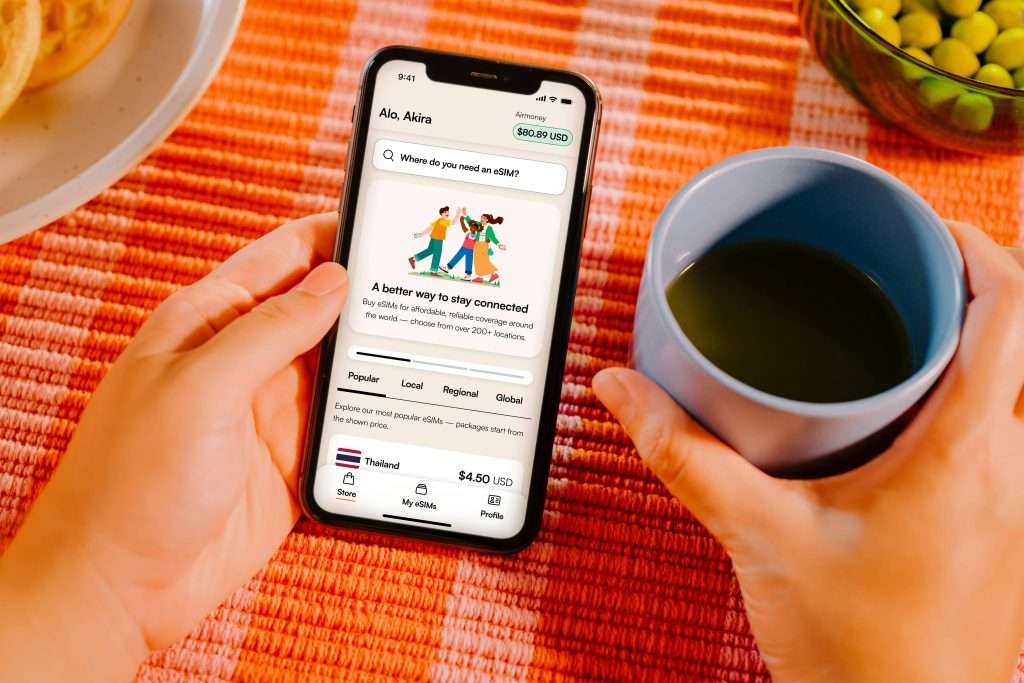

How eSIM Technology Is Changing the Way People Travel Internationally
International travel has become easier in many ways, but staying connected abroad has not always been one of them. Travelers have traditionally faced expensive roaming charges, long queues at airport SIM counters, unfamiliar mobile plans, and the inconvenience of swapping tiny SIM cards. Today, eSIM technology is changing that experience by making mobile connectivity available digitally, often before a traveler even boards a flight.
Whether someone is exploring historic European cities, working remotely from another country, or backpacking through Southeast Asia, an international travel eSIM can make it easier to access maps, communicate with family, book transportation, and find essential travel information.
An eSIM does more than replace a physical SIM card. It changes how travelers prepare for their journeys, choose mobile networks, manage data costs, and move between countries.
What Is eSIM Technology?
An eSIM, short for embedded SIM, is a digital SIM built into a compatible device. Instead of inserting a physical SIM card, users download a mobile network profile and activate a supported cellular plan electronically.
For international travelers, this means they can purchase a suitable data plan online, install it on their phone, and connect to a supported mobile network after arriving at their destination.
The process is generally straightforward:
- Check whether the smartphone supports eSIM and is unlocked.
- Choose a travel eSIM plan that covers the destination.
- Install the eSIM through a QR code, an app, or the provider’s supported activation method.
- Follow the provider’s instructions to activate the plan and configure mobile data.
- Connect to the available network when the plan becomes active.
Some eSIMs can be installed before departure and activated upon arrival, while others begin their validity period as soon as installation or activation occurs. Checking these conditions before purchasing can prevent unnecessary data loss.
Unlike a conventional SIM card, an eSIM does not need to be physically removed or replaced. Compatible phones can also support multiple stored profiles, although the number of profiles and simultaneously active lines depends on the device.
Why eSIM Technology Is Becoming Important for International Travelers
Travelers increasingly depend on their smartphones for more than making calls. A phone often serves as a navigation tool, boarding-pass holder, translation assistant, payment companion, accommodation finder, and emergency communication device.
Losing mobile connectivity can therefore cause more than a minor inconvenience.
1. Travelers Can Get Connected Before Leaving Home
One of the biggest advantages of a travel eSIM is the ability to arrange connectivity in advance.
Instead of searching for a SIM vendor after a long flight, travelers can often purchase and install their plan while they still have a reliable internet connection at home.
Once they arrive, they can follow the activation instructions and connect to a supported local network.
This is particularly useful for people arriving late at night, traveling with children, or visiting a destination where they do not speak the local language.
Having mobile data available can make it easier to access hotel directions, arrange airport transfers, contact a host, and find the correct public transportation route.
2. eSIMs Can Help Travelers Manage Mobile Data Costs
International roaming can become expensive when a home mobile plan charges separately for overseas data. Travel eSIMs offer an alternative through prepaid packages with specified data allowances, coverage areas, and validity periods.
A traveler can compare the total cost of a plan before buying it, rather than discovering unexpected charges on a later bill.
However, an eSIM is not automatically cheaper in every situation. Some mobile operators include international roaming in their existing packages, while certain travel eSIMs charge premium rates for unlimited data or specialized coverage.
The smartest approach is to compare:
- Total price for the intended trip.
- Included data allowance.
- Number of days the plan remains valid.
- Supported countries and network operators.
- Any speed restrictions or fair-use policies.
- Whether calls, SMS, or only mobile data are included.
For a short city break, a small prepaid data package may be enough. Someone working remotely, uploading videos, or frequently using video calls may need a larger allowance or an alternative plan.
3. Keeping Your Home Number Can Be Easier
Many travelers want to access international mobile data without giving up their usual phone number.
On supported devices, a home SIM and a travel eSIM can often be used together. Travelers may keep their home line available for important calls or messages while selecting the travel eSIM as the preferred line for mobile data.
This arrangement is useful for people who need to receive banking notifications, manage work communications, or remain reachable by family.
There is one important precaution: keeping the home line active can still result in roaming charges, depending on the operator and how calls, SMS, and data are handled. Travelers should disable data roaming on the home line when appropriate and check their carrier’s international charges before departure.
4. Switching Countries Can Become More Convenient
Traditional SIM cards can become inconvenient when an itinerary includes several countries. Travelers may need to purchase separate SIM cards, manage different phone numbers, or repeatedly change their mobile setup.
A regional or multi-country eSIM plan can simplify this process by covering several destinations under one package.
For example, a traveler visiting Italy, Spain, and another European country may prefer a regional plan if it covers all the places on the itinerary. A person traveling through multiple Southeast Asian destinations may benefit from a package designed for that region.
Coverage should never be assumed, however. Some plans exclude particular territories, use different partner networks in different countries, or impose restrictions on cross-border use.
Before purchasing, check every destination on the itinerary and confirm whether the plan works across borders without requiring a separate activation.
5. Digital Connectivity Makes Travel More Flexible
An eSIM can make it easier to adjust travel arrangements as circumstances change.
A traveler who extends a holiday, adds another destination, or needs additional data may be able to purchase another package digitally, depending on the provider and device.
There is no need to visit a physical shop simply to obtain another compatible plan.
This flexibility is especially useful for digital nomads, business travelers, students studying abroad, and backpackers whose schedules may change unexpectedly.
It is still important to understand whether the provider allows top-ups, extensions, or additional profiles. Buying a new package is not always the same as extending an existing one.
Travel eSIM vs. Physical SIM vs. International Roaming
Although all three options can provide mobile connectivity abroad, they differ in how travelers obtain service and manage costs.
| Feature | Travel eSIM | Physical SIM | Home-carrier roaming |
|---|---|---|---|
| Setup | Digital installation | Insert a SIM card | Enable an eligible roaming service |
| Purchase | Often online before departure | Online or in person | Through the existing carrier |
| Cost control | Often prepaid with a set allowance | Depends on the plan | Depends on the carrier’s rates or package |
| Physical card required | No | Yes | Not necessarily |
| Local phone number | Depends on the plan | Often available | Usually retains the home number |
| Multi-country use | Depends on the plan’s coverage | Usually requires compatible roaming or a new SIM | Depends on the roaming agreement |
| Device requirements | Compatible, generally unlocked device | Compatible SIM slot and device | Compatible device and supported service |
A travel eSIM is often convenient for people who mainly need data and want to prepare before departure. A physical SIM can still be a good choice for travelers who need a local phone number or have an older device. Home-carrier roaming may be the simplest option when an existing plan already includes affordable international service.
The best choice depends on the destination, trip length, data requirements, and total cost—not simply on whether a product uses eSIM technology.
How eSIM Technology Improves Everyday Travel Experiences
The practical value of an eSIM becomes clearer when considering what travelers actually do during a trip.
Navigation and Transportation
Mobile data helps travelers use navigation apps, check train schedules, locate bus stops, compare taxi services, and find walking routes.
For someone arriving in an unfamiliar city, reliable connectivity can reduce confusion and make it easier to move between the airport, accommodation, and major attractions.
Accommodation and Travel Bookings
Travel plans can change quickly. A hotel reservation may need confirmation, a flight may be delayed, or a host may send updated check-in instructions.
With a working mobile data connection, travelers can access booking details and communicate with service providers without relying entirely on public Wi-Fi.
Translation and Local Discovery
Translation tools, digital maps, restaurant listings, and local travel guides can help visitors understand unfamiliar surroundings.
An eSIM does not guarantee uninterrupted service everywhere, but it can provide a convenient connection wherever its supported network has coverage.
Travelers should still download offline maps, save booking confirmations, and keep essential information accessible without internet access.
Remote Work and Business Travel
For remote workers, connectivity can determine whether a trip remains productive. A suitable eSIM plan can provide access to email, collaboration platforms, cloud documents, and online meetings when Wi-Fi is unavailable.
People who depend on video conferencing should check data allowances carefully. Video calls and large file transfers can consume substantially more data than messaging or occasional web browsing.
An eSIM should be viewed as a connectivity option rather than a guaranteed replacement for reliable broadband. Network congestion, coverage gaps, and local infrastructure can affect performance.
Choosing an eSIM for Different International Destinations
Every destination presents different connectivity needs. Network coverage, available operators, regional geography, and the length of the trip can all influence which plan is appropriate.
Brazil: Staying Connected Across Large Distances
Brazil’s size makes destination-specific coverage an important consideration. A traveler exploring São Paulo and Rio de Janeiro may have different connectivity requirements from someone visiting the Amazon region or traveling between smaller towns.
When researching an eSIM for Brazil, check which local networks the provider uses, whether the package includes the areas you plan to visit, and how much data you are likely to need.
City sightseeing may require moderate data for maps, ride-hailing, messaging, and restaurant searches. Longer journeys or remote excursions may require more preparation, including offline navigation and alternative communication arrangements.
Italy: Convenient Connectivity for City Hopping
Italy is a popular destination for travelers combining several cities in one trip. Someone traveling between Rome, Florence, Venice, and Milan may benefit from a plan that supports the full itinerary.
An eSIM for Italy can help visitors access train information, digital tickets, walking directions, and reservation details while moving between destinations.
Before buying, check whether the plan includes sufficient data for navigation and daily travel activities. Travelers heading into rural areas or mountainous regions should also review local coverage expectations rather than assuming that service will be equally strong everywhere.
Spain: Data for Urban Exploration and Coastal Trips
Travelers visiting Spain may split their time between major cities, islands, coastal resorts, and smaller towns. Their data requirements will depend on how they travel and which activities they prioritize.
A suitable eSIM for Spain can support everyday tasks such as finding restaurants, checking public transport, communicating with accommodation providers, and sharing travel photos.
If the itinerary includes multiple Spanish regions or nearby countries, verify that the selected package covers every destination. A country-specific plan and a regional European plan can have different pricing and coverage conditions.
Vietnam: Practical Connectivity for Flexible Travel
Vietnam offers a mix of busy cities, coastal destinations, and rural landscapes. Travelers may use mobile data for ride-hailing, translation, navigation, accommodation bookings, and communication while moving between locations.
When comparing an eSIM for Vietnam, look beyond the advertised data allowance. Check supported local networks, the package’s validity period, hotspot permissions, and whether the coverage suits the places you intend to visit.
For longer journeys through mountainous or remote areas, download maps in advance and avoid relying on continuous mobile service as the only way to navigate.
How to Choose the Right International Travel eSIM
Not every eSIM package offers the same value. The cheapest plan may be perfectly suitable for light messaging but inadequate for remote work or frequent navigation.
Use the following checklist before purchasing.
1. Confirm device compatibility. Check the manufacturer’s specifications and your device settings. An eSIM-compatible device may still be carrier-locked, and compatibility can vary by model, market, or region.
2. Confirm destination coverage. Verify every country you intend to visit, including any stopovers where you may need mobile data.
3. Estimate your data usage. Messaging and basic browsing typically require less data than video streaming, hotspot use, and large uploads.
4. Check plan validity. Confirm when the validity period begins and whether unused data expires at the end of the package.
5. Understand activation requirements. Some plans require installation before departure, while others should only be activated at the destination. Follow the provider’s instructions carefully.
6. Review network and speed details. Look for the supported network operator, available network technology, and any restrictions on speed or data usage.
7. Check calling and SMS support. A data-only eSIM may not provide a conventional local phone number. Internet-based calling apps can help, but they are not the same as regular cellular calls or SMS.
8. Read the support and refund terms. Find out how to contact the provider if installation fails or the service does not work as expected.
Travelers comparing providers can use Travel eSIM Reviews to explore destination-specific comparisons and review the available plan details before making a decision.
Common eSIM Mistakes Travelers Should Avoid
Even a suitable plan can become frustrating if it is configured incorrectly or purchased without checking its conditions.
Assuming Every Phone Supports eSIM
Not all smartphones support eSIM. Even within a device family, support can differ according to model and market. Confirm compatibility before paying for a plan.
Installing a Plan Without Checking Its Validity Rules
Some eSIM packages begin their validity period on installation, while others start when they connect to a supported network or are manually activated.
Read the activation terms so the plan does not expire earlier than expected.
Forgetting to Select the Correct Data Line
Phones with multiple SIM profiles may require the traveler to select the travel eSIM as the mobile data line.
Follow the device-specific instructions, and check the home SIM’s data-roaming settings to avoid unintended charges.
Expecting Unlimited Data to Mean Unlimited Full-Speed Use
Some packages advertised as unlimited have fair-use policies, speed restrictions, or hotspot limitations. Read the provider’s terms instead of relying solely on the plan name.
Relying Exclusively on Mobile Coverage
An eSIM cannot eliminate network dead zones or guarantee service during every part of a journey. Offline maps, saved tickets, and a small amount of travel preparation remain valuable.
Is an eSIM Safe to Use While Traveling?
An eSIM offers a practical security advantage because it cannot be physically removed from a lost or stolen phone in the same way as a removable SIM card.
However, this does not make the phone immune to theft, account compromise, malicious apps, or insecure websites.
Travelers should protect their devices with a strong passcode, enable available device-tracking features, keep software updated, and use trusted providers when purchasing mobile plans.
It is also wise to avoid entering sensitive information on suspicious websites and to use secure connections for important account activity.
Mobile data can reduce the need to depend on unfamiliar public Wi-Fi networks, but it does not replace good digital security practices.
The Future of International Travel Connectivity
eSIM technology is part of a broader shift toward digital travel services. Travelers can already arrange flights, accommodation, transportation, tickets, and mobile connectivity through digital platforms.
As eSIM support becomes available across more devices and mobile networks, travelers may find it increasingly convenient to compare plans, activate service, and manage connectivity without visiting a physical shop.
The technology also supports more flexible travel habits. A business traveler may need a short-term data plan, while a digital nomad may prefer a longer package or a plan that covers multiple countries. Families may need to compare individual device plans, and frequent travelers may value the ability to store several eSIM profiles.
Nevertheless, the quality of the experience will continue to depend on practical factors: network coverage, plan transparency, device compatibility, customer support, and fair pricing.
An eSIM is not a substitute for good mobile infrastructure. It is a simpler way to access supported mobile service when the right network and plan are available.
Final Thoughts
eSIM technology is changing international travel by making mobile connectivity easier to arrange, manage, and adapt to different journeys. It can reduce the hassle of finding a SIM card after arrival, make data costs more predictable, and help travelers stay connected while moving between destinations.
The greatest benefit is not simply the absence of a physical SIM card. It is the ability to prepare ahead, understand the cost of connectivity, and choose a plan that fits the trip.
Before traveling, check your device, compare available providers, verify coverage, and read the activation terms. A little preparation can make it easier to navigate unfamiliar places, communicate when plans change, and spend more time enjoying the journey.
For travelers planning their next international trip, exploring destination-specific comparisons at Travel eSIM Reviews is a practical starting point for making a more informed connectivity decision.
FAQs
What is an eSIM, and how does it work when traveling internationally?
An eSIM is a digital SIM embedded in a compatible device. Travelers download a mobile plan from a supported provider and activate it according to the plan’s instructions. Once connected to a supported network, it provides mobile service without requiring a physical SIM card.
Is an eSIM better than international roaming?
A travel eSIM can offer more predictable costs through prepaid data packages, while international roaming can be more convenient if your existing mobile plan includes affordable overseas service. Compare the total cost, coverage, data allowance, and calling requirements before deciding.
Can I use my regular SIM and a travel eSIM at the same time?
Yes, many compatible devices support dual-SIM functionality. Depending on the phone, travelers can keep their home number available while using the travel eSIM for mobile data. Check your device’s capabilities and your home carrier’s roaming charges first.
Does a travel eSIM work in every country?
No. Coverage depends on the provider, the selected plan, supported local networks, and the destination. Some plans cover one country, while regional or global packages cover several. Always verify the countries included before purchasing.
When should I install my travel eSIM?
Installing it before departure is often convenient because you can use a reliable internet connection and troubleshoot problems at home. However, activation and validity rules differ between providers, so follow the specific instructions for your plan.
Image Ideas and Alt Text
A traveler preparing for an international trip
Traveler preparing smartphone connectivity before an international flight
Setting up a travel eSIM
Smartphone settings showing mobile network options during travel eSIM setup
Staying connected while exploring a destination
Traveler using smartphone navigation while exploring a foreign city
Essential travel connectivity checklist
Smartphone passport and boarding pass prepared for an international journey