
Artificial intelligence is changing how people apply for jobs and how employers evaluate candidates. Applicants can now use AI tools to prepare written responses, solve questions, and improve their application materials. While these tools can be useful for learning and productivity, unauthorized assistance during recruitment assessments can make it difficult to identify genuine skills.
This is why Anti AI Cheating practices are becoming increasingly important for businesses that want to maintain fair and reliable hiring processes.
How Is AI Changing Recruitment Assessments?
AI tools have made it easier for candidates to generate answers and complete certain online tasks. For employers, this creates a challenge when assessments are intended to measure independent knowledge, reasoning, or practical abilities.
A candidate may submit an impressive response without necessarily having the skills required to perform the job. As a result, recruiters need better ways to evaluate applicants beyond resumes and written answers.
The growing role of AI in Hiring makes it important to establish clear assessment rules and use evaluation methods that reflect actual workplace responsibilities.
Why Is Anti AI Cheating Important?
Assessment integrity helps employers understand whether candidates can demonstrate the abilities they claim to possess.
Without appropriate safeguards, recruiters may find it difficult to distinguish between independently completed work and responses produced with unauthorized assistance.
An effective approach to Anti AI Cheating can help organizations:
Maintain consistency during candidate assessments.
Identify unusual activity that may require further review.
Evaluate practical skills rather than polished responses alone.
Make recruitment decisions using relevant assessment evidence.
Establish clear expectations for candidates.
However, unusual activity should not automatically be treated as proof of misconduct. Employers should review the available evidence and consider the circumstances.
How Can Businesses Reduce Unauthorized AI Assistance?
Employers can take several practical steps to improve assessment integrity.
Use job-related questions: Assessments should reflect the actual responsibilities of the position.
Introduce randomized questions: Different question combinations can make it harder for candidates to rely on shared answers.
Set clear assessment guidelines: Candidates should understand which external tools are permitted and which are not.
Review unusual activity: Browser activity, unexpected pasting behavior, and unusual answer timing can provide additional information for human review.
Include practical tasks: Realistic exercises can help employers understand how candidates approach work-related problems.
How Does HireValid Support Assessment Integrity?
HireValid helps businesses evaluate applicants through online pre-employment assessments. Its approach combines skills testing with integrity information to give employers additional insight into candidate performance.
Its Anti AI Cheating approach uses AI-resistant assessment design and activity signals to help make unauthorized assistance harder and easier to review.
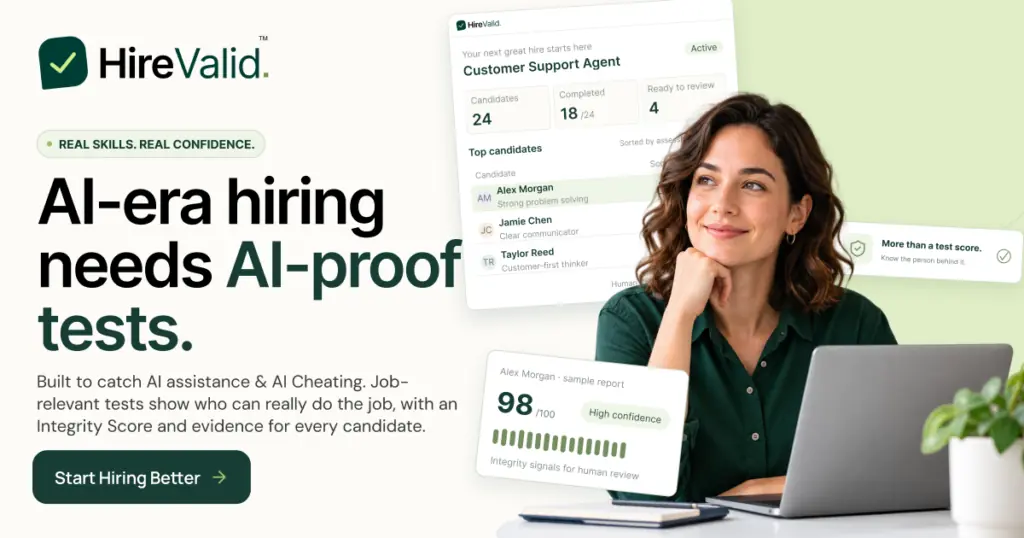
An effective Anti AI Cheating Solution should not depend on a single automated detector. HireValid provides an Integrity Score with supporting evidence, helping recruiters examine potential irregularities while keeping final decisions under human control.
Conclusion
AI is becoming a regular part of recruitment, but employers still need to understand what candidates can genuinely accomplish. Combining relevant assessments, clear guidelines, and integrity checks can help businesses improve the reliability of their screening process.
With HireValid, employers can review candidate skills alongside available integrity signals and make more informed hiring decisions.