
Electric motors are an essential part of industrial operations. They power pumps, conveyors, compressors, fans and production machinery. However, not every application requires a motor to operate at full speed throughout the day. Running motors without considering actual operating requirements can increase electricity consumption and place unnecessary stress on connected equipment.
A Variable Frequency Drive (VFD) provides a practical way to manage motor speed according to process requirements. It allows industries to control motor operation, improve process consistency and manage energy consumption.
However, selecting the right VFD requires more than checking the motor’s horsepower or kilowatt rating. Factors such as load characteristics, operating conditions, electrical supply and control requirements also influence the selection.
This article explains the important factors industries should consider when choosing a VFD for their motor applications.
What Is a Variable Frequency Drive?
A Variable Frequency Drive is an electronic device that controls the speed of an AC motor by adjusting the frequency and voltage of its electrical supply.
In a conventional motor installation, the motor generally operates at a speed determined by its supply frequency and design. A VFD allows operators to change the output frequency, making it possible to increase or decrease motor speed according to operational requirements.
For example, a water treatment plant may need different pump speeds depending on water demand. Instead of operating the pump continuously at maximum speed, a VFD can adjust its operation to match the required flow.
This approach is particularly useful in industrial environments where motor speed affects production, energy consumption and equipment performance.
Why Is Choosing the Right VFD Important?
Selecting an unsuitable drive can affect motor performance and the overall electrical system. A properly selected VFD helps ensure that the motor operates within its intended electrical and mechanical limits.
Some important benefits include:
Energy Management: Adjusting motor speed according to actual demand can reduce unnecessary electricity consumption, especially in variable-torque applications.
Controlled Starting: Gradual acceleration reduces sudden mechanical stress during motor startup.
Better Process Control: Operators can adjust motor speed to match production requirements.
Reduced Equipment Stress: Controlled acceleration and deceleration can reduce mechanical shocks.
Operating Information: Modern drives provide information about frequency, current and fault conditions, supporting maintenance activities.
The actual benefits depend on the application, motor characteristics and drive configuration.
7 Important Factors to Consider When Selecting a VFD
Choosing the right drive requires an understanding of both the motor and the connected equipment. The following factors can help engineers and maintenance teams make a suitable selection.
1. Check the Motor Power Rating
The first step is to identify the motor’s rated power.
Motor ratings are generally mentioned in kilowatts (kW) or horsepower (HP). The selected VFD should support the motor’s electrical requirements and rated current.
Engineers should review:
Motor rated power in kW or HP.
Full-load current.
Rated voltage.
Operating frequency.
Motor nameplate information.
Selecting a drive based only on kilowatt ratings may not be sufficient. Motor current and application requirements should also be considered.
2. Understand the Type of Load
Different industrial machines have different load characteristics. Understanding the load helps determine the appropriate drive capacity and control method.
Common industrial load types include:
Variable-Torque Loads
These applications include centrifugal pumps and fans. Their torque requirements change with operating speed. VFDs can be particularly useful in these applications because reducing speed can significantly reduce power demand.
Constant-Torque Loads
Conveyors, mixers and certain material-handling machines often require relatively consistent torque across their operating speed range.
These applications may need a drive with suitable overload capacity and torque control.
3. Verify the Input Voltage and Supply
The incoming electrical supply must match the VFD’s specified input requirements.
Before selecting a drive, check:
Single-phase or three-phase supply.
Available supply voltage.
Supply frequency.
Electrical system conditions.
For example, industrial VFD installations commonly use three-phase electrical supplies. A mismatch between the incoming supply and the drive rating can create operational problems.
4. Consider the Operating Environment
The installation environment has a direct impact on electrical equipment.
A VFD installed in a clean indoor electrical room may have different enclosure and cooling requirements compared with one installed in a dusty or humid industrial area.
Consider the following conditions:
Ambient temperature.
Dust and moisture exposure.
Ventilation availability.
Panel enclosure protection.
Heat generated by the drive.
Suitable ventilation and enclosure protection help maintain appropriate operating conditions.
5. Evaluate Control and Automation Requirements
Modern industrial operations often connect motor control systems with automation equipment.
Depending on the project, a VFD may need to communicate with a Programmable Logic Controller (PLC), Human Machine Interface (HMI) or Supervisory Control and Data Acquisition (SCADA) system.
Before finalizing the drive, identify the required communication protocols and control functions.
Common requirements include:
Local and remote operation.
Speed reference through an external signal.
PLC integration.
Fault monitoring.
Automatic control based on process feedback.
Considering these requirements during the selection stage can simplify future system integration.
6. Check Overload and Protection Requirements
Industrial motors may experience changing loads during normal operation. The selected VFD must have suitable overload capacity for the application’s operating conditions.
Engineers should evaluate:
Motor starting and acceleration requirements.
Expected overload conditions.
Short-circuit protection arrangements.
Overtemperature protection.
Drive fault monitoring.
The protection arrangement should be coordinated with the complete electrical installation rather than relying on the VFD alone.
7. Consider Maintenance and Future Requirements
A VFD installation should support convenient inspection and maintenance.
Engineers should consider accessibility, cooling arrangements, wiring layout, spare component availability and monitoring requirements.
It is also useful to evaluate whether the drive system can support future changes in production capacity or automation.
Planning these requirements early can reduce the need for major modifications later.
Common Industrial Applications of VFD Systems
VFD systems are used across several industries because motor speed control is important in many mechanical processes.
Water and Wastewater Treatment
Pumps are used to move water through treatment plants, pipelines and distribution systems. VFDs can adjust pump speed according to flow and pressure requirements.
Manufacturing Industries
Production facilities use motors in machinery, processing equipment and material-handling systems. Variable speed control helps operators adjust machine performance according to production needs.
HVAC Systems
Heating, ventilation and air-conditioning systems use motors to operate fans and pumps. VFDs can regulate their speed based on ventilation and cooling requirements.
Conveyor Systems
Conveyor equipment is commonly used in manufacturing, warehouses and material-handling operations. VFDs allow operators to control conveyor speed according to material movement requirements.
Drilling and Heavy Industrial Equipment
Certain drilling and heavy industrial applications require controlled motor operation under changing load conditions. Appropriate VFD configurations can support these operating requirements.
What Is the Difference Between a VFD and a Soft Starter?
Both VFDs and soft starters help control motor starting, but they perform different functions.
| Parameter | VFD | Soft Starter |
|---|---|---|
| Main function | Controls motor speed | Controls motor starting and stopping |
| Running speed | Variable | Generally fixed |
| Frequency control | Yes | No |
| Starting current management | Yes | Yes |
| Continuous speed adjustment | Yes | No |
| Typical application | Pumps, fans, conveyors | Motors requiring controlled starting |
A VFD is suitable when continuous motor speed control is required. A soft starter is generally used when the main requirement is to reduce starting stress without needing variable-speed operation.
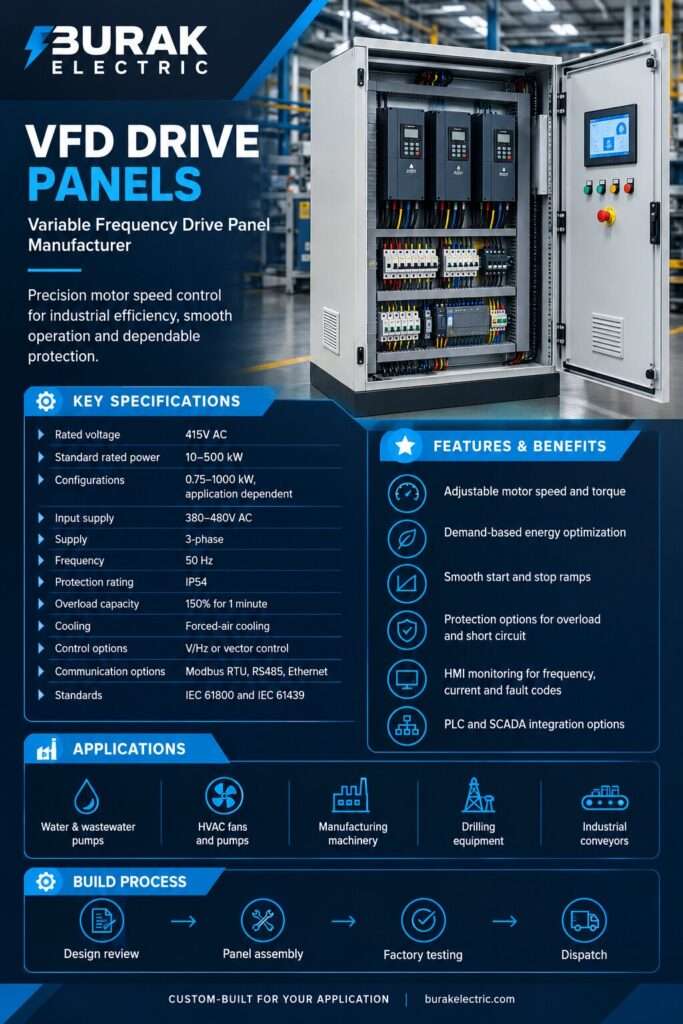
Why Does the VFD Panel Configuration Matter?
A VFD is only one part of an industrial motor control installation. The electrical panel that houses the drive also plays an important role in system performance and protection.
A VFD panel brings together the drive, electrical protection, control wiring and associated components within an enclosure.
Its configuration should consider:
Motor power and current requirements.
Suitable electrical protection.
Panel ventilation and cooling.
Control and communication requirements.
Enclosure protection.
Applicable electrical standards.
For industrial projects, the panel configuration should be finalized after reviewing the motor details and operating conditions.
Final Thoughts
Choosing the right VFD involves understanding the motor, load, electrical supply and operating environment. A drive selected according to these requirements can support better motor control, smoother operation and more effective energy management.
Industries should evaluate technical specifications before purchasing a VFD or complete drive panel. Proper planning also helps ensure compatibility with existing electrical and automation systems.
Businesses looking for industrial motor speed-control solutions can explore the VFD Drive Panels offered by Burak Electric to review product specifications and application details.