
Most small marketing teams do not lose money because their creative is bad. They lose it because they test one direction, get a mediocre result, and then have no budget left to try a second one. The bottleneck is rarely design skill; it is the number of visual options the team can afford to put in front of an audience.
Why draft volume matters more than polish
Paid social and search creatives are decided by response, not by taste. A campaign that ships with one hero image is really a single bet: if the composition, the background or the message space is wrong, the whole test fails and nothing is learned about the offer itself. Shipping five cheaper drafts changes the nature of the test. You stop asking whether one image works and start asking which visual idea the audience responds to.
A four-step workflow that keeps comparisons honest
- Lock the objective in one line. Launch, retargeting or seasonal push – write it down first. Then list only the three visual elements that objective actually needs.
- Change one variable per round. Hold prompt, subject and aspect ratio steady while changing only the background, or only the lighting, or only the negative space reserved for copy. Two changes at once make the result unreadable.
- Anchor the subject with a reference image. If you have a product shot or an existing model image, feed it in as a reference rather than describing it again. This is the single biggest quality difference between a usable draft and a throwaway one.
- Add text afterwards. Generate the image with clean empty space, then set the headline in your design tool. Small type, numbers and brand marks are exactly where image models degrade first.
What to look for in a low-cost image tool
For drafting, the metric that matters is cost per image, because that number sets how many directions you can afford to explore. A two-tier structure works well: a cheap model for the first five to ten directions, then a stronger model only for the direction that survived review.
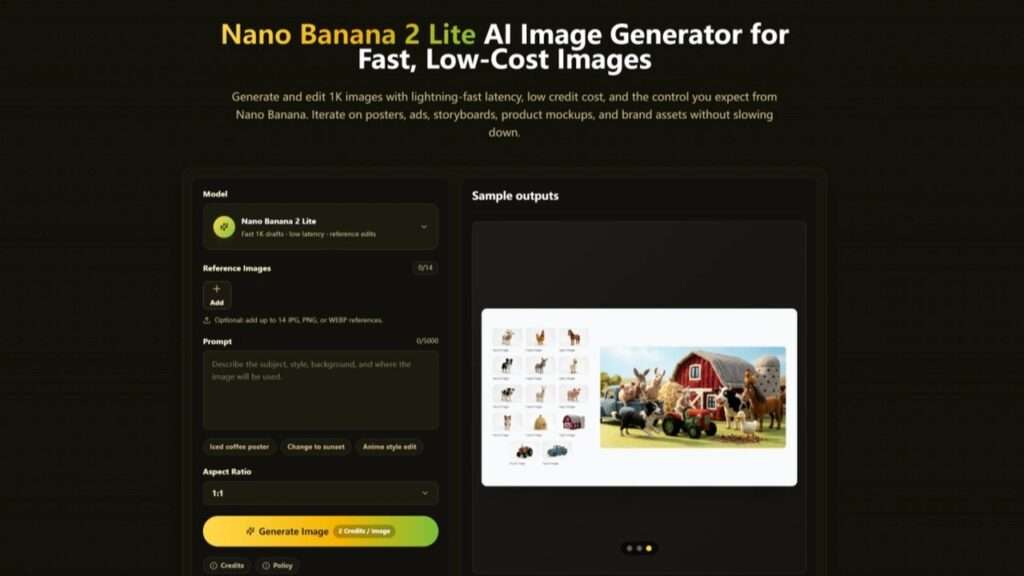
One example of that structure is Nano Banana 2 Lite, an independent third-party image generator and editor. Its Lite model produces 1K drafts at two credits per image, and its Pro model runs at nine credits for 1K or 2K output and eighteen for 4K. It accepts up to fourteen JPG, PNG or WEBP object references per request, which is what makes the subject-anchoring step above practical, and it offers a match-input-image aspect ratio for edits that must follow an existing asset. Credits are sold as one-time packs rather than a subscription, and they do not expire – a detail that matters for teams with irregular campaign calendars.
Where AI images still fail
Every model in this class has the same weak spots, and ignoring them is how a cheap draft turns into an expensive mistake. Text inside the image, brand marks, numbers and diagrams need manual verification before anything goes live. Character consistency across separate generations is not guaranteed. And tools that do not use search grounding cannot be trusted for current events, statistics or any claim that has to be factually true.
Treat the output as a layout and mood decision, not as a source of information. If a visual needs to state a number, add that number in the design layer where you can still edit it.
A simple budget rule
Spend roughly eighty per cent of your creative budget on cheap drafts and twenty per cent on final production of the one or two directions that earned it. That ratio keeps the testing loop alive without inflating cost, and it keeps the decision about which direction to pursue in front of the audience rather than in a meeting room.
Teams that adopt this usually find the same thing: the winning creative is rarely the one anybody would have picked first. The point of cheap volume is not to produce more ads. It is to find that out earlier, for less money.