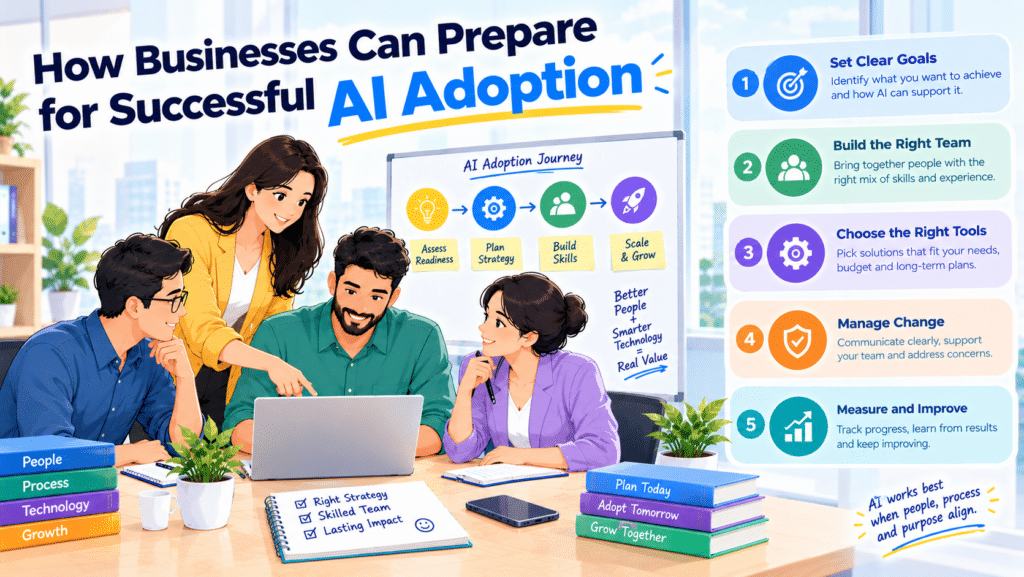

Artificial intelligence is changing how businesses manage information, serve customers, and improve operational efficiency. However, adopting AI successfully requires more than investing in new software. Businesses need a clear strategy, reliable data, the right technical expertise, and a plan for integrating new solutions into existing workflows.
Whether a company wants to automate repetitive tasks or develop intelligent applications, preparation can help reduce implementation challenges and improve the chances of achieving meaningful results.
Define Clear Goals Before Starting an AI Project
The first step toward AI adoption is identifying what the business wants to achieve. Some organizations want to reduce manual work, while others aim to improve customer experiences, analyze large datasets, or develop new digital services.
Businesses should prioritize problems where AI can provide measurable value. For example, a customer service team might benefit from an intelligent assistant that handles routine questions, while an operations team could use predictive analytics to identify potential delays.
Clear objectives help businesses select appropriate technologies, estimate costs, and establish performance indicators before development begins.
Prepare Data for AI Implementation
Data plays an important role in the performance of AI applications. Incomplete, outdated, or inconsistent information can affect the accuracy and usefulness of a solution.
Before starting development, businesses should review their existing data sources, identify quality issues, and establish appropriate access controls. They should also determine which information the application needs and how it will be updated.
For generative AI applications, techniques such as retrieval-augmented generation can help connect language models with relevant business information. However, the results still depend on the quality of the source material and the design of the retrieval process.
Preparing data early can make development more efficient and help teams identify potential risks before deployment.
Choose the Right AI Technology
Not every business problem requires the same technology. Understanding the available options helps organizations avoid unnecessary complexity.
Generative AI for Knowledge Management
Generative AI can summarize documents, answer questions, draft content, and help employees locate information. Businesses can use these capabilities to improve internal knowledge sharing and support customer-facing applications.
Organizations considering generative AI development solutions should evaluate model capabilities, data requirements, integration options, and security controls before selecting an approach.
AI Agents for Business Workflows
AI agents can support multi-step tasks by retrieving information, using approved tools, and preparing actions for review. They may help with workflows such as information gathering, internal support, and routine administrative tasks.
Businesses exploring AI agent development specialists should assess how their proposed systems handle permissions, errors, unexpected inputs, and human approval.
Starting with a controlled workflow can help teams evaluate reliability before allowing an agent to perform more complex tasks.
Machine Learning for Predictions
Machine learning can identify patterns in historical data and support demand forecasting, anomaly detection, and other analytical tasks.
Businesses should evaluate data quality, model performance, and the practical value of predictions before deploying these systems. In some cases, conventional analytics or rule-based automation may be sufficient.
Find a Partner With the Right Technical Skills
Many businesses need external expertise to plan, develop, or integrate AI applications. However, selecting a provider requires more than reviewing its service list.
When comparing AI development service providers, businesses should examine relevant experience, technical capabilities, communication practices, security measures, and post-launch support.
Ask potential partners to explain how they would approach the project, which technologies they recommend, and how they plan to measure success. Reviewing previous projects and requesting a clear proposal can help determine whether a provider understands the business requirements.
Organizations should also clarify responsibilities for maintenance, monitoring, and future improvements before signing an agreement.
Compare Providers Based on Business Needs
Location, team availability, and project costs can influence the selection process, but they should not be the only deciding factors.
Businesses evaluating AI development providers in the USA may value local collaboration, overlapping working hours, or experience with enterprise projects.
Similarly, companies exploring AI development providers in India may compare technical expertise, team structures, engagement models, and budget requirements.
For a fair comparison, share the same project brief with every shortlisted provider. Assess the proposed solution, estimated timeline, security approach, and ongoing costs against consistent criteria.
Address Security and Governance Early
AI applications may process customer details, business records, and confidential documents. Businesses should determine how information will be accessed, processed, stored, and protected.
Depending on the application, security measures may include encryption, role-based permissions, audit logs, and human review. Organizations should also establish procedures for identifying errors and responding to unexpected behavior.
The NIST AI Risk Management Framework offers guidance for identifying and managing risks associated with AI systems.
Security and governance requirements should be included in project planning so they can be addressed throughout development, testing, and deployment.
Start Small and Measure Results
Launching a limited pilot can help businesses understand whether an AI solution performs as expected. Rather than automating several departments at once, organizations can begin with a specific process and evaluate its results.
Useful performance indicators may include processing time, task completion rates, response accuracy, error frequency, or customer satisfaction. Establishing a baseline before implementation makes it easier to assess improvements.
Businesses should also collect feedback from employees and users. Their experience can reveal usability problems, missing features, or workflows that need adjustment.
Once the pilot demonstrates consistent value, the organization can decide whether to expand the solution to additional teams or business functions.
Conclusion
Successful AI adoption starts with preparation, clear objectives, reliable data, and suitable technical expertise. Businesses should select technologies based on actual requirements, evaluate potential partners carefully, and address security before deployment.
A measured approach allows organizations to test ideas, learn from real-world use, and improve solutions over time. By connecting AI investments with specific business goals, companies can make more informed decisions and build applications that support long-term operational improvements.