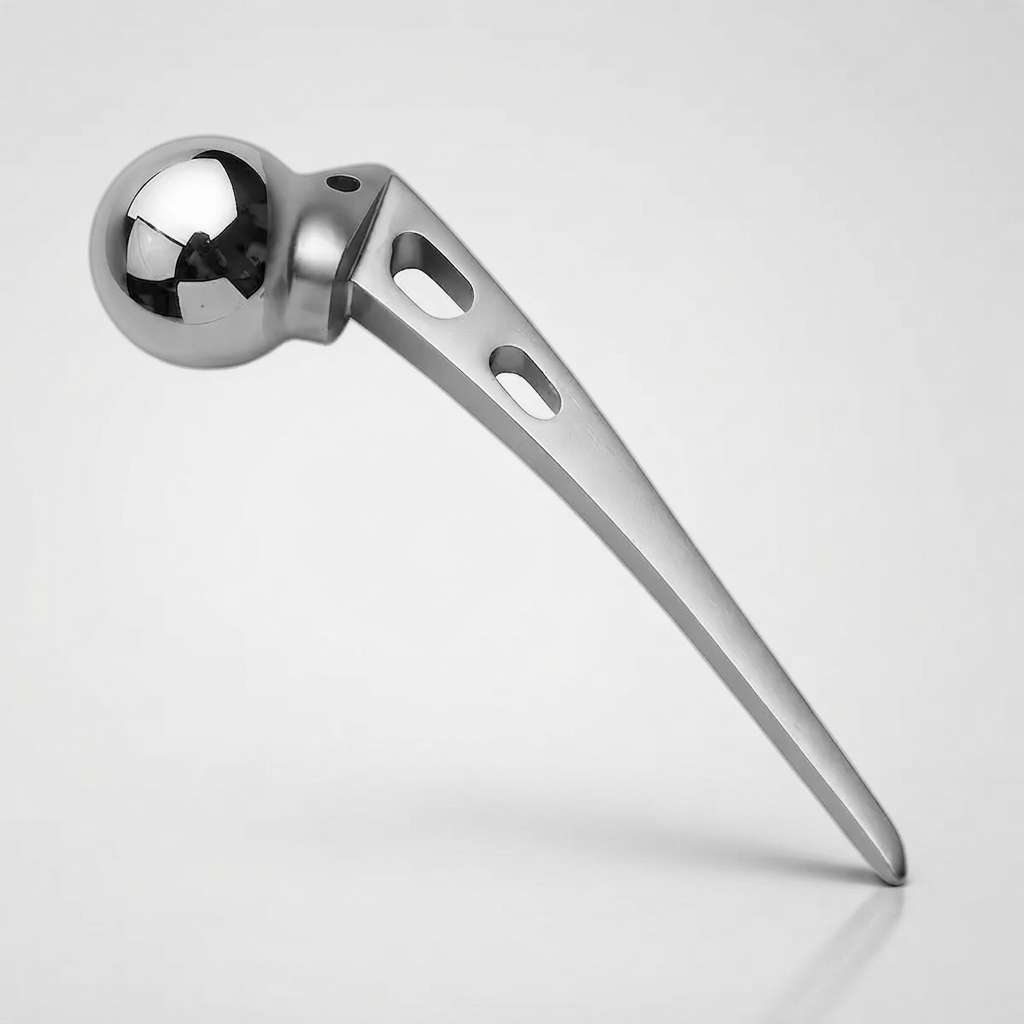

An Austin Moore Hip Prosthesis is a one-piece implant used for partial hip replacement. This operation is called hemiarthroplasty. It replaces the damaged femoral head and part of the neck. The patient’s natural hip socket remains in place.
Understanding this implant requires more than knowing its size. Its design, fixation method, clinical limitations, and recovery needs also matter. [1]
Understanding the Hip Joint
The hip is a ball-and-socket joint. The ball is the femoral head at the top of the thighbone. The socket, called the acetabulum, is part of the pelvis.
The femoral neck connects the ball to the thighbone. A displaced fracture in this area can damage the blood supply to the femoral head. As a result, the bone may fail to heal or develop avascular necrosis. This means bone tissue dies because it does not receive enough blood. Replacement surgery may then be considered. [2]
What Makes the Austin Moore Design Different?
The Austin Moore prosthesis is a monoblock, unipolar implant. Its head, neck, and stem form one fixed piece. The metal head moves directly against the natural socket.
Its main parts include:
- Head: The rounded surface that fits inside the socket.
- Neck: The section connecting the head to the stem.
- Collar: A supporting shoulder near the upper stem.
- Stem: The section inserted into the thighbone.
- Fenestrations: Openings in the stem that are characteristic of this design.
The supplier lists a cementless design. Check the selected model’s dimensions and instructions. [3,10]
When Is It Used?
Austin Moore hemiarthroplasty has been used for selected displaced intracapsular femoral neck fractures. Intracapsular means the fracture lies within the hip joint capsule.
However, a fracture diagnosis alone does not determine the implant. The surgeon must consider the patient’s bone quality, health, walking ability, and treatment goals. A younger patient may need treatment that preserves the natural femoral head. Other hip fractures may require screws, plates, or nails. [2,4]
Cementless Fixation and Current Recommendations
A cementless stem relies on a suitable fit within the prepared femoral canal. A cemented stem uses bone cement to secure the implant.
This difference matters in older patients with weak bone. NICE recommends cemented implants for hip fracture arthroplasty. AAOS also recommends cemented femoral stems for arthroplasty after femoral neck fractures in older adults. Its evidence highlights lower fracture risk around the implant and better short-term outcomes, while acknowledging possible increases in surgical time and blood loss.
Therefore, the traditional cementless Austin Moore prosthesis should not be described as the preferred implant for every older patient. Clinical guidelines and the surgeon’s assessment must guide selection. [5,6]
Available Sizes and Materials
According to the Samis Instruments product listing, the following options are available:
| Specification | Listed details |
|---|---|
| Product type | Monoblock unipolar hip prosthesis |
| Head diameter | 30–60 mm, in 1 mm increments |
| Number of head sizes | 31 |
| Stem configurations | Standard, Narrow, Broad |
| Materials | 316L stainless steel, 316LVM stainless steel, titanium |
| Stem design | Fenestrated |
| Fixation design | Cementless |
Head diameter does not describe stem length or width. Also, buyers should confirm which size, stem, and material combinations are available.
Hospitals and distributors can review the Austin Moore Hip Prosthesis listing for specifications and ordering information. [3]
How Is the Correct Implant Selected?
Selection involves the head size, stem fit, implant position, and support beneath the collar.
A study of 243 Austin Moore hemiarthroplasties found that poor collar seating was associated with pain and revision for loosening. Differences in head size were also associated with pain. These findings show why accurate sizing and placement matter.
The Standard, Narrow, and Broad names alone cannot confirm patient suitability. The treating surgeon needs the relevant measurements and technical information. [3,4]
Austin Moore, Bipolar, and Total Hip Replacement
These options replace different parts or use different designs.
| Option | Main difference |
|---|---|
| Austin Moore hemiarthroplasty | One-piece implant with a head that moves against the natural socket |
| Bipolar hemiarthroplasty | Has an additional joint within the prosthetic head |
| Total hip replacement | Replaces the femoral side and the socket surface |
Modern modular systems allow more adjustment of the head and neck. Total hip replacement may be considered for selected active patients or those with existing socket arthritis. No single option suits every patient. [1,5]
What Happens During Surgery?
Hemiarthroplasty involves removing the damaged femoral head, preparing the femoral canal, inserting the chosen implant, and restoring the joint.
The surgical team checks stability and movement before closing the wound. The approach and fixation method depend on the patient and implant. [1]
Before surgery, doctors also assess medical conditions and medicines, including blood thinners. Hip fracture guidelines support timely surgery once it is safe to proceed. [2,6]
Potential Benefits and Limitations
The goals of fracture surgery include reducing pain and helping the patient move again. Early movement can reduce problems linked to prolonged bed rest. [2]
However, Austin Moore’s fixed design offers fewer adjustment options than a modular system. The natural socket remains exposed to the artificial head. Socket wear can later cause pain and may require revision. [10]
These limitations should be considered alongside the patient’s needs. Implant availability alone does not establish clinical suitability. [1]
Possible Risks and Complications
Potential complications include:
- Infection in the wound or joint.
- Blood clots in the leg or lungs.
- Dislocation of the prosthetic head.
- Fracture around the stem.
- Implant loosening or persistent pain.
- Wear of the natural socket.
- A difference in leg length.
- Injury to nearby nerves or blood vessels.
Some complications require further surgery. Loosening and socket wear may develop later, so follow-up remains important. [1,4,6,7]
Recovery and Rehabilitation
Recovery depends on the fracture, general health, surgical result, and previous mobility. It can take weeks or months. Some patients do not regain their earlier strength or independence. [8]
Physiotherapists help patients stand, walk, and practise daily activities. A walking frame or crutches may be needed. The surgical team determines how much weight the patient can place on the leg. Medicines and other measures may be used to reduce blood clot risk. [2]
At home, patients should follow their exercise plan and movement precautions. Restrictions vary, so instructions should come from the treating team. Driving, work, and heavier activities require individual clearance. [9]
Bone health assessment and fall prevention also matter after a hip fracture. Removing trip hazards and arranging support can help with safer recovery. [8]
Warning Signs After Surgery
Increasing wound redness, discharge, fever, or worsening leg pain and swelling need prompt medical assessment. These symptoms may indicate infection or a blood clot.
Chest pain or difficulty breathing requires emergency medical care. Sudden severe hip pain or inability to move the leg also needs urgent assessment. [7]
What Should Professional Buyers Check?
Before ordering, hospitals and distributors should request:
- The exact head diameter and stem dimensions.
- The material grade and relevant test documents.
- Instructions for use and intended fixation method.
- Sterile or nonsterile supply status.
- Validated sterilization instructions, where applicable.
- Packaging details, shelf life, and batch identification.
- Regulatory documents required in the destination country.
- Compatible instrument information.
A general material name does not confirm the finished implant’s approval or suitability. Buyers should assess the actual product documents. They should also confirm the quotation, available configurations, and delivery terms with the supplier.
Frequently Asked Questions
Is an Austin Moore prosthesis a total hip replacement?
No. It is used for hemiarthroplasty, which retains the natural socket. Total hip replacement also replaces the socket surface. [1]
Is it suitable for every hip fracture?
No. Treatment depends on the fracture pattern and patient. Some fractures need fixation, while others may need partial or total replacement. [2]
Does the Samis Instruments version require bone cement?
The product page lists a cementless design. Use must follow the exact model’s instructions and the surgeon’s treatment plan. [3]
Can patients walk after surgery?
Rehabilitation aims to restore walking where possible. The timing, support needed, and permitted weight bearing depend on clinical assessment. [2,8]
How long does an Austin Moore prosthesis last?
There is no guaranteed lifespan for every patient. Loosening, socket wear, pain, or other complications may lead to revision. General lifespan claims for modern total hip replacements should not be applied automatically to this implant. [1,4]
Is titanium always the best material?
Material choice alone cannot establish the best implant. Buyers and clinicians must also consider the exact grade, design, documentation, and clinical requirements.