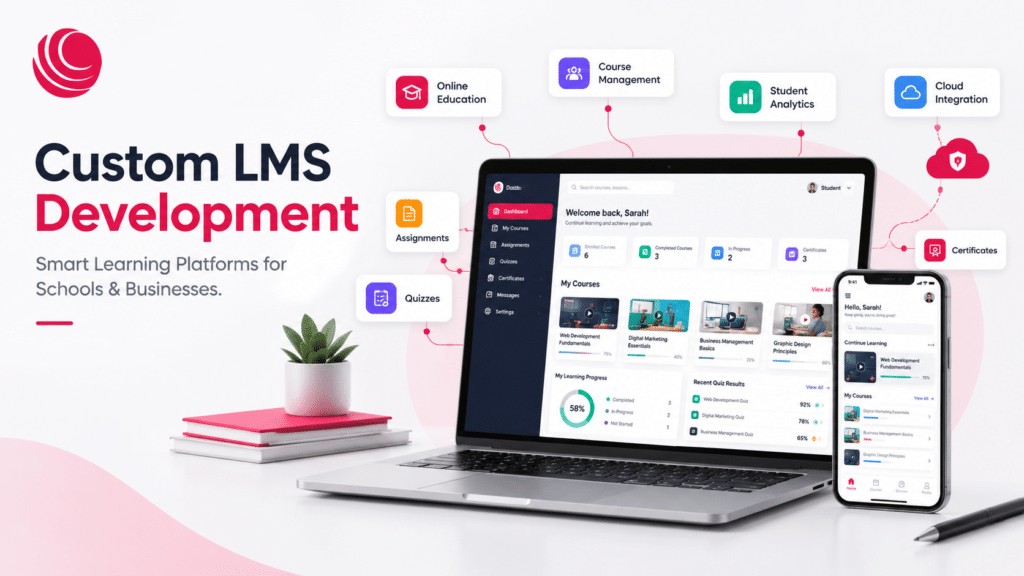

Online learning has changed how schools, universities, training centers, and businesses teach people. Today, learners expect easy access to courses, video lessons, assignments, quizzes, and results from their computers and mobile phones. At the same time, teachers and administrators need better ways to manage students, track progress, and organize learning materials.
This is where custom LMS development becomes valuable. A Learning Management System (LMS) helps organizations manage learning activities through one digital platform. A custom solution goes further by providing features designed around specific educational or business needs.
In this guide, we will explore what custom LMS development means, its key features, its benefits, and the factors that affect development costs.
What Is Custom LMS Development?
Custom LMS development is the process of designing and building a Learning Management System according to an organization’s requirements. Instead of relying only on ready-made software, organizations can choose the features, design, user roles, and workflows they need.
For example, a school may need student attendance, homework submission, examination schedules, and parent access. However, a corporate training company may need employee training courses, performance reports, certificates, and progress tracking.
A custom LMS can support both types of organizations with a solution designed for their goals.
A professional LMS development project may include:
-
Student and teacher dashboards
-
Online courses and video lessons
-
Course and quiz management
-
Assignment submission and grading
-
Online examination systems
-
Student progress tracking
-
Certificates and completion reports
-
Mobile-friendly interfaces
-
Third-party software integrations
The final features depend on the organization’s budget, users, and learning requirements.
Why Do Organizations Need a Custom Learning Management System?
Many organizations begin with spreadsheets, emails, messaging apps, and separate tools to manage learning. Although these methods may work for a small group, they become harder to manage as the number of learners increases.
A custom learning management system brings important learning activities into one place.
1. Manage Courses More Easily
Teachers and administrators can create courses, upload learning materials, organize lessons, and update content through a central dashboard. This makes course management simpler and reduces the need to share files manually.
2. Track Student Progress
An LMS can help teachers monitor quiz results, assignment completion, course activity, and overall progress. As a result, they can identify learners who need extra support and improve their teaching methods.
3. Automate Repetitive Tasks
A well-designed platform can automate tasks such as quiz grading, course completion notifications, certificate generation, and progress reports. This saves time and allows teachers to focus more on teaching.
4. Support Remote Learning
Learners can access course materials from different locations. With a responsive design, they can use the platform on desktops, tablets, and smartphones.
5. Improve Learning Management
Administrators can manage users, courses, permissions, and reports from a single system. This makes it easier to organize learning activities as an institution or business grows.
Essential Features of Custom LMS Development
The right LMS features depend on how people will use the platform. However, several functions are important for most learning environments.
User Management and Role-Based Dashboards
A learning platform should support different user roles, such as students, teachers, instructors, and administrators. Each role should have access to the tools and information it needs.
For example, students can view lessons and results, teachers can manage assignments, and administrators can control users and courses.
Course and Content Management
Course management is a core part of LMS software development. Administrators should be able to create courses, organize modules, upload documents, add videos, and update lessons without unnecessary technical work.
A clear course structure also helps learners find the information they need.
Online Exams, Quizzes, and Assignments
Assessment tools allow teachers to check student understanding. Depending on the requirements, an LMS can include multiple-choice questions, timed quizzes, question banks, assignment uploads, grading tools, and examination reports.
These features can reduce manual work and make assessment management more organized.
Student Progress Tracking and Analytics
Progress tracking gives teachers and administrators a clearer view of learning activity. Reports may show course completion, quiz scores, assignment status, and learner performance over time.
These insights can help organizations improve courses and make better decisions.
Mobile-Friendly Learning
Many learners prefer to study on their phones. Therefore, a modern e-learning platform should provide a smooth mobile experience.
Depending on the project, businesses can choose a responsive web platform or develop dedicated Android and iOS applications.
Integrations With Other Systems
An LMS may need to connect with payment gateways, email services, video conferencing tools, customer relationship management systems, or existing academic software.
LMS integration helps different systems exchange information and reduces duplicate data entry.
Benefits of Custom LMS Development for Different Industries
A custom LMS can serve many industries because each organization can select features that match its workflow.
Schools, Colleges, and Universities
Educational institutions can use an LMS to manage courses, lecture materials, assignments, examinations, attendance, grades, and student portals. Teachers can share resources, while students can access learning materials without depending entirely on printed documents.
Universities may also need department-based permissions, semester management, and integration with existing academic systems.
Corporate Training and Employee Development
Businesses can use learning management software to train employees, introduce new staff members, and deliver professional development courses.
Managers can assign training programs, monitor completion, and review performance reports. This creates a more organized approach to employee learning.
Online Academies and Coaching Centers
Online academies can use an LMS to sell courses, provide recorded lectures, schedule assessments, and issue certificates. A custom platform can also support different batches, membership plans, and payment options.
Training and Certification Providers
Organizations that provide professional training can use custom e-learning solutions to manage course enrollment, assessments, certificates, and learner records from one place.
Custom LMS Development vs Ready-Made LMS Software
Ready-made LMS software can be a suitable choice for organizations with simple requirements. It often provides standard features and may allow a faster initial setup.
However, some organizations need workflows or integrations that existing platforms cannot support easily.
A custom LMS offers greater control over the user experience, business rules, dashboards, and integrations. It can also grow as requirements change.
Before choosing an approach, consider these factors:
-
Budget: Ready-made solutions may have lower initial costs, while custom development requires a project-specific investment.
-
Customization: A custom LMS can be designed around your exact requirements.
-
Integrations: Review whether the platform can connect with your existing systems.
-
Scalability: Consider how the solution will support more users and courses in the future.
-
Ownership: Understand who owns the source code, data, and custom components.
-
Maintenance: Compare ongoing support, updates, hosting, and licensing costs.
An established platform such as Moodle may also be customized to meet additional requirements. The best choice depends on your project scope, budget, and long-term plans.
How Much Does Custom LMS Development Cost?
The cost of custom LMS development depends on the features and technical requirements of the project. There is no single price that applies to every organization.
A basic learning platform with user accounts, courses, and quizzes will usually require less work than an advanced university system with examinations, mobile apps, integrations, and detailed analytics.
The main factors affecting the cost include:
Project Complexity
More user roles, specialized workflows, and advanced features require additional planning, development, and testing.
UI and UX Design
A user-friendly interface helps students, teachers, and administrators navigate the platform. Custom branding and specialized dashboards can increase the design workload.
Integrations and Mobile Applications
Connecting the LMS with external software or developing separate mobile applications adds to the project scope.
Security and Scalability
The system must protect user information and handle its expected workload. Larger platforms may need additional infrastructure, performance testing, backups, and monitoring.
Maintenance and Support
After launch, organizations should plan for bug fixes, security updates, technical support, and future improvements.
To receive a reliable estimate, prepare a list of required features, expected users, integrations, and future goals before requesting a quotation.
How to Choose the Right LMS Development Company
Choosing the right development partner is an important step. The company should understand both software development and the learning process.
Before making a decision, consider the following points:
-
Review relevant experience: Ask about previous LMS projects, student portals, or e-learning platforms.
-
Discuss your requirements: Make sure the team understands your users, workflows, and business goals.
-
Check technical capabilities: Ask how the company handles security, integrations, performance, and future growth.
-
Understand the development process: Request information about planning, design, testing, deployment, and training.
-
Confirm ownership terms: Clarify source-code ownership, data access, and licensing.
-
Ask about ongoing support: Confirm how the team handles updates, bugs, and future feature requests.
If you are looking for a development partner, explore MAGMA3C’s LMS Development Services. MAGMA3C provides LMS solutions that include custom development, course management, student progress tracking, mobile-friendly design, and integrations.
Why Choose MAGMA3C for Custom LMS Development?
MAGMA3C is a software company offering services such as website development, mobile app development, custom software solutions, and LMS development.
A learning platform may need more than course pages. It may also require user dashboards, automated workflows, secure data management, mobile access, and connections with other business systems.
By planning these requirements before development begins, organizations can create an LMS that supports their current needs and future growth.
Whether you want to launch an online academy, improve an existing student portal, or build a learning platform for employee training, start by defining your goals and selecting features that solve real problems.
Visit MAGMA3C’s LMS Development page to explore the available services and discuss your project requirements.
Conclusion
Custom LMS development helps schools, universities, training centers, and businesses manage learning through a platform designed for their needs. It can bring courses, assessments, student progress, reporting, and integrations into one organized system.
The right solution depends on your users, budget, required features, and long-term goals. Some organizations may benefit from customizing an existing LMS, while others may need a platform built around unique workflows.
Before starting your project, identify the problems you want to solve, plan your essential features, and choose a development partner that understands your requirements. With the right approach, a custom LMS can make learning easier to manage and improve the experience for both learners and educators.
Frequently Asked Questions
1. What is custom LMS development? Custom LMS development is the process of building a learning management system around an organization’s specific requirements, including courses, assessments, dashboards, and reporting.
2. How much does custom LMS development cost? The cost depends on the features, design, integrations, user capacity, security requirements, and maintenance needs of the project.
3. How long does it take to build a custom LMS? Development time depends on project complexity, required features, integrations, testing, and deployment requirements.
4. Is a custom LMS better than Moodle? A custom LMS offers greater control over unique workflows, while Moodle provides an established platform that can often be customized; the best option depends on your needs.
5. Which organizations can benefit from custom LMS development? Schools, universities, online academies, corporate training departments, coaching centers, and professional certification providers can all benefit from a suitable LMS.