
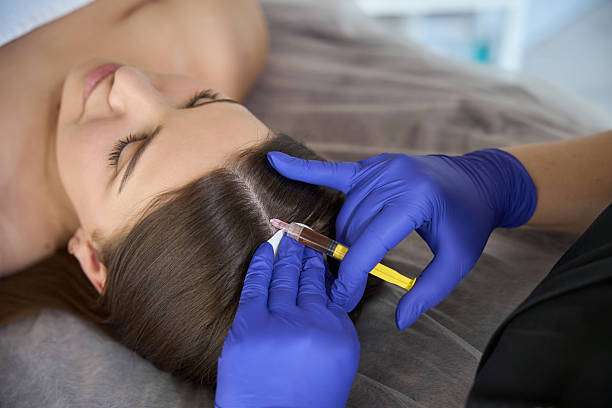

Hair Fillers Treatment in Dubai may be considered for both men and women experiencing selected forms of hair thinning. The important factor is not simply gender but the underlying cause of hair loss, the condition of the scalp, the presence of viable follicles, and the patient’s treatment goals.
Men and women can experience different patterns of thinning, although there is considerable individual variation. A treatment plan therefore needs to examine the scalp and hair rather than applying the same protocol to every patient.
Tajmeels describes its hair filler treatment as a nonsurgical injectable approach using a specialized formulation containing hyaluronic acid and biomimetic peptides.
Hair Loss Patterns Can Differ Between Individuals
Male and female patients can develop thinning for many different reasons.
Some experience gradual pattern-related thinning, while others notice diffuse reduction in density, temporary shedding, localized changes, or hair changes associated with other conditions.
The location of thinning can also vary.
Men may notice changes around the temples, frontal hairline, or crown. Women may notice reduced density through the central parting or a more diffuse reduction across the scalp.
These patterns can overlap, so a professional examination remains more useful than assuming a diagnosis from gender alone.
Why Diagnosis Comes Before Treatment
Hair filler is not intended to treat every cause of hair loss.
A clinician may first establish whether the hair change is consistent with pattern thinning, temporary shedding, scalp inflammation, traction, nutritional factors, hormonal changes, or another condition.
The distinction matters because the treatment objective changes according to the diagnosis.
If the scalp is inflamed or a medical issue is suspected, that problem may need to be addressed before considering cosmetic injections.
Hair Fillers for Men With Thinning Hair
Men often seek treatment when they notice a gradual reduction in density around the crown, frontal region, or temples.
In earlier stages, there may still be substantial follicular activity in these areas.
An injectable scalp treatment may be discussed when the goal is to support existing hair rather than surgically relocate follicles.
However, hair fillers do not recreate donor follicles and should not be presented as a replacement for transplantation in cases where substantial permanent follicular loss has already occurred.
Hair Fillers for Women With Reduced Density
Women can experience thinning in a more diffuse pattern, making the scalp increasingly visible through the hair.
Changes may be particularly noticeable around the part line or upper scalp.
A woman experiencing this pattern may have several possible causes that need to be considered before treatment.
An assessment can help determine whether an injectable approach is reasonable and whether other interventions should also be considered.
Hair Filler Treatment Is Not Determined by Gender
A common misconception is that men and women require completely different hair filler products.
The more important factors are the scalp, hair-loss pattern, formulation, treatment area, and clinical objectives.
The injection strategy may be adapted according to anatomy and the distribution of thinning.
In other words, personalization should follow the patient’s biology rather than a simple male-versus-female template.
The Importance of Follicle Health
Hair fillers are most relevant to areas where existing follicles remain.
A follicle that produces a very fine strand is biologically different from an area where follicles have been permanently lost.
This is why the same visible level of thinning can lead to different treatment recommendations.
A clinician may assess hair caliber, density, scalp condition, and the distribution of thinning before deciding whether injections are appropriate.
How the Consultation May Differ Between Patients
A consultation for a man with temple recession may focus heavily on the frontal pattern and progression.
A consultation for a woman with diffuse central thinning may involve a different diagnostic discussion.
Neither assessment is automatically more complex. The point is that treatment planning follows the individual presentation.
The patient’s history is equally important.
The clinician may ask when the thinning began, whether it is progressing, what treatments have already been tried, and whether there have been recent changes in health, medications, or lifestyle.
What Hair Fillers Can and Cannot Do
It is useful to define the treatment in practical terms.
Hair fillers may be intended to:
- Deliver a specialized formulation into selected scalp areas
- Support the local scalp environment
- Address selected areas where existing hair remains
- Improve the appearance of fullness in appropriate patients
- Provide a nonsurgical alternative to discuss alongside other treatments
They should not be presented as a guaranteed way to:
- Create completely new follicles
- Permanently cure every type of hair loss
- Replace a donor area
- Reverse every cause of thinning
- Produce identical results in every patient
Clear boundaries help patients make better treatment decisions.
Comparing Common Patient Goals
| Patient goal | Hair filler discussion |
|---|---|
| Support existing thinning hair | May be considered in selected cases |
| Restore a completely bald area | Injectable treatment may not address permanent follicular loss |
| Avoid surgery | Hair filler offers a nonsurgical treatment format |
| Improve overall appearance of density | May be possible depending on response |
| Address active scalp disease | Diagnosis and management should come first |
| Treat progressive hair loss | Underlying cause should be evaluated |
This table describes possible treatment considerations rather than guaranteed outcomes.
The Role of Hair Filler Formulation
Tajmeels describes its formulation as containing hyaluronic acid and biomimetic peptides.
Hyaluronic acid is associated with tissue hydration and is used in numerous aesthetic applications. Biomimetic peptides are designed to interact with biological signaling pathways, although their exact role depends on the specific formulation.
Patients should not assume that every hair filler contains the same ingredients.
Evidence must also be interpreted at the product level. A clinical study involving one formulation cannot automatically establish the effectiveness of every other product marketed under the same broad category.
Men and Women Can Have Different Treatment Expectations
A man’s goal may be to make a thinning crown less noticeable while preserving an established hairline.
A woman’s goal may be to improve the appearance of a widening part or overall reduced density.
The cosmetic objective influences treatment planning.
A clinician may therefore discuss not only the scalp itself but also hairstyle, hair length, density distribution, and the patient’s preferred appearance.
The Importance of Realistic Expectations
Hair restoration is a gradual process.
Even when a treatment works well for a particular patient, the outcome may involve improved appearance or hair characteristics rather than a dramatic transformation.
Patients should also understand that hair growth cycles take time.
Immediate post-treatment appearance does not necessarily represent the eventual outcome.
Safety Considerations for Both Men and Women
The basic safety considerations apply regardless of gender.
Temporary redness, swelling, tenderness, itching, puffiness, or other local reactions can occur after injections. Tajmeels also notes rare infection as a possible complication.
Because scalp injections involve tissue containing blood vessels and nerves, proper medical technique is important.
There are also published reports of alopecia occurring after certain hyaluronic-acid filler injections in other facial or scalp contexts. These reports are uncommon but demonstrate why appropriate product selection and qualified injection technique matter.
When Another Treatment May Be More Appropriate
Hair fillers may not be the central treatment when the patient has advanced follicular loss, an active scalp disorder, sudden unexplained shedding, or a condition requiring medical investigation.
Depending on the diagnosis, the treatment discussion could include medications, PRP, other injectable approaches, light-based therapies, or transplantation.
The purpose of consultation is to identify the appropriate pathway rather than assuming that one procedure suits everyone.
A Practical Consultation Checklist
Before proceeding, men and women can ask:
- What type of hair loss do I have?
- Are my follicles still active in the thinning areas?
- Which hair filler formulation is being used?
- What evidence supports that formulation?
- What result is realistic for my current level of thinning?
- How will progress be measured?
- What alternatives should I consider?
- What side effects and recovery requirements should I expect?
These questions help turn a general interest in hair fillers into an individualized medical discussion.
Final Perspective
The suitability of Hair Fillers Treatment in Dubai is not determined by whether the patient is male or female. It depends more closely on the cause and pattern of hair loss, the condition of the scalp, the presence of viable follicles, the formulation selected, and the patient’s goals.
For both men and women, an individualized assessment is the most useful starting point.
Tajmeels Clinic offers hair-restoration consultations designed to evaluate the patient’s concerns and develop a treatment approach based on the scalp and existing hair.
Medical note: Hair filler treatments differ by formulation and evidence base. Suitability and expected results vary from patient to patient and should be assessed by a qualified medical professional.