
Picture the sales call. The strategist shares their screen, a line chart climbs toward the top right, and somewhere around minute twelve you hear it: “We’ll get you into AI Overviews within 60 days. Guaranteed.”
It sounds like progress. It’s a sales line, and in 2026 a lot of agencies are running it.
The short answer: no honest AI SEO agency can guarantee rankings, AI Overview citations, ChatGPT mentions or a fixed delivery date, because none of those outcomes is in the agency’s control. Google says so in its own documentation. What a good agency can promise is its process, its evidence and its honesty in reporting.
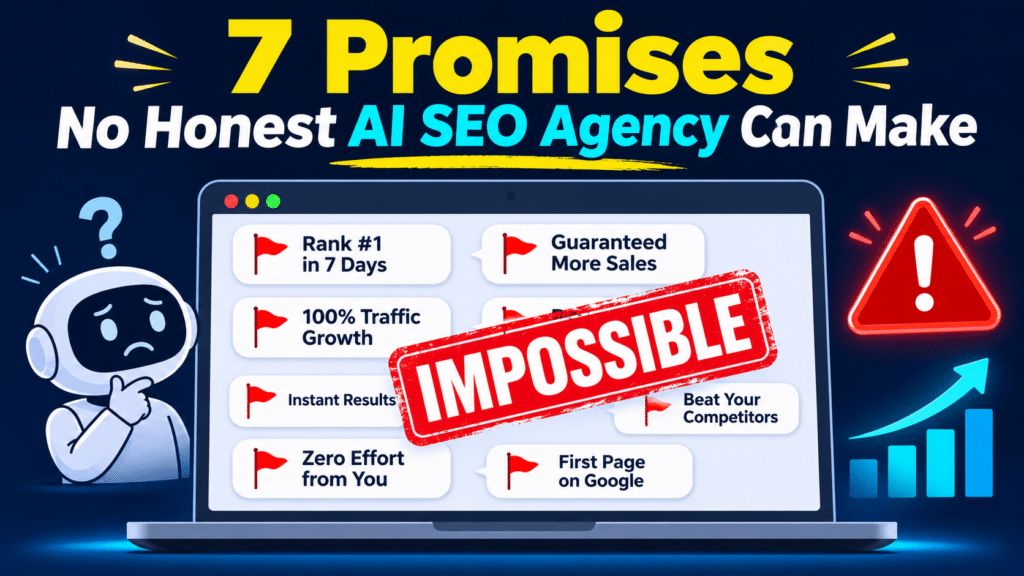
These are the seven AI SEO agency red flags that should end the conversation:
- “We guarantee #1 rankings.”
- “We guarantee citations in AI Overviews, ChatGPT or Perplexity.”
- “You’ll see AI visibility in X days.”
- “We know how Google’s AI chooses its sources.”
- “We’ll publish AI content at scale and it will rank.”
- “We’ll buy you mentions, links or ‘citation packages’.”
- “We’ll make you AI-ready with llms.txt, special schema and chunking.”
For each one, you’ll get what you’ll hear on the call, why it falls apart, what an honest agency says instead, and one question that exposes it. Everything attributed to Google comes from Search Central pages updated between December 2025 and October 2026. Every outside number carries its source and date. Facts checked on November 4, 2026.
Why AI search made inflated promises easier to sell
Classic SEO had one scoreboard: your position on a results page. AI search split that scoreboard into pieces, and the confusion is where overpromising lives.
Google’s AI Overviews and AI Mode don’t simply read the top ten results. Both can use “query fan-out,” which means running a batch of related searches across subtopics and building the answer from what comes back (Google Search Central). Google also says AI Overviews appear only when its systems judge them additive to classic search, so they often don’t trigger at all.
The effect on citations is measurable. In a March 2026 study of 863,000 keyword SERPs and roughly 4 million cited URLs, Ahrefs found that 37.9% of AI Overview citations also appeared in the first ten results. Another 31.2% came from positions 11 to 100, and 31.0% from beyond the top 100 (Ahrefs). The same measurement was around 76% in July 2025, although Ahrefs notes the two aren’t perfectly comparable: it improved its parsing, and Gemini 3 started powering AI Overviews in January 2026.
Read that carefully, because it cuts two ways. Ranking well no longer guarantees you’ll be cited. And because Ahrefs describes AI Overviews as probabilistic, with content and citations that shift from query to query, nobody can promise a specific outcome on a specific day.
This doesn’t make AI search hype. Search Console now has a dedicated Generative AI performance report for Google’s AI features, so it’s a real channel you can measure. Google also frames “AEO” and “GEO” as ordinary SEO from its side, and tells site owners to check any third-party AEO or GEO advice against its official guidance. You can measure this channel. You just can’t buy a guarantee on it.
Red flag 1: “We guarantee #1 rankings”
What you’ll hear: “Page one in 90 days or your money back.” “Guaranteed top three for your main keywords.”
Why it fails. Google’s advice for anyone hiring an SEO is blunt: no one can guarantee a #1 ranking on Google. Rankings come out of Google’s systems, your competitors’ work and what searchers actually do. The agency controls none of that.
So how does an agency ever “deliver” a guarantee? Usually by choosing the finish line carefully. Watch for:
- keywords nobody searches, or your own brand name, counted as wins
- rankings checked from one location, on one device, in a logged-out browser
- a “page one” claim for a phrase so narrow that page one means very little
A #1 position for a zero-volume phrase is a real result. It’s also worth nothing to your business.
There’s a 2026 wrinkle on top of this. The results page itself varies: AI Overviews show up for some queries and not others, so “position 1” is a moving target before you even count personalization.
What an honest agency says instead: “We can’t promise a position. We’ll agree the target queries with you, show the search volume and intent behind each one, set 90-day leading indicators, and report what moved and why.”
Ask this: “Which exact keywords, with what monthly volume and intent, count as success? And what happens to your fee if a core update shifts the results?”
Red flag 2: “We guarantee AI Overview, ChatGPT or Perplexity citations”
What you’ll hear: “We’ll get you cited in ChatGPT.” “Guaranteed AI Overview placement.” Often with a screenshot of a client being named in an answer.
Why it fails. Start with what Google documents. To be eligible as a supporting link in AI Overviews or AI Mode, a page must be indexed and eligible to appear with a snippet, and Google lists no additional requirements. It also warns that meeting every requirement doesn’t mean it will crawl, index or serve the page. If serving isn’t guaranteed, citation can’t be.
Then there’s how generative answers behave. Research on answer engines describes them as non-deterministic: the same query submitted twice can produce a different set of cited sources (arXiv, 2026). Google adds that AI Mode and AI Overviews may use different models and techniques, so the links each one shows will differ. ChatGPT and Perplexity are separate products from separate companies, each with its own retrieval. No single agency holds a contract with all of them.
That’s why the screenshot proves less than it seems. It shows your brand was cited once, on one run, for one phrasing. It says nothing about whether the next hundred runs agree.
What an honest agency says instead: “We’ll build a baseline first: a fixed panel of a few dozen real buyer questions, run repeatedly across each engine, so we can report how often you appear and watch the trend. Our job is to raise that rate, and we’ll show you the data, not a lucky screenshot.”
Ask this: “How many times did you run each prompt, on which dates, across which engines? Can I see the raw log?”
Red flag 3: “You’ll see AI visibility in 60 days”
What you’ll hear: “First AI Overview appearance in six to twelve weeks.” “Traffic uplift by month three.”
Some published agency guides quote windows like that as if they were standard, without showing the data behind them. A window like that is a guess dressed up as a schedule.
Why it fails. SEO timelines depend on things outside the contract: how fast Google recrawls your pages, how competitive the topic is, how strong your site already is. Google notes that recrawling can take anywhere from several days to several months, depending on how often its systems decide a page needs refreshing. And that’s before anyone gets cited.
Fast wins do exist. Fixing a robots.txt block or a broken canonical tag can show movement quickly. But that’s repair, not growth, and it happens early for the simple reason that something was broken.
What an honest agency says instead: a ranged plan with checkpoints. Something like:
- Month 1: technical and indexation fixes, an AI visibility baseline, target topics agreed
- By day 90: leading indicators you can see, such as indexed pages, impressions in Search Console’s Generative AI performance report, and coverage of the sub-questions behind your core topics
- Month 4 onward: citation rate and qualified leads, reported as ranges rather than single numbers
Ask this: “What will we be able to measure at day 30, 60 and 90, and what would make you tell us the plan needs to change?”
Red flag 4: “We know how Google’s AI picks its sources”
What you’ll hear: “Our proprietary AI engine reverse-engineers the algorithm.” “We have a direct line to Google.” “Google-approved GEO methodology.”
Why it fails. Google addresses this head-on. No third-party tool has access to its internal ranking or AI systems, and it tells site owners to be wary of tools that claim to use “internal” Google metrics. Its hiring advice adds a warning about SEOs who claim a special relationship with Google or advertise a “priority submit”.
The Google Partner badge is the usual prop. But Google says advertising with it has no effect on your presence in organic results, so an ads badge tells you nothing about SEO skill.
An agency can have excellent hypotheses and well-run tests, and that’s genuinely valuable. What it can’t have is a view inside Google’s systems. Anyone who pretends otherwise is either confused or selling.
What an honest agency says instead: “Here’s what Google documents, here’s what third-party studies suggest, and here’s what we’ve tested on our own clients. We’ll label each one as fact, evidence or hypothesis.”
Ask this: “Which Google documentation supports this recommendation?” Google itself suggests asking whether an SEO cites official documentation for their advice, and whether their AEO or GEO advice lines up with its guidance.
Red flag 5: “We’ll publish AI content at scale and it will rank”
What you’ll hear: “200 articles a month.” “We’ll cover every long-tail question and every fan-out query.”
Why it fails. This is the red flag with the most direct policy risk. Google’s spam policies define scaled content abuse as generating many pages mainly to manipulate rankings rather than help people, and they list using generative AI tools to produce many pages without adding value as an example. Sites that break the policies may rank lower or not appear in results at all, and manual actions are possible.
Google’s newest guidance targets the AI-era version of the tactic. Creating a separate page for every variation of how people might search, fan-out queries included, mainly to manipulate rankings or generative responses falls under that same policy. Google also says a high page count doesn’t make a site more relevant.
To be fair, Google isn’t against AI-assisted writing. Its guidance says generative AI can help with research and structure, but asks you to fact-check everything by hand, because models predict likely words rather than retrieve facts. What it rewards is “non-commodity” content: first-hand experience and a point of view that a model summarizing existing pages couldn’t produce. Mass production is the opposite of that.
What an honest agency says instead: “We’ll publish fewer pages, each with a named author, original input from you and real editing. AI can speed up research and first drafts, but a person who knows your market owns every page.”
Ask this: “Show me a recent article. Who wrote it, who checked it, what’s original in it, and why is this month’s page count the right number?”
Red flag 6: “We’ll buy you mentions, links or ‘citation packages’”
What you’ll hear: “50 brand mentions a month.” “AI citation package: 20 placements, flat fee.” “High-authority guest posts, guaranteed.”
Why it fails. Google’s link spam policy lists buying or selling links to influence rankings, using automated tools to create links, and paid articles with optimized anchor text. Paid links are fine for advertising as long as they carry the sponsored or nofollow attribute. The policy’s own definition of spam now covers attempts to manipulate generative AI responses in Google Search, so “AI citation packages” sit squarely inside it.
On the AI side, Google says chasing inauthentic mentions isn’t as helpful as it seems, because its generative features rely on the same quality ranking systems and spam defenses as the rest of Search.
Real mentions do matter. They come from being worth mentioning: original data, a useful tool, customers who talk about you, a video that explains something well. Ahrefs, for example, found YouTube to be the most-cited domain in AI Overviews, and in its 75,000-brand study, brand mentions on YouTube correlated most strongly with AI Overview visibility. That’s correlation, not proof, but it points toward earned attention rather than purchased placements.
What an honest agency says instead: “We earn coverage by making something people want to cite: data, expert commentary, tools, partnerships. Every placement is a live URL you can inspect, and sponsored ones are labelled.”
Ask this: “Send me ten live URLs from last month, and tell me the editorial reason each one exists.”
Red flag 7: “We’ll make you AI-ready with llms.txt, special schema and chunking”
What you’ll hear: “Our AI-readiness package: llms.txt, FAQ schema on every page, content chunked for LLMs. Two weeks, fixed price.”
This is the subtlest red flag, because the deliverables sound technical and responsible, and some of them are harmless. The problem is selling a fixed checklist as the strategy before anyone has looked at your site.
Why it fails. Google’s current guide is explicit about what you can ignore for Google Search: llms.txt and similar special files, splitting content into tiny “chunks,” rewriting content only for AI systems, chasing inauthentic mentions, and overfocusing on structured data. There is no special schema.org markup for AI features, although structured data still helps with rich-result eligibility and should match the visible text. Google adds that maintaining an llms.txt file for other systems is fine and will neither help nor harm your Google visibility.
In fairness, if another platform you care about reads llms.txt, a file that takes an hour to write may be worth having. The red flag is the price tag and the framing. Treat it as a side task, never as the strategy.
What a checklist package leaves out is the audit. Is Googlebot allowed to crawl you, including through your CDN? Are your pages indexed and eligible for snippets? Is the content something a model couldn’t produce on its own? If you sell products or serve local customers, are your Merchant Center and Business Profile details current? Google lists these unglamorous items as the foundation, and they come before any file.
What an honest agency says instead: “First an audit, then a prioritized plan. Anything we do ‘for AI’ will be labelled as low-cost and optional, unless we have evidence it matters for your situation.”
Ask this: “What did the audit find on my site that makes this package the right first step?”
Also Read – How to Choose an AI SEO Agency: 12 Questions and Red Flags (2026)
What honest agencies promise instead
Every red flag has an honest twin. Here is the swap in one place.
The promise | Why it breaks | What an honest agency commits to |
|---|---|---|
Guaranteed #1 rankings | Google controls the results; no one can guarantee a position | Agreed target queries, 90-day leading indicators, transparent reporting |
Guaranteed AI citations | Answers vary by run and by engine; serving isn’t guaranteed | A repeatable prompt-panel baseline, with citation rate reported as a range |
Results in a fixed number of days | Crawl and serving timelines sit outside the agency’s control | Checkpoints at 30, 60 and 90 days, with what is measurable at each |
Insider knowledge of Google’s AI | No third-party tool can see Google’s internal systems | Recommendations tied to documentation, tests and labelled hypotheses |
AI content at scale | Scaled content abuse policy; thin pages add risk, not relevance | Fewer expert-led, fact-checked pages with named authors |
Bought mentions and links | Link spam policy; inauthentic mentions don’t help | Earned coverage, live URLs you can inspect, sponsored links labelled |
A fixed “AI-ready” package | Google says llms.txt, chunking and special schema aren’t needed | Audit first, then a plan prioritized to your site |
Questions to ask before you sign
Google’s own hiring advice makes a good starting script. The list below keeps its best questions and adds the AI-era checks.
- Can I see past work and speak to a past client? Google suggests asking for examples and checking business references. Listen for named clients and numbers from the client’s own analytics, not third-party traffic estimates.
- Which Google documentation supports your main recommendations? Listen for specific pages, not “best practice.”
- Will you share every change you make to my site, and the reasoning? Google lists this as a question to ask. A vague answer here is a bad sign.
- How do you measure AI visibility, and how often do you re-run it? Listen for a fixed prompt panel, repeated runs, more than one engine, and ranges instead of single screenshots.
- Who writes, who edits, and who owns my strategy? Listen for named people and a clear review step.
- Who owns the Search Console, Analytics and content accounts? The answer should be you. Google advises granting only read access to Search Console while an audit is being scoped.
- What happens if we stop? Listen for a clear exit, content you own outright, and no data held hostage.
- What would make you tell me not to invest in this right now? An agency that can name a case where SEO isn’t the right move is more likely to be honest about the cases where it is.
FAQ: AI SEO agency promises
Can an SEO agency guarantee a #1 ranking?
No. Google’s hiring guidance says no one can guarantee a #1 ranking, and it warns against anyone claiming a special relationship with Google. An agency can commit to process, evidence and reporting, but not to a position. Treat a ranking guarantee as a reason to end the conversation.
Can anyone guarantee citations in AI Overviews or ChatGPT?
No. Google documents eligibility (indexed and snippet-eligible) but says serving isn’t guaranteed, and research shows answer engines can cite different sources for the same query on different runs. Honest agencies measure citation rate over repeated runs and work to raise it.
Is GEO different from SEO?
For Google Search, Google treats optimizing for generative AI features as SEO, and says the same fundamentals apply. Platforms like ChatGPT and Perplexity run on their own systems, and the public evidence on what moves citations there is thinner. A good agency separates what’s documented from what it has tested.
Do I need llms.txt or special schema to appear in AI Overviews?
No. Google says AI Overviews and AI Mode have no extra technical requirements and no special schema, and that Google Search ignores llms.txt. Structured data is still useful for rich results. Don’t pay a premium for either as an “AI-ready” package.
How long does AI SEO take?
It depends on your starting point, your competition and how quickly Google recrawls your pages, which Google says can take days to months. Fixes tend to show first and citations later. A credible plan gives 30-, 60- and 90-day checkpoints instead of a delivery date.
Is AI-written content safe for SEO?
It can be, when a person adds expertise, checks the facts and publishes because the page helps readers. Google’s spam policy targets using generative AI to produce many pages without adding value. A few well-edited pages are safer than hundreds of thin ones.
How do I measure AI visibility honestly?
Use the Generative AI performance report in Search Console for Google, plus a fixed panel of real buyer questions run repeatedly on the engines you care about. Report the share of runs where you appear, as a range, with dates. A single screenshot is an anecdote.
The takeaway
All seven red flags share one shape: a promise about an outcome somebody else controls. Google controls the rankings. The AI engines control the citations. Crawl schedules, competitors and searcher behavior control the timeline.
Strong agencies promise what they can actually own: a real audit, careful work, clear labels on what’s fact and what’s hypothesis, and reporting that includes the awkward months. So before you sign, run every promise through one filter: does this stay inside what the agency controls? If it doesn’t, you’ve found your red flag.