

Introduction
Pakistan’s construction industry faces unique challenges. From the humid coastal air of Karachi to the extreme temperatures of Punjab, from the monsoon rains that test every seal to the dusty winds that penetrate every gap — buildings in this country need protection that ordinary materials cannot provide.
For decades, contractors relied on traditional methods to seal gaps and insulate cavities. Cement mortar cracked and fell out. Fiberglass settled and lost effectiveness. Basic caulks shrank and pulled away from surfaces. The result was constant maintenance, escalating energy costs and frustrated clients.
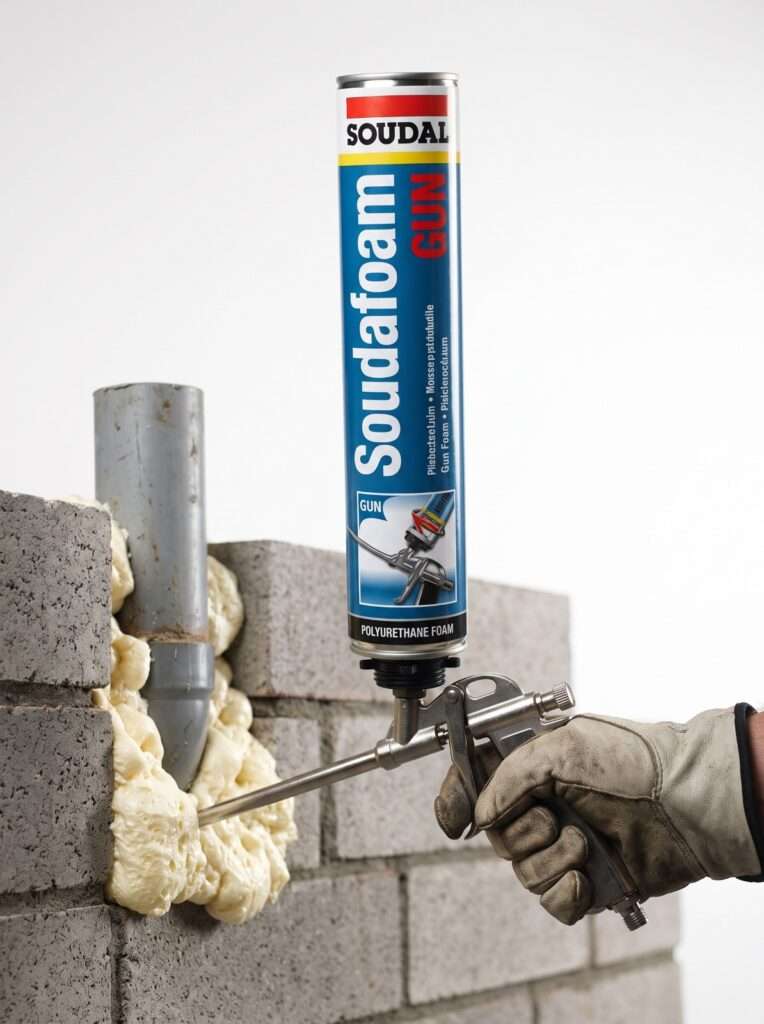
Then came polyurethane foam technology. Soudafoam, manufactured by Soudal and available through PATSA Pakistan, has transformed how professionals approach gap filling, insulation and weather sealing. This one-component, moisture-curing foam has become the gold standard for contractors who demand reliability in every season and every climate.
This comprehensive guide examines Soudafoam’s capabilities, applications and performance characteristics based on its official technical data sheet. Whether you are a contractor working on a high-rise in Karachi, a builder constructing homes in Lahore or a maintenance professional protecting industrial facilities, this article will help you understand why Soudafoam is the preferred choice for weather sealing and insulation across Pakistan.
The Evolution of Gap-Filling Technology
Before the development of modern polyurethane foams, filling gaps and cavities was a frustrating exercise in compromise.
Cement mortar was the traditional choice. It was cheap and familiar, but it cracked as buildings settled and moved. Every crack was an invitation for water penetration and every winter freeze expanded those cracks further. Within a few years, mortar joints needed replacement.
Fiberglass insulation was another option. It provided decent thermal performance initially, but gravity caused it to settle over time. What started as a full cavity became empty at the top, with air flowing freely through the void.
Caulks and putties worked for small gaps but could not fill deep cavities. They shrank as they cured, pulling away from surfaces and creating new gaps.
Soudafoam solved all these problems through its unique combination of expansion, adhesion and stability. When applied, it expands to fill every corner of any cavity, no matter how irregular. It adheres firmly to most common building materials. And after curing, it remains stable with minimal shrinkage and no post-expansion.
Understanding the Chemistry of Soudafoam
Soudafoam belongs to a class of materials called moisture-curing polyurethanes. The chemistry behind this product is elegant in its simplicity.
Inside the sealed can, the foam exists as a stable liquid containing reactive polymers. The absence of moisture keeps these polymers inactive. The moment the foam is dispensed, it contacts moisture present on surfaces and in the air. This moisture triggers a chemical reaction called polymerization, where individual molecules link together to form long chains.
This reaction produces two simultaneous effects. First, the material expands dramatically — a 750 ml can produce approximately 28 liters of cured foam, an expansion of nearly 40 times. Second, the material transforms from a liquid to a solid, flexible foam with a fine, uniform cell structure.
The result is a material that fills every irregularity of the cavity while providing excellent thermal and acoustic insulation.
Technical Performance Characteristics
The official technical data sheet provides specific performance numbers that define Soudafoam’s capabilities.
Density and Weight: The cured foam has a density of approximately 27 kilograms per cubic meter. This low density explains the remarkable expansion ratio and contributes to the product’s exceptional insulating properties.
Curing Timeline: Skin formation occurs at 10 minutes, meaning the outer surface becomes tack-free and can be touched. Cutting time is 25 minutes, when excess foam can be trimmed cleanly. Full cure depth varies with conditions but typically reaches approximately 25 millimeters within 24 hours.
Thermal Insulation: With a thermal conductivity of 0.037 W/m·K, Soudafoam ranks among the best insulating materials available. This low conductivity means heat flows slowly through the foam, keeping buildings cooler in summer and warmer in winter.
Acoustic Performance: The 58 dB sound insulation rating means Soudafoam significantly reduces noise transmission through filled cavities. This makes it valuable for multi-family buildings, home theaters and any space where sound control matters.
Mechanical Strength: Compression strength of approximately 21 kPa, shear strength of approximately 33 kPa and tensile strength of approximately 79 kPa provide useful mechanical performance for most construction applications.
Dimensional Stability: Why It Matters for Weather Sealing
Two specifications in the TDS are particularly important for long-term weather sealing performance.
Shrinkage after curing is less than 2 percent. This means a 50 millimeter thick fill will shrink by less than 1 millimeter. The foam maintains contact with surrounding surfaces, preserving the weather seal.
Post-expansion is none. Some competing foams continue expanding after curing, putting pressure on window frames and door jambs. This pressure can cause distortion, sticking and even cracking of surrounding materials. Soudafoam’s zero post-expansion eliminates this risk.
These stability characteristics ensure that weather seals remain intact through countless thermal cycles, from winter cold to summer heat, without compromising the building envelope.
The Importance of Moisture in Curing
The curing reaction requires moisture. Without adequate moisture, the foam will not cure properly and may remain soft or sticky indefinitely.
The TDS addresses this directly: “Moisten surfaces with a water sprayer prior to application.” This step is essential for successful results, particularly in Pakistan’s sometimes dry conditions.
For deep cavities requiring multiple layers, the TDS instructs: “If you have to work in layers repeat moistening after each layer.” Each layer needs its own moisture supply to cure properly.
The moisture requirement explains why foam applied in very dry conditions sometimes fails to cure. The solution is simple: spray water on surfaces before applying foam. This small step ensures proper curing and optimal performance.
UV Vulnerability and Protection Requirements
One limitation in the TDS is critical: Soudafoam is not UV-resistant. Prolonged exposure to direct sunlight causes the foam to degrade, turning yellow, becoming brittle and eventually crumbling.
This does not mean the foam cannot be used outdoors. It simply means that any foam exposed to sunlight must be protected. The TDS lists three acceptable protection methods:
1. Overpainting with exterior-grade paint
2. Sealing with a weatherproof sealant (silicone, polyurethane, acrylic or hybrid polymer)
3. Covering with a physical barrier
In window and door installations, the foam is typically covered by trim, casing or plaster, providing natural UV protection. For exposed applications, proper protection is essential to maintain the weather seal.
Yield and Coverage for Project Planning
One 750 ml can produces approximately 22 linear meters of bead or 28 liters of expanded foam. These numbers allow accurate material estimation for any project.
Practical examples help illustrate coverage:
· Window and door installation: Typical gaps of 10–20 mm wide by 30–50 mm deep. One can fills approximately 8–12 standard windows depending on frame size.
· Pipe penetration sealing: A 100 mm pipe through a 150 mm hole creates approximately 1 liter of annular volume. One can fills approximately 28 penetrations.
· Cavity wall insulation: A 50–100 mm cavity. One can fills approximately 0.5–1 square meter of wall area.
These figures help contractors order the right quantity for any job.
Application Temperature Guidelines
Successful application requires proper temperatures. The TDS specifies three separate temperature ranges:
Can temperature: 5°C to 30°C. If the can has been stored in cold conditions, warm it to room temperature before use.
Ambient temperature: 5°C to 35°C. Cold air slows curing; hot air accelerates it.
Surface temperature: 5°C to 35°C. Cold surfaces can cause uneven curing; hot surfaces can cause excessive expansion.
The cured foam withstands temperatures from -40°C to +90°C, covering every practical condition in Pakistan.
Applications Across Pakistan
In Karachi’s coastal environment, Soudafoam seals gaps around windows and doors against humid air and monsoon rains. It fills cavities in coastal structures to prevent condensation and mold.
In Lahore’s urban development, it insulates cavity walls to reduce air conditioning costs. It seals around pipes and conduits to prevent air leakage.
In Islamabad’s modern architecture, it provides acoustic sealing between apartments and offices. It fills gaps in curtain wall construction to maintain the building envelope.
In industrial facilities, it seals around mechanical penetrations, insulates cooling systems and fills gaps in structural assemblies.
In residential construction, it provides weather sealing around windows and doors, fills gaps in framing and insulates exterior walls.
Storage and Shelf Life
Unopened cans of Soudafoam have a shelf life of 24 months when stored in a cool, dry location between 5°C and 25°C.
Heat is the enemy. Storage in hot warehouses, vehicles or direct sunlight can reduce shelf life dramatically. The propellant pressure increases with temperature, stressing the can seal.
The Duravalve system allows cans to be stored in any orientation, but upright storage is recommended for convenience.
Frequently Asked Questions (FAQs)
Q1: Can I use Soudafoam for soundproofing?
A: Yes, its 58 dB sound insulation rating makes it effective for acoustic applications.
Q2: How does Soudafoam cure?
A: It cures by reacting with moisture in the air and on surfaces. The chemical reaction transforms the liquid foam into a solid, flexible foam.
Q3: How long does it take to form a skin?
A: Skin formation occurs within 10 minutes at standard conditions (23°C and 50% RH).
Q4: When can I cut the foam?
A: Cutting time is 25 minutes according to EN 17333–3 testing.
Q5: What is the thermal conductivity of Soudafoam?
A: The thermal conductivity is 0.037 W/m·K, making it an excellent insulator.
Conclusion
Soudafoam has established itself as a leading polyurethane foam solution for the Pakistani construction market. Its combination of exceptional expansion, strong adhesion and superior insulation properties makes it invaluable for professionals who demand quality and reliability.
From the humid coastal areas to the extreme temperature variations across the country, Soudafoam delivers consistent performance when properly applied. Its ability to fill irregular cavities, provide thermal and acoustic insulation and maintain dimensional stability makes it a versatile solution for countless applications.
For contractors, builders and maintenance professionals working with Patsa Pakistan, Soudafoam offers the performance and dependability that professional jobs require.
Call to Action
For more information about Soudafoam or to locate an authorized dealer, contact Patsa Pakistan directly.