
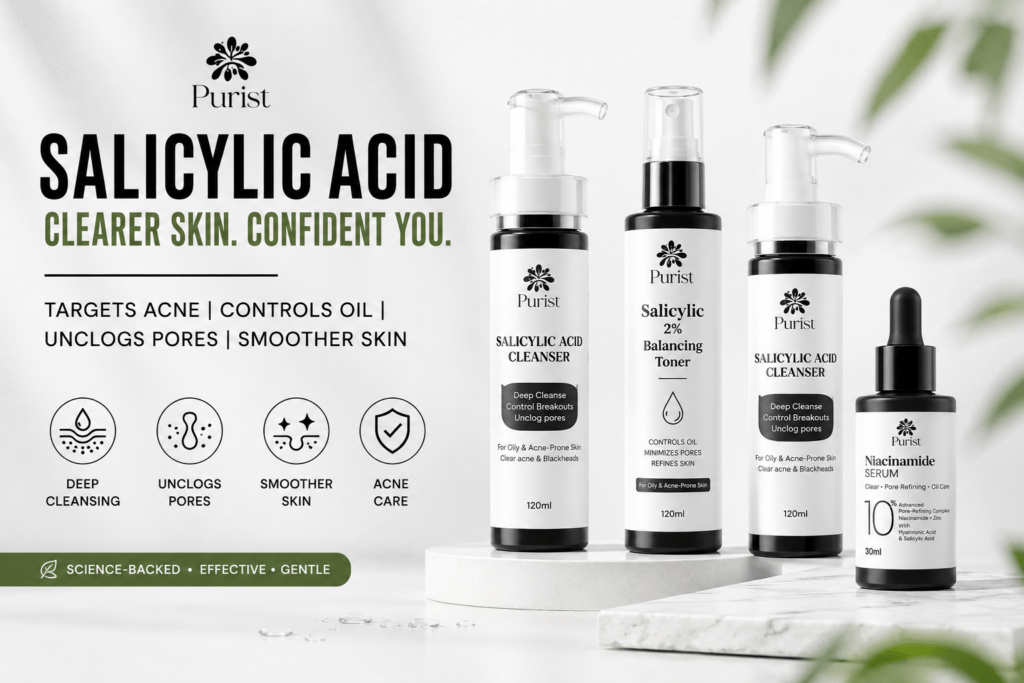

Salicylic Acid is one of the most widely used skincare ingredients for acne, clogged pores, blackheads, and oily skin. It belongs to the beta hydroxy acid (BHA) family and is known for its ability to exfoliate the skin and help clear buildup from pores.
Unlike physical scrubs, Salicylic Acid chemically exfoliates dead skin cells, making it a popular choice for people who experience congestion and recurring breakouts.
What Is Salicylic Acid?
Salicylic Acid is a keratolytic ingredient that helps loosen dead skin cells and excess buildup. Because it is oil-soluble, it can work within pores where sebum and dead skin cells can accumulate.
According to the American Academy of Dermatology (AAD), Salicylic Acid helps unclog pores and exfoliate the skin and is particularly useful for whiteheads and blackheads. [1]
This makes it especially relevant for oily and acne-prone skin.
Salicylic Acid Benefits for Skin
Helps Unclog Pores
Dead skin cells and excess oil can contribute to clogged pores. Salicylic Acid helps remove this buildup, supporting cleaner-looking pores and smoother skin.
Helps Reduce Blackheads and Whiteheads
Salicylic Acid is particularly useful for comedonal acne. Regular use can help reduce the buildup responsible for blackheads and whiteheads.
Supports Acne-Prone Skin
Clinical evidence supports topical Salicylic Acid as one option for managing mild acne. The AAD includes Salicylic Acid among recommended topical acne treatments. [1]
Helps Improve Skin Texture
By removing accumulated dead skin cells, Salicylic Acid can help skin feel smoother and appear more refined.
Helps Manage Excess Oil
Its exfoliating action can help remove excess oil and impurities from the skin, making it a popular ingredient in products formulated for oily and combination skin.
What Does Research Say About 2% Salicylic Acid?
The commonly seen 2% concentration isn’t simply a marketing number.
The U.S. FDA’s over-the-counter acne monograph recognizes Salicylic Acid in concentrations from 0.5% to 2% for topical acne products. [2]
Clinical research has also investigated 2% Salicylic Acid formulations.
A 2024 randomized clinical trial involving 500 people with mild-to-moderate facial acne compared a 2% supramolecular Salicylic Acid hydrogel with adapalene. After 12 weeks, marked improvement or regression was reported in 51.01% of participants using the Salicylic Acid treatment, compared with 43.10% in the adapalene group. The difference was not statistically significant, so the study does not prove Salicylic Acid was superior. [3]
The important takeaway is simpler: 2% Salicylic Acid has been studied clinically and can provide meaningful improvement for mild-to-moderate acne.
Who Can Use Salicylic Acid?
Salicylic Acid may be particularly helpful for people dealing with:
- Oily or combination skin
- Blackheads
- Whiteheads
- Clogged pores
- Mild acne
- Uneven skin texture
- Excess oil and shine
People with dry or sensitive skin can sometimes use it too, but introducing it gradually is important.
If your skin becomes excessively dry, irritated, burning, or uncomfortable, reduce the frequency of use.
Salicylic Acid Face Wash vs Serum
Salicylic Acid comes in different formulations, and the best choice depends on your skin and routine.
A Salicylic Acid Face Wash is rinsed off and can be an easier starting point for people who want to introduce BHA into their routine.
A Salicylic Acid Serum remains on the skin longer and provides prolonged contact with the ingredient. It may be more suitable for people specifically targeting persistent congestion or breakouts.
The concentration isn’t the only factor that matters. Formulation, pH, contact time, and how frequently the product is used can all influence how the skin responds.
How to Use Salicylic Acid Safely
Start according to the product’s instructions rather than assuming you need daily application.
Avoid immediately combining Salicylic Acid with multiple strong exfoliants or active ingredients. Excessive exfoliation can cause dryness and irritation.
A simple routine can include:
Morning: Cleanser → Moisturizer → Sunscreen
Evening: Cleanser → Salicylic Acid treatment → Moisturizer
Consistency is more important than using the ingredient aggressively.
Is Salicylic Acid Safe?
Salicylic Acid has a long history of cosmetic and dermatological use. However, more does not mean better.
The Cosmetic Ingredient Review concluded that Salicylic Acid and related salicylates are safe for use in cosmetics under specified conditions. [4]
Irritation can still occur, particularly when products are used too frequently or combined with other irritating ingredients.
People with persistent, severe, painful, or scarring acne should consult a dermatologist rather than relying solely on cosmetic skincare.
Final Thoughts
Salicylic Acid remains one of the most useful ingredients for oily and acne-prone skin because it targets one of the central problems behind clogged pores: the buildup of oil and dead skin cells.
Research supports its use, particularly for blackheads, whiteheads, and mild acne, while the 0.5%–2% range is widely recognized for topical acne products.
The best results don’t come from using the strongest product possible. They come from choosing an appropriate formulation, introducing it gradually, moisturizing consistently, and giving your routine enough time to work.
References
[1] American Academy of Dermatology — Acne Clinical Guidelines
https://www.aad.org/news/updated-guidelines-acne-management
[2] U.S. Food & Drug Administration — OTC Monograph M006, Topical Acne Drug Products
https://www.accessdata.fda.gov/drugsatfda_docs/omuf/monographs/OTC%20Monograph_M006-Topical%20Acne%20drug%20products%20for%20OTC%20Human%20Use%2011.23.2021.pdf
[3] Ye CX, et al. Journal of Cosmetic Dermatology — 2% Supramolecular Salicylic Acid Hydrogel for Mild-to-Moderate Acne, 2024
https://pubmed.ncbi.nlm.nih.gov/38590107/
[4] Cosmetic Ingredient Review — Safety Assessment of Salicylic Acid and Salicylates
https://www.cir-safety.org/sites/default/files/salicy042019FAR.pdf