
PRP Hair Treatment in Islamabad | Hair Loss & Restoration Guide
Hair loss and thinning hair can affect both appearance and confidence. While hair fall is common, noticeable thinning, receding hairlines, and reduced hair density can become a concern when they continue over time. Today, people looking for non-surgical options for hair restoration have several treatments to consider, and PRP hair treatment in Islamabad is one of the increasingly discussed approaches.
PRP, or Platelet-Rich Plasma therapy, uses components from a person’s own blood and is designed to support the scalp and hair follicles. It is a minimally invasive procedure that does not involve a traditional hair transplant. For people experiencing certain types of hair thinning or early-stage hair loss, PRP therapy may be considered as part of a personalized hair restoration plan.
What Is PRP Hair Treatment?
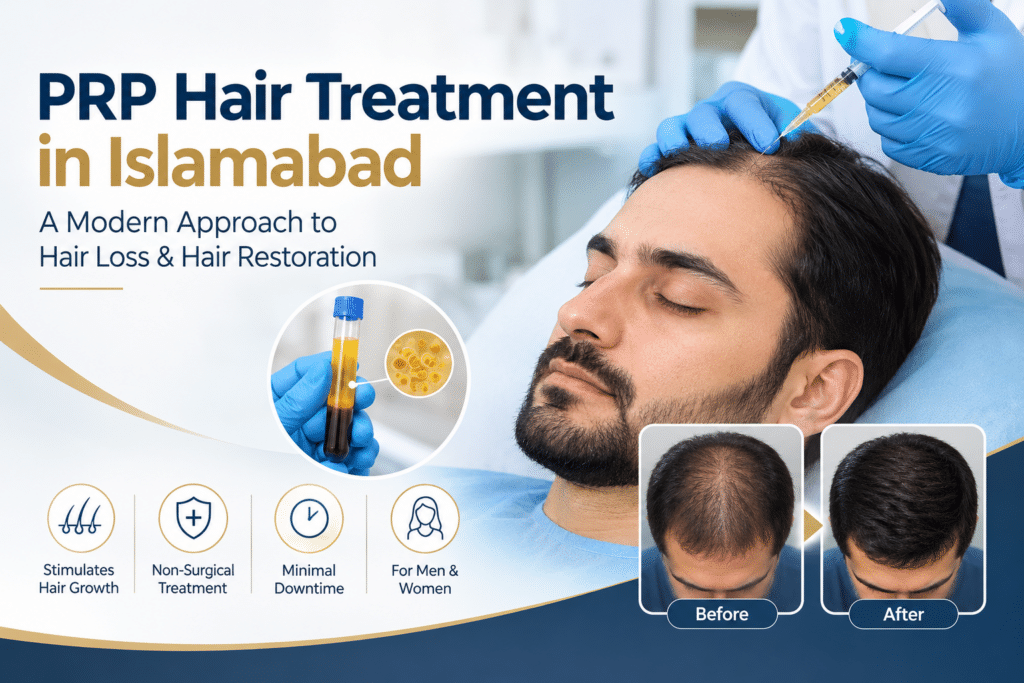
PRP stands for Platelet-Rich Plasma. During the treatment, a small amount of the patient’s blood is collected and processed to separate the platelet-rich plasma from other blood components. The concentrated plasma contains growth factors that may support tissue repair and regeneration.
For hair treatment, the prepared PRP is injected into selected areas of the scalp. The goal is to support the environment around hair follicles and encourage healthier-looking hair growth and density.
The exact preparation technique, concentration, injection method, and treatment plan can vary between practitioners. Therefore, consultation with a qualified medical professional is important before starting treatment.
How Does PRP Therapy Work for Hair Loss?
PRP hair therapy is based on the regenerative properties of platelets and their associated growth factors. After the PRP is prepared, it is carefully administered into areas of the scalp affected by thinning hair.
The treatment is intended to support existing hair follicles rather than physically transplanting new follicles. This makes PRP different from procedures such as FUE or FUT hair transplantation.
According to the information published by Royal Cosmetic Surgery, its PRP procedure involves drawing a blood sample, processing it through a centrifuge, and administering the concentrated plasma to the treatment area. The clinic describes the procedure as a non-surgical approach to hair restoration.
Who May Consider PRP for Hair Loss?
PRP may be considered by people experiencing hair thinning, reduced hair density, or certain forms of early-stage hair loss. Both men and women may be candidates, depending on the underlying cause and condition of their hair.
A consultation is important because hair loss can have many different causes. Genetics, hormonal changes, nutritional issues, medical conditions, medications, stress, and scalp disorders can all contribute to hair loss.
A professional assessment can help determine whether PRP is appropriate or whether another treatment or combination approach would be more suitable.
Benefits of PRP Hair Treatment
One of the main reasons people search for PRP treatment for hair loss is that it is a non-surgical treatment option. Unlike a traditional hair transplant, PRP does not require removing and relocating hair follicles.
Potential advantages of PRP hair therapy include:
Non-surgical approach to hair restoration
Uses the patient’s own blood components
Minimal downtime compared with surgical procedures
May support existing weakened hair follicles
Can be used for certain cases of thinning hair
Suitable for both men and women when clinically appropriate
Natural-looking improvement when successful
Can potentially be incorporated into a broader hair-loss treatment plan
The Royal Cosmetic Surgery service page describes PRP as a minimally invasive treatment with limited downtime and notes that it may help improve hair thickness and density.
What Happens During a PRP Hair Treatment Session?
A typical PRP hair treatment begins with an assessment of the scalp and hair-loss pattern. A small blood sample is then collected from the patient.
The blood is processed using a centrifuge to separate the platelet-rich plasma. Once the PRP is prepared, it is administered to selected areas of the scalp using injections.
Royal Cosmetic Surgery states that its PRP hair procedure generally takes around 60–90 minutes, although treatment time can vary depending on the individual and the clinic’s technique.
Some patients may experience mild discomfort during injections. A practitioner may use a numbing or anesthetic method to improve comfort during the procedure.
How Many PRP Sessions Are Needed?
There is no single treatment schedule that works for everyone. The number of sessions depends on factors such as the degree and cause of hair loss, the patient’s response to treatment, and the medical professional’s assessment.
The Royal Cosmetic Surgery page states that patients may require a series of treatments and describes a commonly recommended course of approximately 3–4 sessions, with intervals between sessions.
It is important not to assume that more sessions automatically mean better results. A personalized treatment plan should be developed after examining the scalp and discussing the patient’s goals.
When Can You See Results From PRP?
PRP hair treatment is not an instant solution. Hair follicles need time to respond, and changes in hair density or thickness can take several months.
The clinic’s published information indicates that noticeable changes may develop over approximately 3–6 months, although individual results can vary.
Results can depend on the cause of hair loss, the condition of the follicles, age, general health, treatment protocol, and consistency with recommended sessions and aftercare.
For this reason, people considering PRP hair restoration in Islamabad should have realistic expectations and discuss potential outcomes with their practitioner before treatment.
PRP Hair Treatment Cost in Islamabad
The cost of PRP treatment can vary considerably depending on the clinic, practitioner, treatment protocol, number of sessions, and individual requirements.
Royal Cosmetic Surgery currently publishes a price range of approximately PKR 10,000 to PKR 25,000 per PRP session for hair, while noting that the final cost can vary according to the patient’s needs and treatment plan.
Because prices can change, prospective patients should confirm the latest treatment cost directly with the clinic before booking an appointment.
PRP vs. Hair Transplant
PRP and hair transplantation are different treatments.
PRP is designed to support existing hair follicles and may be considered for certain types of thinning or early hair loss. A hair transplant, on the other hand, involves surgically moving hair follicles from a donor area to areas where hair has been lost.
Therefore, PRP should not automatically be viewed as a replacement for a hair transplant. In some situations, a medical professional may recommend PRP alone, while in other cases a patient may benefit from a different procedure or a combination of treatments.
The most appropriate option depends on the individual’s hair-loss pattern, available donor hair, follicle condition, and treatment goals.
Aftercare Following PRP Hair Therapy
Following your practitioner’s aftercare instructions can help support the treatment process. The clinic recommends avoiding hair washing for approximately 24 hours after treatment and avoiding certain hair products for at least 48 hours. It also advises avoiding harsh chemical treatments and excessive sun exposure for a period after the procedure.
Patients should always follow the specific instructions provided by their treating professional because aftercare recommendations may differ depending on the treatment protocol and individual circumstances.
Is PRP Hair Treatment Right for You?
If you are experiencing hair thinning, excessive hair fall, or a receding hairline, PRP may be worth discussing with a qualified hair-restoration professional. However, the treatment should begin with an assessment rather than simply choosing a procedure based on an online search.
A consultation can help identify the possible cause of hair loss and determine whether PRP, medication, hair transplantation, lifestyle changes, or another treatment may be appropriate.
For people searching for PRP hair treatment in Islamabad, choosing a clinic with experienced medical professionals and discussing realistic expectations can be an important part of the decision-making process.
Final Thoughts
PRP hair treatment is a modern, non-surgical approach that may help support hair density and the health of existing hair follicles in suitable candidates. Its use of platelet-rich plasma from the patient’s own blood makes it different from surgical hair restoration procedures.
If you are considering PRP therapy for hair loss, the best starting point is a professional consultation. Your hair-loss pattern, scalp condition, treatment goals, and medical history should all be considered before creating a treatment plan.
For those exploring treatment options in the capital, PRP hair treatment in Islamabad can be discussed with the team at Royal Cosmetic Surgery to determine whether it is suitable for their individual hair-restoration goals.