
Why the Bonding Layer Matters
In an embedded membrane system, each layer has one job. The membrane provides the waterproof barrier. The adhesive anchors that barrier to the structure.
A good bonding layer must do three things:
- Wet the fleece completely, so the membrane is locked in mechanically, not just stuck on the surface.
- Hold strongly to concrete, even when the surface is damp.
- Survive constant moisture, because waterproofing lives in wet conditions by definition.
In Hydrobloc’s own words, RF Adhesive acts as the bonding and anchoring layer, while the Geocomp membrane provides the primary waterproofing barrier.
Key features and benefits
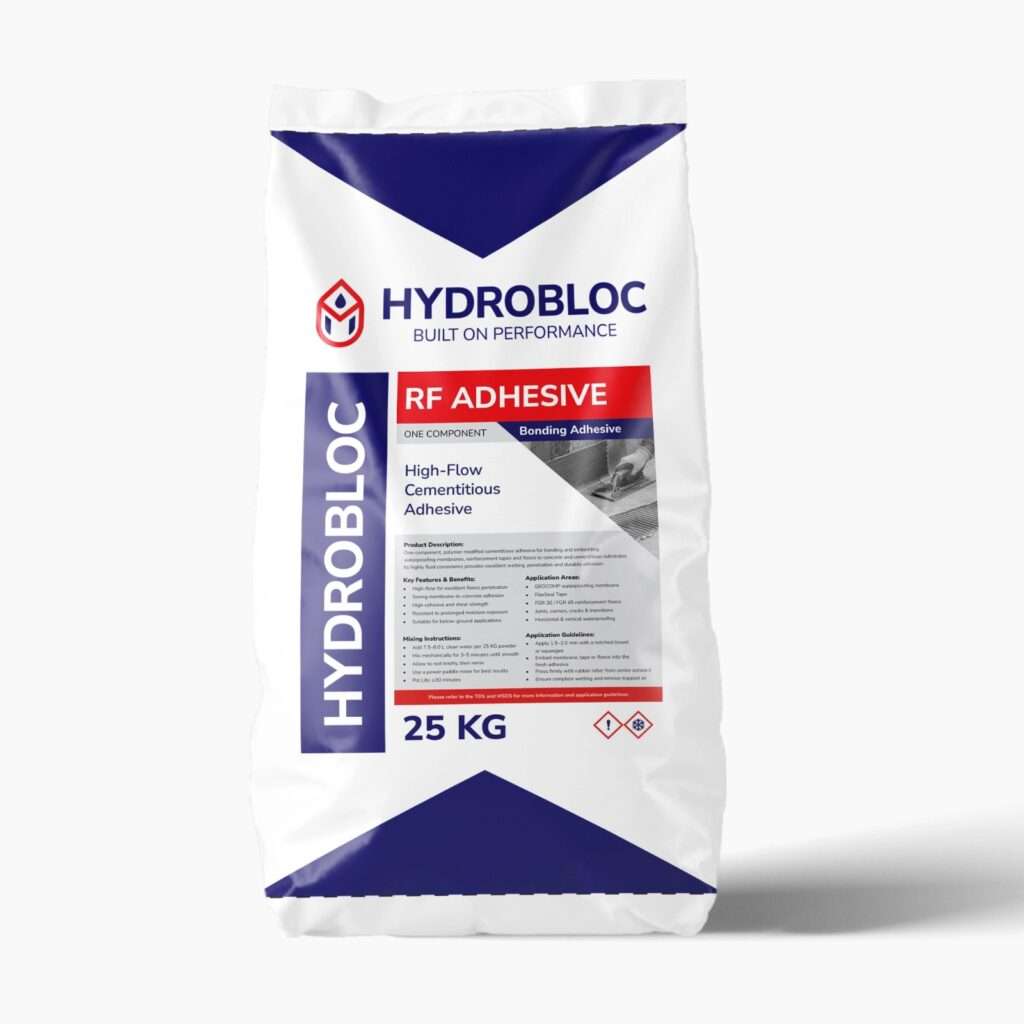
- High-flow formulation for excellent fleece penetration
- Strong membrane-to-concrete adhesion (tensile adhesion to concrete ≥ 1.0 MPa)
- High cohesive and shear strength
- Suitable for vertical applications
- Holds membranes and reinforcement securely
- Can be used beneath plaster, render and tile systems
- Good resistance to prolonged moisture
- Suitable for below-ground and moisture-exposed areas
- Simple to apply with a notched trowel or squeegee
What RF Adhesive Bonds
Hydrobloc RF Adhesive is designed to work with:
- Geocomp composite waterproofing membrane
- Hydrobloc Flex-Seal tape, for joints and transitions
- FGR 30 / FGR 45 reinforcement fleece
Typical locations include joints, corners, cracks and transitions, horizontal and vertical waterproofing, below-ground construction, and moisture-exposed and coastal applications. For Karachi and other coastal sites, its resistance to prolonged moisture is especially relevant.
Step-by-Step Installation
Step 1: Prepare the surface
The substrate must be sound and clean. Remove dust and loose material, cement laitance, oil, grease and any other contaminant that could weaken adhesion.
Damp or SSD (saturated surface dry) surfaces are acceptable. This is useful on basement walls and below-ground work where a fully dry surface is hard to achieve. Remove any standing water before you start.
Step 2: Mix
- For each 25 kg bag, measure about 7.5–8.0 litres of clean water.
- Add the powder to the water gradually while mixing mechanically. A power paddle mixer gives the best result.
- Mix for 3–5 minutes into a smooth, uniform slurry.
- Let it rest briefly, then remix.
- Use within the pot life of at least 30 minutes. Heat and humidity can change this, so mix only what you can place.
Step 3: Apply the adhesive
Spread the adhesive at about 1.5–2.0 mm thick using a notched trowel or squeegee. Work in areas small enough to cover with membrane while the adhesive is still fresh.
Step 4: Embed the membrane, tape or fleece
- Place the membrane, tape or fleece into the fresh adhesive immediately.
- Press it firmly with a rubber roller, working from the centre outward.
- Make sure the fleece is fully wetted and in full contact with the adhesive.
- Remove wrinkles, trapped air and unbonded spots.
Step 5: Protect and cure
Protect the fresh adhesive and the installed system from conditions that could affect curing or adhesion. Make sure the installation is properly cured before other trades work on it or finishes are applied.
Frequently Asked Questions
Q) What is Hydrobloc RF Adhesive used for?
It bonds and embeds waterproofing membranes, reinforcement tapes and fleece, such as Geocomp, Hydrobloc Flex-Seal and FGR 30/45, to concrete and cementitious surfaces.
Q) Is RF Adhesive itself a waterproofing product?
It is the bonding and anchoring layer. The membrane, such as Geocomp, provides the main waterproof barrier.
Q) Can I apply it on a damp surface?
Yes. Damp or SSD surfaces are acceptable, but standing water must be removed.
Q) Can RF Adhesive be used on walls?
Yes, it is suitable for vertical applications. If tiles or plaster go on top, the full assembly must be designed for that weight.
Q) How much water do I add?
About 7.5–8.0 litres per 25 kg bag, mixed for 3–5 minutes with a power paddle mixer.
Conclusion
The best waterproof membrane in Pakistan will still leak if it is not bonded properly. Hydrobloc RF Adhesive gives contractors a reliable, high-flow cementitious bonding layer that fully wets fleece, grips damp concrete and holds up in wet, below-ground and coastal conditions. Mix it right, apply 1.5–2.0 mm, roll from the centre and let it cure. Order Hydrobloc RF Adhesive, pair it with the Geocomp Membrane System, or WhatsApp the PATSA team on +92 300 2288788 for site support.