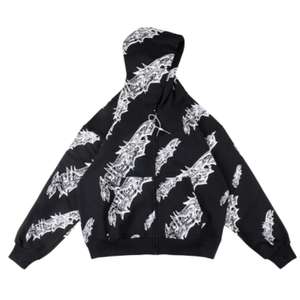

Hellstar clothing has become one of the most recognizable names in modern streetwear. The Los Angeles label appeared in 2020 and quickly developed a following around its intense graphics, distinctive imagery, limited releases, and connection to contemporary music culture. What started as a small creative project has grown into a much larger fashion business with collaborations involving major names such as Adidas, Avirex, and WWE.
But popularity alone does not explain the Hellstar phenomenon.
The brand has created something more difficult to reproduce: anticipation. A new Hellstar release can become a talking point before the clothing even reaches customers. Its pieces appear in music culture, streetwear communities, social feeds, and fashion events. At the same time, limited capsules make certain garments difficult to obtain, adding another layer of desirability.
So, why is Hellstar clothing so popular?
The answer comes down to several elements working together.
1. Hellstar Has a Distinctive Visual Identity
One of the biggest reasons behind Hellstar’s popularity is its unmistakable aesthetic.
The brand does not rely on subtle branding. Its clothing often features large graphics, flames, celestial imagery, distressed treatments, dramatic lettering, and dark visual themes. These elements give Hellstar garments an immediately recognizable appearance.
That recognition is extremely valuable in streetwear.
When someone sees a heavily graphic Hellstar hoodie or T-shirt, the garment can often be identified without needing to see a large traditional logo. The artwork becomes part of the branding.
Hellstar’s co-founder Sean “Seanie” Holland has described the brand’s early approach as deliberately more aggressive and visually prominent compared with some of the calmer branding that dominated the market at the time. Complex reported that bold flame graphics and acid-washed sweats became important characteristics of the label.
This visual consistency has helped Hellstar establish its own territory rather than blending into the enormous streetwear landscape.
2. Limited Drops Create Strong Demand
Scarcity is another major reason Hellstar clothing attracts attention.
Instead of making every item continuously available, Hellstar has historically built much of its business around capsule releases. When a particular collection disappears, customers cannot always assume that the same piece will simply return next month.
That changes how people shop.
A normal clothing item can remain on a wish list for weeks. A limited Hellstar release creates a different kind of urgency. Customers know that waiting could mean missing the opportunity completely.
The strategy has produced some remarkable results.
Complex reported that Hellstar’s tenth capsule generated approximately $2 million in sales within only 30 minutes. That release became one of the defining moments in the brand’s growth and helped turn the drop itself into part of Hellstar’s mythology.
The psychology is straightforward: limited supply can make demand feel even stronger.
3. Hellstar Became Connected With Music Culture
Streetwear and music have always shared a close relationship.
Hellstar benefited from that connection early in its development. According to Complex, early supporters included figures such as FaZe Banks and Young Thug, while one of the brand’s early successful designs featured Dennis Rodman imagery.
This type of cultural exposure can be more powerful than conventional advertising.
When clothing appears naturally around artists, producers, athletes, and other influential figures, it becomes part of a larger lifestyle rather than simply another product being promoted.
Hellstar’s aesthetic also fits naturally into contemporary hip-hop culture. The oversized silhouettes, striking graphics, athletic references, and darker imagery can work well with the visual language surrounding modern rap.
As more people encountered the brand through music and social media, Hellstar became easier to recognize.
4. The Clothing Makes a Statement
Hellstar clothing is not designed to disappear into an outfit.
A Hellstar hoodie can become the centerpiece of an entire look. The same applies to a graphic T-shirt, pair of sweatpants, or track jacket. The artwork often carries enough visual weight to make the garment immediately noticeable.
That quality appeals to people who use clothing as a form of expression.
Streetwear is not only about comfort or practicality. It can communicate personality, interests, attitude, and cultural affiliation. Hellstar’s graphics give wearers an easy way to create that kind of visual statement.
The brand’s approach is also somewhat polarizing, which can actually strengthen recognition.
Some people may find the graphics aggressive or unconventional. Others find that exact quality appealing. Either way, the garment creates a reaction.
In an overcrowded fashion market, being memorable is an advantage.
5. Hellstar Has Built a Strong Community
Popularity becomes more durable when customers feel connected to a community.
Hellstar has developed that type of following through limited releases, social media activity, events, collaborations, and its broader cultural presence. Its growth at ComplexCon illustrates how strong the physical community around the brand has become.
Complex reported that Hellstar went from having an ordinary booth at its first ComplexCon appearance in 2023 to commanding one of the largest crowds at the 2024 event.
That shift is significant.
Online engagement can create the appearance of popularity, but physical demand provides another kind of evidence. Lines, sold-out products, conversations between collectors, and people wearing the same label all reinforce the perception that something important is happening.
Hellstar has managed to turn clothing releases into communal moments.
6. Collaborations Have Expanded the Hellstar Audience
Collaborations have played an important role in taking Hellstar beyond its original streetwear audience.
The brand has worked with Avirex, WWE, and Adidas, among others. Its ongoing relationship with Adidas has been especially significant, giving Hellstar an opportunity to apply its aesthetic to established sportswear silhouettes and footwear.
This creates a useful exchange.
Hellstar receives exposure to a global audience, while its collaborators gain access to the label’s contemporary streetwear credibility.
The Adidas relationship is particularly interesting because footwear gives Hellstar another canvas for its visual language. Instead of limiting its identity to hoodies and T-shirts, the brand can experiment with sneakers and athletic products.
That makes Hellstar feel less like a graphic apparel label and more like an evolving fashion company.
7. Hellstar Clothing Fits the Current Streetwear Mood
Another reason for Hellstar’s popularity is timing.
Contemporary streetwear has increasingly embraced oversized proportions, distressed finishes, graphic-heavy garments, vintage references, sports influences, and expressive artwork. Hellstar operates comfortably inside that environment.
Its clothing feels connected to the visual culture surrounding today’s music, sneakers, sports, and online communities.
The brand also occupies an interesting middle ground.
It has the rawness associated with independent streetwear, but its collaborations and growing fashion presence give it a broader reach. Complex reported that Hellstar had grown from a two-person operation into a business with more than 20 employees and production across two Los Angeles factories.
That growth demonstrates how quickly the brand has moved from underground recognition toward a much larger fashion footprint.
8. Hellstar Hoodies Became a Signature Piece
Among Hellstar’s various products, hoodies remain especially important to the brand’s streetwear image.
The hoodie provides enough surface area for large artwork, making it an effective medium for Hellstar’s graphic-heavy approach. A large back print, front logo, sleeve artwork, or flame motif can transform a basic silhouette into something much more expressive.
It also fits naturally into everyday streetwear.
A Hellstar hoodie can be worn with loose jeans, cargo pants, sweatpants, track pants, or shorts. That versatility makes the garment useful while preserving its statement-making character.
The same principle applies to Hellstar T-shirts.
A graphic tee can become the foundation of an outfit without requiring multiple complicated layers. For many streetwear fans, that combination of simplicity and visual intensity is part of the appeal.
9. Hellstar’s Limited Availability Supports Its Reputation
Availability can influence how consumers perceive a brand.
When a product is everywhere, it may become familiar very quickly. When it is difficult to obtain, the opposite can happen. Customers begin talking about it, searching for it, comparing prices, and watching for the next release.
Hellstar has benefited from this dynamic.
Its limited capsule model helped create a sense that each release represented a particular moment in the brand’s history. Earlier collections therefore became more than old clothing. They became pieces associated with specific periods of Hellstar’s development.
That collector mentality can strengthen long-term interest.
The phenomenon is not limited to Hellstar, of course. Scarcity has been central to streetwear for decades. What makes Hellstar notable is how effectively scarcity works alongside its visual identity.
A rare item with an instantly recognizable graphic has considerably more cultural visibility than a rare item nobody remembers.
10. Social Media Amplifies the Hype
Hellstar’s rise also reflects how modern fashion discovery works.
People no longer have to visit a department store to discover a new streetwear label. A single photograph, outfit video, release announcement, or celebrity appearance can put a brand in front of thousands of potential customers within minutes.
Hellstar’s graphic-heavy aesthetic is particularly suited to this environment.
The designs photograph well. Large graphics are easy to recognize on screens. Outfit posts can communicate the brand instantly. Limited releases provide natural conversation points.
Earlier reporting also showed considerable online attention around Hellstar. A 2023 brand report noted significant TikTok activity around the name and strong interest in discussions about how to secure sought-after releases.
Social media therefore does more than advertise the clothing.
It helps create the culture surrounding it.
11. Hellstar Is More Than Just Hype
It would be easy to describe Hellstar as another internet-driven hype brand.
That explanation is incomplete.
Hype may create the first wave of attention, but maintaining relevance for several years requires something more substantial. Hellstar has continued developing its product range, collaborations, physical presence, and broader brand ecosystem.
The company has expanded into cut-and-sew clothing and developed Hellstar Sports, while its Adidas partnership continues to grow. Complex reported that the label was also preparing a major Tupac-related collaboration with Interscope Records and the Tupac Shakur Estate for ComplexCon 2026.
That kind of expansion suggests a company thinking beyond one successful hoodie.
The challenge is maintaining the original cultural energy while becoming larger.
So far, Hellstar appears determined to do exactly that.
12. Why People Want Hellstar Clothing
The popularity of Hellstar ultimately comes from a combination of identity, scarcity, culture, and design.
People buy the clothing because it looks different.
They want it because certain pieces can be difficult to obtain.
They recognize it because the visual language is consistent.
They talk about it because releases create anticipation.
And they continue following the brand because Hellstar has demonstrated that it can evolve without completely abandoning its streetwear roots.
That combination is difficult to manufacture artificially.
A brand can copy oversized clothing. It can print flames on a hoodie. It can announce a limited release.
What is harder to reproduce is the cultural momentum that forms when design, community, scarcity, and timing all intersect.
13. What Makes Hellstar Different From Other Streetwear Brands?
Hellstar is not the only brand producing graphic-heavy streetwear. The market is filled with companies competing for the same audience.
Its difference lies in how several elements reinforce each other.
The graphics create recognition. Limited capsules create urgency. Music culture provides visibility. Collaborations create credibility and new audiences. Social media spreads every major release. Community activity keeps the conversation alive.
That creates a self-reinforcing cycle.
More people notice Hellstar. More people want the clothing. Limited quantities increase the pressure to buy. Successful releases generate more discussion. That discussion brings another wave of attention.
The cycle can continue as long as the brand keeps giving its audience something worth discussing.
Hellstar’s recent growth suggests that it has managed to do that.
14. The Future of Hellstar Clothing
Hellstar’s future appears to extend well beyond its original graphic T-shirts.
The brand has already moved further into cut-and-sew apparel, sportswear, footwear, major collaborations, and fashion events. Its continued Adidas partnership gives it an established platform for experimentation, while Hellstar Sports creates another connection with younger communities.
The next challenge will be scale.
Growing too quickly can make a streetwear brand feel ordinary. Staying too small can limit its creative and commercial potential.
Hellstar therefore has to preserve the elements that made people care about it in the first place: strong artwork, cultural relevance, scarcity, experimentation, and a recognizable point of view.
If those elements remain intact, the brand has room to become much more than a successful streetwear label.
Final Thoughts
Hellstar clothing is popular because it offers more than a recognizable logo.
It offers an identity.
The brand combines aggressive graphics, limited releases, music culture, social media visibility, collaborations, and community-driven hype into a cohesive streetwear universe. Its rise from a small Los Angeles project in 2020 to an internationally recognized name demonstrates how powerful that combination can be.
Its popularity is therefore not based on one factor.
The graphics make people notice it. Scarcity makes people want it. Cultural connections make it relevant. Collaborations give it additional reach. Community keeps the conversation moving.
That is why Hellstar continues to appear in discussions about modern streetwear.
It is not simply selling clothing.
It is building a visual language that people recognize, wear, photograph, collect, and talk about.
And that may be the strongest reason Hellstar remains so popular.