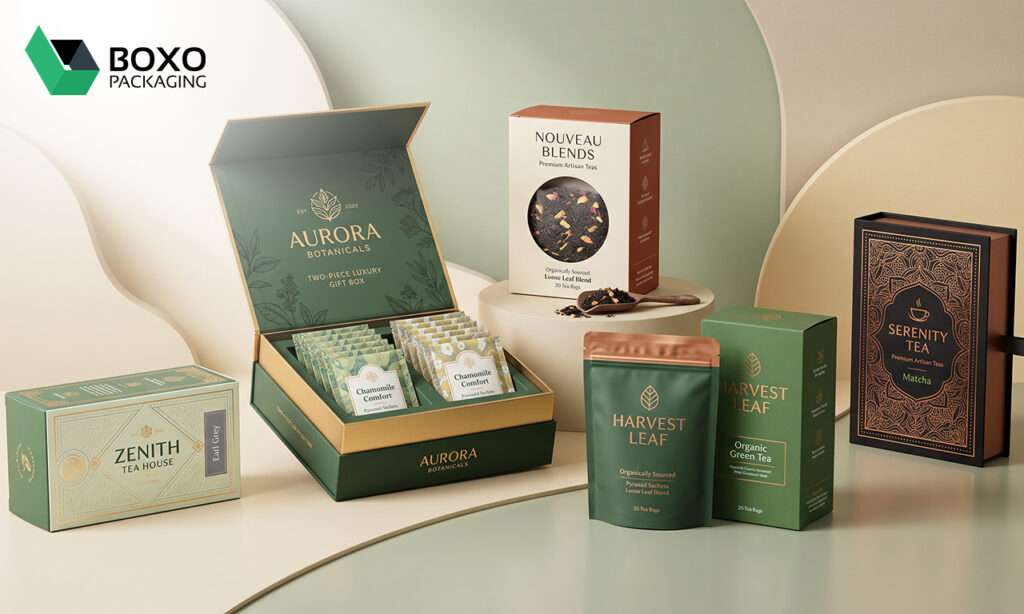

A service carton should make tea varieties easy to identify and portions easy to retrieve. Well-specified Custom Tea Boxes can organize wrapped selections while keeping their names and preparation information accessible. Their layout should follow the service routine rather than impose a decorative arrangement that staff must constantly rearrange.
A guesthouse placing tea selections on a breakfast counter needs a different interior from a sealed presentation gift. Staff replenish the collection, guests remove individual portions, and the carton may remain open during service. Those repeated actions should influence the design from the beginning.
Set compartment sizes from the wrapped portions
Measure the filled wrappers, including their seams and any projecting tags. A compartment drawn around the central sachet can be too narrow for the complete pack. If the portions bend or overlap, guests may have difficulty reading the variety names or removing just one.
Check the arrangement when full and nearly empty. Some packs lean or fall flat after neighboring portions are removed. A shallower compartment or a suitable divider may preserve visibility better than a deep pocket that looks tidy only when completely filled.
A service-layout trial should cover four observations:
- Guests can identify a variety without lifting several unrelated portions.
- The remaining portions stay accessible as a compartment empties.
- Staff can replenish the correct section without mixing the varieties.
- Preparation information remains available when an individual wrapper is removed.
Distinguish selection display from freshness protection
A paperboard organizer does not necessarily provide the barrier needed by unwrapped tea. Establish whether each portion has suitable primary protection or whether the tea belongs in a separate closed container. Dry tea requires attention to moisture, unwanted odors, air, and light exposure.
If the service uses loose leaf, a suitable container and measuring method may be more appropriate than open paperboard compartments. The outer carton can identify the container or group sealed refill packs. It should not be described as airtight simply because its lid closes neatly.
A Counter Display Box can present individually wrapped tea bags, while a tin may remain the everyday container for loose leaves. A tray-and-sleeve format can make sense for a collection that is closed between presentations. Compare those functions before deciding that every service needs the same opening style.
When developing Custom Tea Boxes with Boxo Packaging, provide the wrapper sizes and explain how staff replenish the selection. Include the intended counter position and viewing direction. A service pack works through its repeated use, not just through its appearance when first filled.
Coffee Packaging Boxes for Gifts with a Reusable Item
A coffee-and-cup gift needs separate support for a rigid, potentially fragile object and the sealed coffee pack. With Coffee Packaging Boxes, the interior must manage those different shapes without making either component difficult to remove. The outer carton should not be expected to provide the coffee’s primary freshness barrier.
A neighborhood café offering a reusable travel cup with a small coffee pouch needs to account for the cup’s lid and projecting parts. A cup that fits by body diameter may still catch against the opening or place pressure on the pouch. Prototype the entire gift rather than packing around an empty cup alone.
Keep the coffee pack away from rigid pressure points
A fitted divider can stop the cup from bearing directly against the pouch. Its edges and contact points also need review: an insert that organizes the gift should not scrape a seal or compress a valve. Use the actual filled coffee package in the trial.
Freshly roasted coffee releases carbon dioxide, and suitable primary packs may incorporate a one-way degassing valve. That function belongs to the coffee’s packaging system. The outer gift carton should accommodate it without claiming that an ordinary printed wall performs the same job.
Review the combined gift against these four details:
- The cup lid and any handle clear the opening during insertion and removal.
- The pouch seals do not sit against a sharp insert corner.
- The filled arrangement does not lean or rattle excessively during ordinary handling.
- The recipient can remove one component without dragging it across the other.
Decide whether the gift travels by hand or parcel
A café pickup and a courier delivery create different demands. A presentation carton may suit a controlled counter handover but still need an independently evaluated shipping arrangement for parcel transport. If the cup is ceramic or glass, include its actual protective requirements in that review.
A rigid Gift Box can present the cup and coffee side by side. A corrugated Mailer Box may form part of the delivery system. A simple Sleeve Box can be enough when both products already sit in a protective tray. Choose the combination that addresses the real handling route rather than adding layers automatically.
Keep product information with the component that needs it. Coffee format, product identification, and supplied storage guidance should remain accessible after the recipient removes the gift sleeve. Cup care instructions should not be mistaken for coffee preparation directions merely because both share one printed card.
Approve Coffee Packaging Boxes only after the recipient’s removal sequence has been tested as well as the packing sequence. Tea service emphasizes repeated selection; the coffee gift emphasizes stable presentation and safe access to dissimilar components. Their interiors should reflect that difference even if the exterior branding is related.