
When a new commercial building is being planned, most of the attention naturally goes toward structure, appearance, space, cost, and energy efficiency. Fire safety can sometimes become something that is discussed later, once the main design is already complete.
That approach can create unnecessary problems.
Fire protection works best when it is considered from the beginning of a project. The location of exits, alarm systems, firefighting equipment, emergency lighting, access routes, and other safety features can all affect how a building is designed and used.
For architects, developers, contractors, and property owners, thinking about fire safety early can make a building safer and can also prevent expensive changes later.
Fire Safety Starts With the Building’s Purpose
A building’s purpose has a major influence on its fire risks.
An office may contain computers, electrical equipment, paper, furniture, and a staff kitchen. A warehouse may hold large quantities of packaging, textiles, chemicals, or other combustible materials. A restaurant has cooking equipment and oils, while a manufacturing facility may have machinery, fuel, chemicals, and high-temperature processes.
Because the risks are different, the fire protection strategy should not simply be copied from another building.
Before construction or major renovation begins, project teams should consider what activities will take place inside the property and what materials or equipment will be present.
This helps determine the type and location of fire detection, firefighting, and evacuation systems required.
Plan Escape Routes Early
One of the most important parts of fire safety is also one of the simplest: people need a safe way out.
Emergency exits and escape routes should be considered as part of the original building layout. They should remain accessible and should lead people away from danger rather than creating unnecessary bottlenecks.
The number and arrangement of exits will depend on factors such as building size, occupancy, layout, and local requirements.
It is also important to think about how people actually move through a building. A technically available exit may not be very useful if it is difficult to find, regularly blocked, or positioned in an area where people are unlikely to reach it quickly.
Clear signage, emergency lighting, and well-planned circulation areas can all support evacuation.
Fire Detection Provides Valuable Time
A fire does not need to become large before it becomes dangerous. Smoke can spread rapidly, particularly through enclosed spaces and building services.
Fire detection systems are therefore an important part of modern building design.
Depending on the property, a system may include smoke detectors, heat detectors, manual call points, alarm sounders, control panels, and other components.
Larger buildings may use addressable systems that can provide more detailed information about the location of an activated detector.
The important point is that detection should be planned around the building rather than added as an afterthought. Detector placement, wiring routes, equipment locations, and access for future maintenance should all be considered during design.
Firefighting Equipment Needs Accessible Locations
Fire extinguishers are among the most familiar pieces of fire safety equipment, but their placement deserves careful consideration.
An extinguisher hidden behind furniture or stored inside an inaccessible room does not provide much practical protection. Equipment needs to be visible, accessible, properly identified, and suitable for the fire risks present in the area.
Different extinguishing agents have different applications. Water, foam, carbon dioxide, dry chemical powder, and other types should be selected according to the hazards involved.
For larger buildings, the fire protection strategy may also include hose reels, hydrant systems, sprinkler systems, or specialized suppression systems.
Professional fire protection providers such as Flame Defender can help businesses and project teams evaluate fire safety equipment and protection requirements as part of a wider safety strategy.
Special Areas May Need Special Protection
Not every room in a commercial property carries the same level or type of risk.
A server room, electrical room, commercial kitchen, laboratory, storage area, and manufacturing floor may require different protection measures.
For example, sensitive electronic equipment may require a suppression method that is different from the approach used in a warehouse containing ordinary combustible materials.
This is why fire risk assessment is so important. Instead of choosing equipment based only on what is commonly used, the design team can consider the actual hazards of each space.
Building Materials Also Matter
Fire safety is not limited to alarms and extinguishers.
The materials used in a building can influence how fire and smoke behave. Walls, ceilings, doors, insulation, partitions, furnishings, and other components may have specific fire-performance characteristics.
Fire-resistant doors, for example, can help limit the spread of fire and smoke between certain areas when properly specified and installed.
The objective is not simply to stop every fire immediately. A well-designed building can help contain fire and smoke long enough for occupants to evacuate and emergency responders to act.
Do Not Forget Emergency Access
Fire safety planning should consider not only the people inside the building but also emergency responders.
Large commercial properties need suitable access for firefighting vehicles and emergency personnel. Building entrances, access roads, fire service connections, hydrants, and other relevant infrastructure should be considered during planning.
The easier it is for emergency teams to reach the affected area, the better the chances of an effective response.
This is particularly important for large industrial facilities, warehouses, shopping centres, hotels, and multi-storey properties.
Maintenance Should Be Considered During Design
A common mistake is to think only about how equipment will be installed and not how it will be maintained.
Fire safety systems need inspection, testing, repairs, and sometimes replacement throughout their service life.
Detectors need access for testing. Fire alarm panels need suitable locations. Extinguishers need to remain accessible. Pumps, valves, suppression systems, and other equipment need appropriate maintenance space.
If maintenance access is ignored during the design stage, routine servicing can become unnecessarily difficult.
A good building design therefore considers the entire life of the fire protection system, not just the day it is installed.
Staff Training Completes the System
Even the best-designed building still depends on people.
Employees should know what the fire alarm means, where the exits are located, how emergencies are reported, and where they should assemble after evacuation.
Selected staff may also receive training in the safe use of portable extinguishers, but fighting a fire should never take priority over personal safety.
Regular drills can help employees become familiar with evacuation routes and reveal practical problems that were not obvious during design.
Fire Safety Is Part of Good Building Design
Fire protection should not be viewed as an extra feature added after the building is finished.
It is part of responsible design.
When architects, engineers, contractors, developers, and property owners consider fire risks from the beginning, they can create buildings where detection, evacuation, firefighting, emergency access, and maintenance work together.
The result is not simply a building that contains more fire equipment. It is a building designed with safety in mind.
That difference matters. A fire extinguisher can help control a small fire, but a complete fire safety strategy can provide something even more valuable: time.
And during a fire, every extra minute can matter.
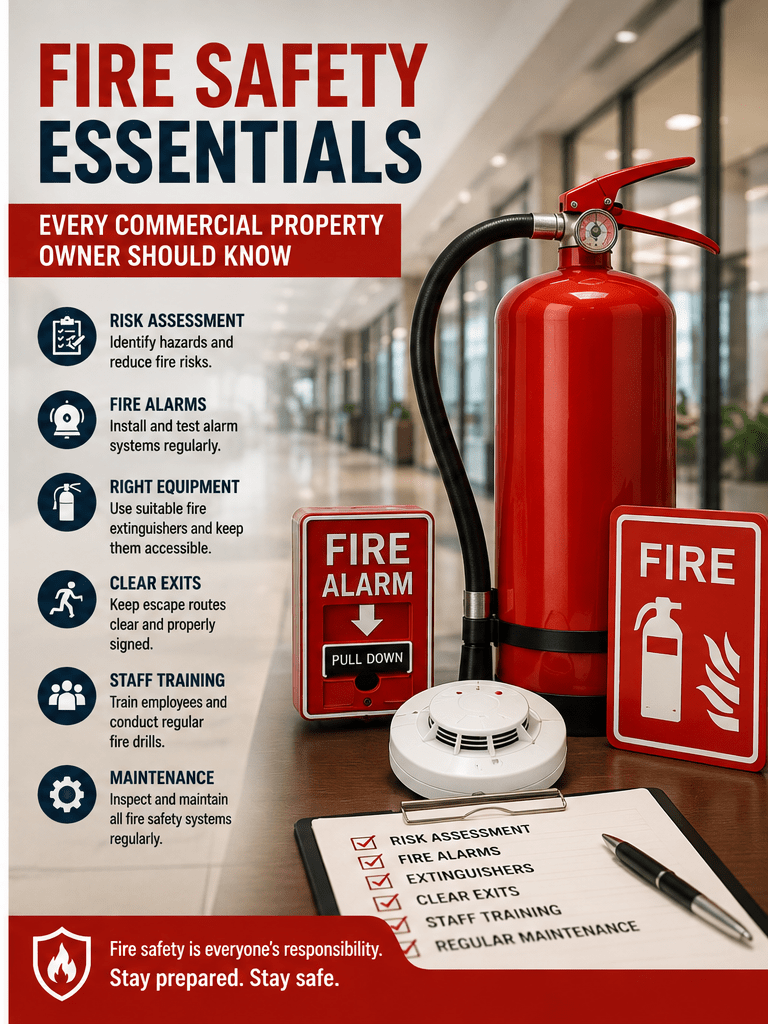
Fire Safety Essentials Every Commercial Property Owner Should Know
Owning or managing a commercial property comes with responsibilities that go far beyond rent collection, maintenance, and keeping tenants satisfied. Safety is one of them.
Fire is one of the risks that property owners cannot afford to overlook. A fire can damage the building, destroy equipment and stock, interrupt business operations, and put employees, customers, tenants, and visitors in danger.
The good news is that many fire risks can be reduced through sensible planning and regular maintenance.
A safe commercial property does not necessarily need complicated technology everywhere. It needs the right protection for the risks that actually exist.
Start With a Fire Risk Assessment
Every property is different.
A small office will not have the same risks as a warehouse, restaurant, factory, hotel, or retail centre. Even two buildings with similar layouts may have different risks because they are used differently.
A fire risk assessment helps identify potential sources of ignition, combustible materials, electrical hazards, escape routes, vulnerable areas, and existing safety measures.
It can also highlight simple problems that are easy to overlook, such as blocked exits, poorly positioned extinguishers, damaged electrical cables, or inappropriate storage.
Property owners should review fire risks whenever the use of a building changes. Bringing in new equipment, changing storage arrangements, renovating an area, or taking on new tenants can introduce hazards that were not present before.
Keep Fire Extinguishers Appropriate and Accessible
Fire extinguishers are a basic but important part of commercial fire protection.
However, the question should not simply be, “How many extinguishers do we need?”
The more important question is whether the extinguishers are suitable for the risks present.
Water, foam, carbon dioxide, dry powder, and other extinguishing agents are designed for different applications. A commercial kitchen, electrical room, office, and workshop may therefore require different types of equipment.
Extinguishers should also be clearly visible and easy to access. They should not be hidden behind stock or furniture.
Businesses should arrange appropriate inspection, servicing, and maintenance rather than assuming that an extinguisher will work simply because it has never been used.
Companies such as Fire Safety Trading provide fire safety equipment and related services for commercial and industrial environments, but property owners should always select equipment according to the specific risks and applicable requirements of their premises.
Fire Alarms Give People Time to React
A fire alarm does something that a property owner cannot do manually: it can warn people about a potential fire when the situation is still developing.
Commercial fire alarm systems can include smoke detectors, heat detectors, manual call points, sounders, control panels, and other components.
The correct system depends on the size and use of the building.
A small office may have relatively straightforward requirements, while a large commercial property may need a more sophisticated system capable of identifying the location of an activated detector.
Whatever system is installed, regular testing is essential. Employees should also know what the alarm sounds like and what they are expected to do when it activates.
Never Treat Emergency Exits as Storage
This is one of the simplest fire safety rules, yet it is frequently ignored.
Commercial properties need clear escape routes. Corridors, staircases, doorways, and emergency exits should not become convenient storage areas.
The problem often develops gradually. A few boxes are placed near an exit because there is nowhere else to put them. Later, more stock is added. Eventually, the route becomes difficult to use.
Property managers should inspect escape routes regularly and remove anything that could delay evacuation.
Emergency lighting and clear signage can also help people find their way out, particularly in larger buildings or areas that may become dark during a power failure.
Pay Attention to Electrical Equipment
Electrical systems are a major part of modern commercial buildings, which makes electrical safety particularly important.
Property owners and managers should take warning signs seriously. Burning smells, sparks, damaged cables, hot sockets, unusual noises, and repeatedly tripping circuits can all indicate problems.
Electrical panels should not be obstructed, and unauthorized modifications should be avoided.
Businesses using large amounts of electrical equipment may need more frequent inspections depending on the type of installation and local requirements.
It is much better to deal with an electrical fault during normal business hours than after it becomes an ignition source.
Think About the Building’s Tenants
In multi-tenant properties, fire safety can become more complicated because different businesses may use the same building in different ways.
One tenant may operate a normal office while another stores materials, uses cooking equipment, or operates machinery.
Property owners should understand how tenants use their spaces and make sure responsibilities are clear.
Tenants should know which fire safety measures they are responsible for and which systems are managed centrally by the property owner or building management.
Clear communication can prevent gaps where everyone assumes someone else is responsible.
Keep Firefighting Systems Maintained
A commercial property may contain much more than extinguishers and alarms.
Depending on the building, it may have hose reels, hydrants, sprinkler systems, pumps, suppression systems, fire doors, emergency lighting, smoke control equipment, and other safety measures.
These systems need appropriate inspection and maintenance.
Equipment that has been ignored for years cannot be considered reliable simply because it looks clean or has never been needed.
Maintenance records should be kept so property managers can track inspections, repairs, testing, and outstanding issues.
Train the People Who Work There
Fire safety equipment is only useful when people understand how to respond.
Employees should know the evacuation procedure, emergency exits, assembly point, and method for reporting a fire.
Some staff members may receive additional training, depending on the workplace and their responsibilities.
Regular drills are useful because they turn a written emergency plan into something employees have actually practised.
Drills can also reveal problems. Maybe visitors do not know where to assemble. Perhaps a particular section of the building cannot hear the alarm. Or employees may be using an unsuitable exit because the preferred route is not clearly marked.
These are issues worth discovering during a drill rather than during a real emergency.
Do Not Wait for an Inspection to Find Problems
Compliance inspections are important, but fire safety should not be reduced to preparing for an inspection.
Property owners should regularly walk through their buildings and look for obvious risks.
Are exits clear? Are extinguishers accessible? Are fire doors being kept open? Is combustible waste accumulating? Are electrical panels unobstructed? Can emergency signs be seen?
A short inspection can reveal problems that would otherwise remain unnoticed for months.
Update Fire Safety Measures When the Property Changes
Commercial properties rarely stay exactly the same.
A business may expand, add machinery, change its storage system, renovate the interior, or change how certain rooms are used.
Each change can affect fire risk.
For this reason, fire safety should be reviewed after significant modifications rather than assuming that the original safety plan will always remain appropriate.
This is particularly important when a building changes from one type of use to another.
A Safer Property Protects More Than the Building
Fire safety is sometimes viewed as a cost because it involves equipment, inspections, maintenance, and training.
It is more useful to think of it as protection.
A well-prepared commercial property protects people, reduces the potential for serious damage, supports business continuity, and gives emergency responders a better environment in which to work.
There is no single product that makes a property fire-safe.
The strongest approach combines prevention, detection, firefighting equipment, clear escape routes, regular maintenance, employee training, and ongoing risk assessment.
For property owners, the goal should be simple: identify problems before they become emergencies.
A fire may start unexpectedly, but preparation does not have to.