
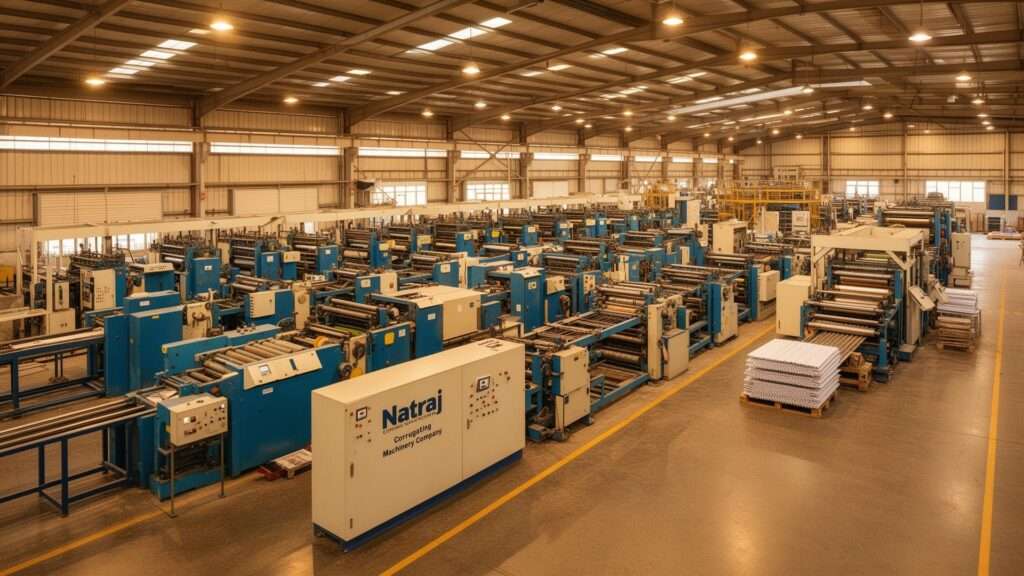

Buying corrugated box making machinery is one of the biggest decisions a packaging business owner makes.
Get it right and your plant runs efficiently for years. Get it wrong and you deal with downtime, poor output quality, and machines that do not fit your production needs.
The problem most buyers face is simple. There are many types of corrugated box making machinery available. Each type has different features, different output capacity, and a different price range. Comparing them without a clear guide is confusing.
This article fixes that. Here is a complete, clear comparison of every major type of corrugated box making machinery. What each machine does. What it costs. What features matter. And which type fits which scale of corrugated box plant.
What Is Corrugated Box Making Machinery
Before the comparisons, a quick overview.
A corrugated box plant converts raw paper rolls into finished corrugated boxes. The process involves multiple machines working in sequence. Each machine handles a specific stage of production.
The full production flow looks like this:
Paper Rolls → Board Plant → Slitter Scorer → Sheeting Machine → Flexo Printer Slotter → Folder Gluer or Stitching Machine → Finished Boxes
Every machine in this line must be matched to the others in speed and board width. A mismatch creates bottlenecks that reduce output and increase waste.
Working with experienced corrugated box making machine manufacturers who plan the full line rather than selling individual machines is the smart approach.
Types of Corrugated Box Making Machinery
Here is a breakdown of every major machine type in a corrugated box plant.
- Corrugated Board Plant
The corrugated board plant is the foundation of every corrugated box plant. It takes raw paper rolls and produces corrugated board sheets that are used to make all types of boxes.
How It Works: Paper rolls feed into the machine. A fluted (wavy) middle layer is created using heat and pressure. Flat liner sheets are bonded to both sides. The result is corrugated board ready for converting into boxes.
3 Ply Board Plant Produces board with one fluted layer between two flat liners. Lighter weight. Used for standard shipping boxes, consumer goods packaging, and lighter applications. Lower investment entry point. Best suited for e-commerce, FMCG, and retail clients.
5 Ply Board Plant Adds an extra liner layer for greater strength and rigidity. Used for heavy-duty boxes carrying appliances, auto parts, industrial goods, and export shipments. Higher investment but commands better selling price per box and attracts larger clients.
- Flexo Printer Slotter Die Cutting Machine
This is one of the most important machines in any corrugated box plant. It handles three operations in a single pass: printing, slotting, and die cutting.
Flexo Printing applies text, logos, barcodes, and graphics to the board using flexible printing plates.
Slotting cuts vertical grooves into the board so it folds cleanly at the right points.
Die Cutting cuts the board into the required box shape, including custom shapes with handles, windows, or irregular openings.
A single colour machine is suited for plain boxes and basic barcodes. A two colour machine handles basic branding. A multi-colour machine with three to six print stations handles full branded packaging for FMCG and retail clients. Price ranges from Rs. 8 lakh for a basic single colour machine to Rs. 80 lakh for a high-speed multi-colour fully automatic version. Multi-colour machines attract better-paying clients and deliver higher margins per box.
- Automatic Folder Gluer Machine
After the board is cut into flat blanks, the folder gluer folds and glues them into finished box shapes automatically.
The machine picks up flat blanks, folds them along scored lines, applies adhesive at the right points, and presses the panels together in one continuous operation.
Semi-automatic folder gluers require manual feeding and cost Rs. 5 lakh to Rs. 10 lakh. They suit smaller plants with lower daily volumes. Fully automatic folder gluers cost Rs. 20 lakh to Rs. 50 lakh. They require minimal operator involvement, run faster, and deliver far more consistent glue application across every batch. Servo-controlled models give precise alignment even at high speeds. In 2026, fully automatic folder gluers are the stronger long-term investment as labour costs continue to rise.
- Box Stitching Machine
Some boxes are joined using metal wire staples instead of adhesive. The box stitching machine drives staples through overlapping box panels to create strong, reliable joints.
Stitched boxes are preferred for heavy industrial goods, export shipments requiring maximum joint strength, and applications where boxes are stored in damp or humid conditions.
Manual stitching machines cost Rs. 1 lakh to Rs. 3 lakh and suit very small plants. Semi-automatic versions run Rs. 3 lakh to Rs. 8 lakh. Fully automatic high-speed stitching machines cost Rs. 10 lakh to Rs. 25 lakh and are used in large volume corrugated box plants where stitching is part of the main production line.
- Rotary Slotting Machine
The rotary slotting machine is a standalone machine used specifically for slotting corrugated board. It cuts vertical grooves that become the fold lines of the finished box.
Unlike the combined flexo printer slotter, this machine handles only slotting. It is used when slotting needs to be done as a separate operation, or when a plant processes many different board thicknesses and box sizes that need dedicated slotting runs. Price range is Rs. 4 lakh to Rs. 15 lakh depending on width and automation level.
- Flute Laminator Machine
The flute laminator bonds a flat liner sheet to a single-faced corrugated web using heat and pressure. This is part of the board-making stage and directly affects the strength and flatness of your finished board.
Good lamination produces flat, warp-free board that runs smoothly through all downstream machines. Poor lamination leads to board that peels, warps, or loses strength under load. Price range is Rs. 8 lakh to Rs. 30 lakh. The flute laminator must be matched to your board plant output speed to avoid creating a bottleneck.
- Flat Bed Die Cutting Machine
For complex box shapes and smaller production runs, the flat bed die cutting machine delivers precision that rotary die cutting cannot match.
A flat steel cutting die is pressed onto the board to cut the required shape. Slower than rotary die cutting but more accurate. Price range Rs. 8 lakh to Rs. 35 lakh. Ideal for custom shaped boxes, display trays, and retail packaging with intricate cut-outs. Many corrugated box plants keep both a rotary die cutter for high-volume standard work and a flat bed die cutter for custom and smaller batch jobs.
- Slitter Scorer Machine
The slitter scorer cuts large corrugated board into smaller sheets and adds fold score lines in a single operation. Score lines are compressed creases that allow the board to fold cleanly without cracking.
This machine comes early in the converting process. Errors in slitting or scoring at this stage affect every machine and every box downstream. Price range is Rs. 3 lakh to Rs. 15 lakh. Accuracy here is non-negotiable.
- Sheeting Machine
The sheeting machine cuts the continuous corrugated board web into individual sheets of a defined size. These sheets are stacked and fed into converting machines like the flexo printer or die cutter.
A slow sheeting machine creates a bottleneck that holds back the entire production line. Price range is Rs. 4 lakh to Rs. 20 lakh. Speed must be matched to your board plant output to keep the line flowing without interruption.
Semi-Automatic vs Fully Automatic Corrugated Box Making Machinery
This is the decision most plant owners find hardest.
Semi-automatic corrugated box making machinery has a lower upfront cost. It needs more manual involvement. Output speed is lower. Quality consistency varies by operator. Best suited for plants producing up to 30,000 boxes per day. Labour cost per unit is higher at scale. Clients served are typically local and regional.
Fully automatic corrugated box making machinery costs more upfront. It requires minimal manual operation. Output speed is significantly higher. Quality consistency is excellent across every shift. Best suited for plants producing 30,000 boxes per day and above. Labour cost per unit drops sharply as volumes increase. Fully automatic plants can credibly serve large FMCG, pharma, and export clients who demand zero variation across batches.
In 2026, the case for full automation is stronger than ever. Labour costs are rising across India. Fully automatic machinery is more accessible than it was five years ago. And large clients are increasingly choosing suppliers with consistent automated output over those relying on manual processes.
Investment by Plant Scale
Here is what a complete corrugated box plant setup costs at different scales:
|
Plant Scale |
Daily Output |
Machinery Cost |
Total Setup Cost |
|
Small Plant |
Up to 20,000 boxes |
Rs. 35L to Rs. 70L |
Rs. 80L to Rs. 1.8Cr |
|
Medium Plant |
20,000 to 80,000 boxes |
Rs. 70L to Rs. 1.5Cr |
Rs. 1.8Cr to Rs. 4Cr |
|
Large Plant |
80,000 boxes and above |
Rs. 1.5Cr to Rs. 4Cr |
Rs. 4Cr to Rs. 10Cr |
Total setup cost includes machinery, land and building, raw material initial stock, utilities setup, compliance, and working capital reserve. Get detailed quotes from established corrugated box making machine manufacturers before finalising your budget. Actual costs depend on your specific location, machine specifications, and production targets.
3 Ply vs 5 Ply Board Plant: Which Should You Choose
This is one of the most common questions new corrugated box plant owners ask.
A 3 ply plant produces lighter standard board. Lower upfront cost. Large market across e-commerce, FMCG, food, and retail. Standard selling price per box. Good starting point for most new plants.
A 5 ply plant produces heavier, stronger board. Higher upfront cost. Targets industrial goods, appliances, auto components, and export shipments. Higher selling price per box. Better margin potential for plants serving industrial and export clients.
Many successful corrugated box plants run both. They start with a 3 ply plant and add 5 ply capability as their client base grows into industrial and export markets. Starting with 3 ply is the lower-risk entry point for most new plant owners.
What to Look for in Corrugated Box Making Machine Manufacturers
Choosing the right corrugated box making machine manufacturers matters as much as choosing the right machine.
Look for ISO certification as your first filter. Confirm they design and build their own machines rather than assembling imported components. Ask whether their engineers can reach your plant location for installation and breakdown calls. Check how quickly they can supply critical spare parts. Find out whether they can supply your complete machine line rather than just individual machines. Ask for references from existing corrugated box plants they have equipped.
Natraj Machines, based in Palwal, Haryana, has been manufacturing corrugated box making machinery since 1965. ISO 9001-2008 certified, they manufacture over 100 types of corrugating machines and supply complete corrugated box plants across India and international markets.
Final Thoughts
Choosing the right corrugated box making machinery starts with understanding what each machine does, what it costs, and how it fits into your production line.
Use the investment table in this guide as your starting reference for budget planning. Then talk to experienced corrugated box making machine manufacturers who can help you plan a complete machine line that matches your production targets, your budget, and your growth plans.
The right machines from the right manufacturer make the difference between a corrugated box plant that runs profitably for decades and one that struggles from the start.
Choose well. Build well. And produce well.