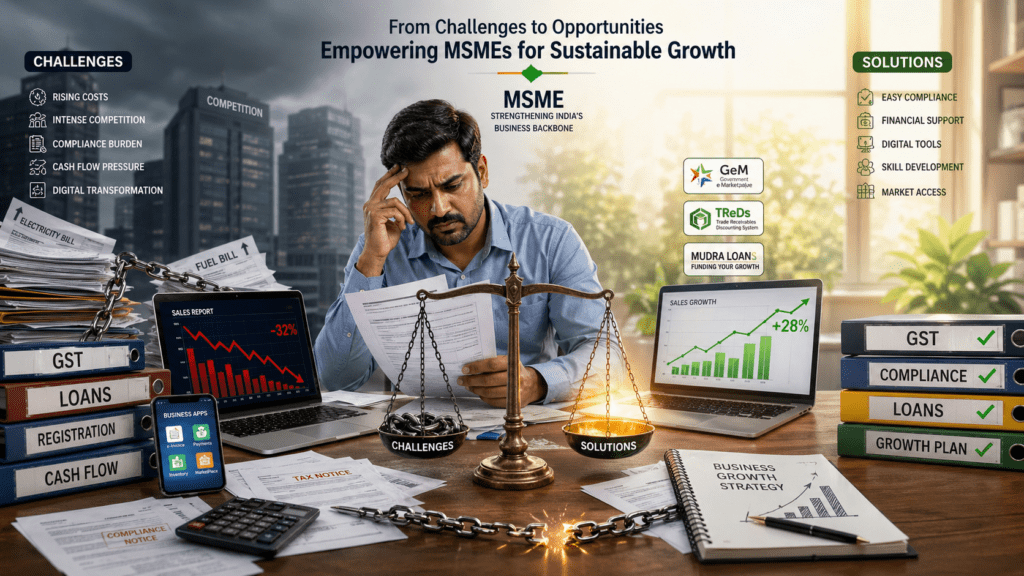

India’s Micro, Small, and Medium Enterprises (MSMEs) are often called the backbone of the Indian economy, and with good reason. They contribute nearly 30% of India’s GDP, employ over 110 million people, and account for about 45% of the country’s total exports. Yet, despite their enormous economic footprint, millions of MSMEs struggle daily with challenges that threaten their survival and growth.
If you run a small or medium business in India, you already know this isn’t just statistics, it’s lived reality. This guide breaks down the most pressing challenges Indian MSMEs face and, more importantly, offers practical, actionable ways to overcome them, starting with one of the most foundational steps: MSME Udyam Registration.
1. Access to Formal Credit Remains the Biggest Bottleneck
Ask any MSME owner what keeps them up at night, and the answer is almost always the same: money. Specifically, the lack of timely, affordable credit.
Despite India’s vast banking network, a large proportion of MSMEs, particularly micro-enterprises, are still unable to access formal loans. Banks often demand collateral that small business owners simply don’t have. Credit histories are thin or non-existent. And the paperwork involved can feel designed to exclude rather than include.
How to overcome it:
The single most impactful step an MSME can take to unlock formal credit is to complete their MSME Udyam Registration on the official government portal (udyamregistration.gov.in). Udyam Registration is free, paperless, and based on Aadhaar, making it accessible to virtually every business owner.
Once registered, MSMEs become eligible for:
- Collateral-free loans under the Credit Guarantee Fund Trust for Micro and Small Enterprises (CGTMSE)
- Priority Sector Lending from banks
- Lower interest rates a nd faster loan processing
- Government-subsidised credit schemes like MUDRA loans and Stand-Up India
Registration is the key that unlocks these doors. Without it, you’re essentially an invisible enterprise to the formal financial system.
2. Raw Material Costs and Supply Chain Disruptions
The post-pandemic world exposed just how fragile supply chains can be. For Indian MSMEs, which often operate on razor-thin margins, a spike in raw material costs or a disruption in supply can be catastrophic.
Small manufacturers in sectors like textiles, food processing, and auto components frequently report that inconsistent supply and price volatility make it nearly impossible to quote fixed prices to clients or plan production schedules reliably.
How to overcome it:
- Form clusters and cooperatives to negotiate better bulk pricing with suppliers. The government supports MSME clusters under schemes like the Micro & Small Enterprises – Cluster Development Programme (MSE-CDP).
- Diversify your supplier base across geographies to reduce dependency on a single source.
- Explore government procurement portals like GeM (Government e-Marketplace), where registered MSMEs get preferential access to public sector buyers — and can also source materials competitively.
- Udyam-registered MSMEs get exemption from security deposit in government tenders, making it easier to win contracts that stabilise revenue and reduce supply pressure.
3. Technology Adoption Gap
Walk into a large Indian corporation, and you’ll find ERP systems, cloud-based inventory management, and automated invoicing. Walk into most small businesses, and you’ll often find ledger books, WhatsApp groups, and Excel spreadsheets held together by habit.
This isn’t a criticism; it’s a reflection of limited resources and awareness. But the technology gap is widening, and MSMEs that don’t digitise risk being left behind by competitors who do.
How to overcome it:
The government has introduced several digital support schemes specifically for MSMEs:
- Digital MSME Scheme: Provides cloud computing services to small b
- usinesses at subsidised rates.
- SAATHI (Sustainable and Accelerated Adoption of Efficient Textile Technologies to Help Small Industries): Supports textile MSMEs in adopting energy-efficient machinery.
- ZED (Zero Defect Zero Effect) Certification: Helps MSMEs improve quality management and production efficiency.
Start small. Digitise your invoicing and accounting first. Adopt a basic CRM. Move inventory tracking to a simple cloud tool. These changes don’t require large upfront investments but dramatically improve efficiency and scalability. MSME Registration also opens doors to government-sponsored technology upgrade grants and subsidies.
4. Delayed Payments from Buyers
This is perhaps the most emotionally frustrating challenge for MSME owners. You deliver your goods or services. You wait 60 days. Then 90 days. Then 120 days. And all the while, your own suppliers are asking you to pay on time.
Payment delays create a vicious cash-flow cycle that stunts growth, forces expensive short-term borrowing, and sometimes pushes otherwise viable businesses into closure.
How to overcome it:
India’s legal framework actually provides strong protections here, but only for registered MSMEs. Under the MSMED Act, 2006, buyers are legally required to make payments to MSMEs within 45 days of accepting goods or services. If they don’t, they owe compound interest at three times the RBI’s bank rate.
But this protection only applies if you have completed your MSME Udyam Registration. Unregistered businesses have no legal recourse under this act.
Additionally, the MSME Samadhaan portal allows registered enterprises to file delayed payment complaints against buyers, including Central and State Government Ministries. This is a powerful tool that many MSME owners are unaware of.
5. Lack of Market Access and Visibility
Many Indian MSMEs produce excellent products, handcrafted goods, precision components, and organic food products, but struggle to find buyers beyond their immediate geography. Their reach is limited by small marketing budgets, lack of a digital presence, and no connections to national or global supply chains.
How to overcome it:
- Register on GeM (Government e-Marketplace): This platform connects registered MSMEs directly with government buyers across India. In FY2023-24 alone, GeM processed orders worth over ₹4 lakh crore, with a significant share going to MSMEs.
- Export promotion through MSME schemes: The government provides financial assistance for international trade fairs, product testing, and export documentation for registered enterprises.
- Build a basic digital presence a Google Business Profile costs nothing and can dramatically increase local discoverability.
- Leverage ONDC (Open Network for Digital Commerce) to reach e-commerce customers without depending on large marketplace platforms.
6. Skilled Labour Shortages
India has a large and young workforce, but a persistent mismatch between the skills industry needs and what workers are trained in means MSMEs often struggle to find and retain qualified people.
High attrition, especially in manufacturing and service sectors, adds hidden costs through constant recruitment and retraining.
How to overcome it:
- Partner with ITIs (Industrial Training Institutes) and Skill India-certified training providers to hire apprentices and build a skilled pipeline.
- Udyam-registered MSMEs can access subsidised apprenticeship programmes under the National Apprenticeship Promotion Scheme (NAPS), which reimburses a portion of the stipend paid to apprentices.
- Invest in internal training. Even informal mentorship programmes significantly improve retention by signalling that the company values its workers.
- Regulatory Complexity and Compliance Burden
GST filing, EPF contributions, ESI compliance, factory licences, and environmental clearances, the regulatory landscape for MSMEs can feel overwhelming, especially for first-generation entrepreneurs without professional support.
How to overcome it:
The government has been working to simplify compliance for MSMEs. Udyam Registration itself is a step in this direction; it’s a single, self-declared registration that reduces the documentation burden significantly.
Beyond that:
- Use the Udyam Assist Platform if you’re in the informal sector and not yet eligible for Udyam.
- Leverage MSME Development Institutes (MSMEDIs) spread across India for free advisory support on licensing, compliance, and schemes.
- Hire a part-time chartered accountant or use compliance-as-a-service platforms to manage GST and statutory filings cost-effectively.
Why MSME Udyam Registration Is the Starting Point for Everything
If there’s one takeaway from every challenge discussed above, it’s this: MSME Udyam Registration is not just a formality, it is the foundation upon which nearly every government benefit, legal protection, and financial opportunity is built.
Whether it’s accessing collateral-free credit, filing a delayed payment complaint, bidding for government tenders, or enrolling in technology upgrade schemes, registration is the prerequisite. And the process itself has been deliberately simplified: it requires only an Aadhaar number and PAN, takes less than 10 minutes, and is completely free.
If you run a micro, small, or medium enterprise in India and haven’t yet completed your MSME Registration, this is the single highest-leverage action you can take today.
Final Thoughts
Indian MSMEs are resilient. They’ve survived demonetisation, GST rollout, a global pandemic, and supply chain upheaval, often with minimal institutional support. But resilience alone isn’t a strategy for growth.
The opportunities available to registered MSMEs in credit, markets, technology, and legal protection are genuinely transformative. The challenge is awareness and action. Now that you know the challenges and the solutions, the next step is yours.