
Artificial intelligence is becoming an important part of how businesses operate, from customer service and healthcare to manufacturing, retail, transportation, and financial services. However, developing an effective AI model requires more than choosing the right technology. The model also needs accurate, well-organized, and properly labeled data to learn from.
Preparing training data can take considerable time and effort. Businesses working with thousands of images, videos, text documents, audio recordings, or other data sources often find that labeling everything internally becomes difficult. Their teams may lack the required expertise, resources, or time to complete the work while managing their regular responsibilities.
This is where AI Data Labeling in USA becomes an important consideration for businesses looking to develop reliable AI solutions. Outsourcing data labeling can help organizations access skilled professionals, manage large datasets, improve annotation quality, and complete projects within their expected timelines.
In this guide, we will explain when businesses should outsource AI data labeling, what challenges indicate the need for external support, how outsourcing can improve AI development, and what companies should consider before choosing a service provider.
What Is AI Data Labeling and Why Does It Matter?
AI data labeling is the process of identifying, categorizing, tagging, or annotating raw data so that machine learning models can understand and learn from it.
AI models depend on examples to recognize patterns, make predictions, and perform tasks. Without properly labeled training data, a model may struggle to identify objects, understand language, recognize activities, or make accurate decisions.
For example:
-
In computer vision, images may be labeled with objects such as vehicles, people, products, or road signs.
-
In healthcare AI, medical images may be annotated to identify specific areas that need examination.
-
In autonomous driving, video footage may be labeled with pedestrians, vehicles, traffic lights, and road boundaries.
-
In natural language processing, text may be categorized according to sentiment, intent, topic, or meaning.
The quality of these labels directly affects how well an AI model performs.
Businesses investing in AI Data Labeling in USA need to understand that inaccurate or inconsistent labels can create problems during model training. Even if the model architecture is advanced, poor-quality training data can limit its performance.
7 Signs Your Business Should Outsource AI Data Labeling
Not every organization needs an external data labeling team. However, several situations can make outsourcing a practical and valuable decision.
1. Your Data Labeling Workload Is Increasing
One of the most common reasons businesses outsource is the growing volume of data.
A project that initially requires labeling a few thousand images may eventually involve hundreds of thousands or millions of data points. Managing this workload internally can become difficult, especially when the business does not have a dedicated annotation team.
For example, an e-commerce company developing an AI-powered product recommendation or visual search system may need to label product images according to categories, colors, sizes, brands, and product features.
As the dataset grows, employees may struggle to complete labeling tasks alongside their existing responsibilities.
Outsourcing AI Data Labeling in USA can help businesses manage increasing workloads without continuously hiring and training additional employees. External teams can support different project stages and help organizations handle larger datasets more efficiently.
2. Your Internal Team Lacks Specialized Skills
Some data labeling projects require more than basic tagging or classification.
Tasks such as medical image annotation, semantic segmentation, object tracking, sentiment analysis, and video activity recognition require specific knowledge and experience.
If your employees do not have the necessary skills, assigning complex labeling work internally may result in inconsistent annotations and unreliable training datasets.
For example, a company developing an AI-powered medical imaging solution may need annotations that identify specific structures or abnormalities. Such work requires carefully defined guidelines and appropriately qualified annotators.
Businesses can benefit from outsourcing when they need access to experienced professionals who understand different annotation techniques and project requirements.
Working with specialized AI Data Annotation Services in USA can help organizations manage complex tasks while maintaining clear annotation standards and quality expectations.
3. Your AI Project Has Tight Deadlines
AI development projects often operate according to specific timelines. Delays in preparing training data can affect model development, testing, product launches, and overall project progress.
If your internal team is unable to label data quickly enough, outsourcing may help reduce the time required to complete the dataset.
For instance, a retail business preparing an AI-based inventory management system before a seasonal sales period may need thousands of product images labeled within a limited timeframe.
Building an internal team for a short-term project may not be practical. Outsourcing allows businesses to bring additional resources into the project without going through a lengthy hiring process.
When considering AI Data Labeling in USA, businesses should evaluate whether external support can help them meet important deadlines while maintaining the quality of their training data.
4. Your Business Wants to Control Operational Costs
Hiring a full-time data labeling team involves several expenses, including salaries, recruitment, training, software, infrastructure, supervision, and employee management.
These costs can become significant when labeling requirements change from one project to another.
Outsourcing may provide a more flexible way to manage data labeling expenses. Businesses can work with external teams based on their project requirements rather than maintaining a large permanent workforce.
For example, a startup developing a machine learning application may need a large dataset during the initial training stage but only occasional labeling support after the model is deployed.
In such cases, outsourcing can help the company avoid maintaining an unnecessary internal team.
However, businesses should not evaluate outsourcing based on price alone. Low-cost labeling without proper quality control may create additional expenses through rework, model errors, and project delays.
The objective should be to find a balance between cost, accuracy, turnaround time, and the level of expertise required.
5. Your Data Requires Consistent Quality Standards
Consistency is one of the biggest challenges in data labeling.
Different annotators may interpret the same image, video, or text differently if the project guidelines are unclear. This can create inconsistent labels and affect the reliability of the training dataset.
For example, a vehicle detection project may require annotators to label partially visible vehicles, vehicles in the background, and objects appearing under poor lighting conditions.
Without clearly defined instructions, different team members may handle these situations differently.
Businesses should consider outsourcing when they need structured annotation workflows, quality assurance processes, review procedures, and consistent labeling guidelines.
Professional AI Data Labeling in USA projects should include clear instructions, sample annotations, review processes, and a method for resolving disagreements between annotators.
These practices help maintain consistent dataset quality throughout the project.
6. You Need to Work With Different Data Types
AI projects frequently involve multiple types of data. A business may need image annotation, video annotation, text classification, audio transcription, or a combination of these tasks.
Managing different data types internally can require separate tools, workflows, technical knowledge, and training.
For example, a smart retail solution may use:
-
Images to identify products on shelves.
-
Videos to understand customer movement.
-
Text data to analyze customer feedback.
-
Audio data to process voice-based interactions.
When a project involves multiple data formats, outsourcing can help businesses access teams with experience across different annotation methods.
Depending on the requirements, businesses may use AI Image Annotation Services in USA for image classification, bounding boxes, polygon segmentation, or keypoint annotation.
Similarly, AI Video Annotation Services in USA can support frame-by-frame labeling, object tracking, activity recognition, and temporal annotation.
Using the right annotation approach for each data type helps create training datasets that better match the needs of the AI model.
7. Your Business Is Expanding Its AI Development
Companies that are beginning to explore AI may initially manage their training data internally. However, as they introduce more AI applications, their data preparation requirements can increase considerably.
A business may start with a chatbot and later develop predictive analytics, computer vision applications, recommendation systems, or automated quality inspection solutions.
At this stage, internal teams may find it difficult to manage several datasets simultaneously.
Outsourcing can provide additional support as AI initiatives expand. Businesses can handle multiple labeling projects, prepare new datasets, and support different development teams without building a separate annotation department for every application.
This makes outsourcing particularly useful for companies planning long-term AI adoption.
When Outsourcing AI Data Labeling Makes Sense for Different Industries
The need for external data labeling support varies depending on the industry, dataset size, project complexity, and business objectives.
Healthcare and Medical Technology
Healthcare AI applications may involve medical images, patient-related documents, clinical information, or specialized datasets.
Medical annotation projects require careful handling of data, clear guidelines, appropriate expertise, and strong privacy practices.
Businesses developing healthcare AI solutions may outsource annotation when they need additional qualified resources, specialized labeling support, or help preparing datasets for model training.
The service provider should understand the project’s data security requirements and follow agreed privacy and confidentiality procedures.
Retail and E-Commerce
Retail businesses frequently work with large collections of product images, customer reviews, and transaction-related information.
Outsourcing can help retailers label product categories, identify product attributes, classify customer feedback, and prepare visual datasets for search or recommendation systems.
For example, an online store with thousands of products may need consistent labels for product type, material, color, and style. External annotation teams can help organize this information at scale.
Automotive and Transportation
Automotive AI systems may require labeled road images, video footage, traffic objects, lane markings, pedestrians, and vehicle movement.
These datasets can be highly complex because objects may appear under different weather conditions, lighting situations, camera angles, and traffic environments.
Businesses working on computer vision applications may outsource labeling to support object detection, tracking, segmentation, and activity recognition tasks.
Manufacturing
Manufacturing companies use AI for quality inspection, defect detection, predictive maintenance, and production monitoring.
Outsourcing can help prepare image datasets containing product defects, surface irregularities, damaged components, and manufacturing issues.
For example, a company developing an automated inspection system may need thousands of product images categorized according to defect types and severity.
A well-organized dataset can support model training and help the business evaluate its AI inspection solution.
What Tasks Can Businesses Outsource?
Businesses can outsource different types of data labeling work depending on their AI applications.
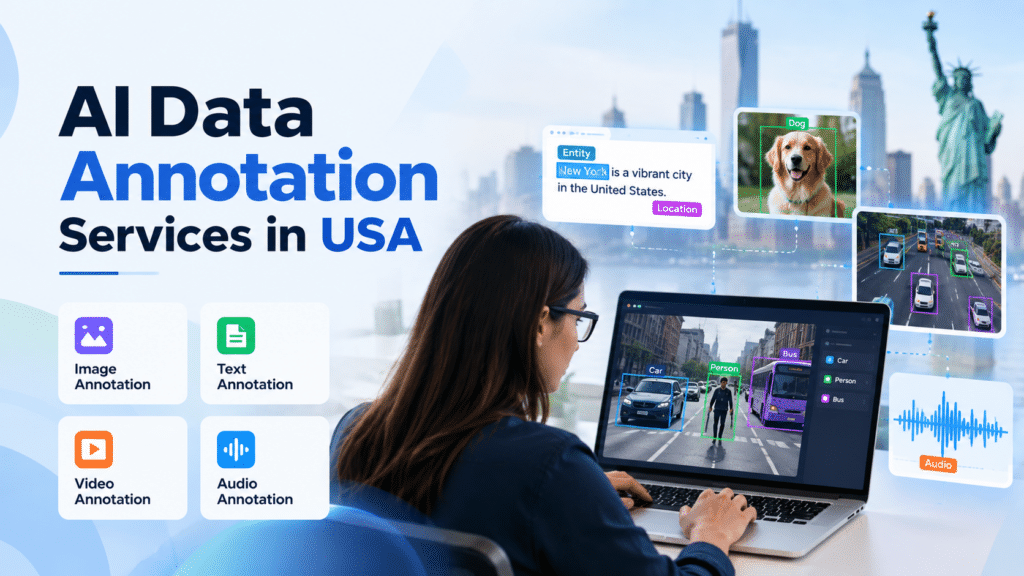
Image Annotation
Image annotation includes labeling objects, identifying image categories, marking specific regions, and locating important features.
Common methods include:
-
Bounding box annotation
-
Polygon annotation
-
Semantic segmentation
-
Instance segmentation
-
Keypoint annotation
-
Image classification
These techniques are commonly used in retail, healthcare, manufacturing, agriculture, robotics, and computer vision applications.
Video Annotation
Video annotation involves labeling objects, activities, movements, and events across video frames.
Common tasks include:
-
Object tracking
-
Frame-level annotation
-
Human activity recognition
-
Video classification
-
Temporal event labeling
-
Bounding box tracking
Video labeling requires consistency across frames so that objects and activities can be identified correctly as they move or change.
Text Annotation
Text annotation helps AI systems understand written language.
Tasks may include sentiment analysis, intent classification, entity recognition, text categorization, document labeling, and conversational data annotation.
These services are useful for chatbots, customer support automation, search systems, and language-based AI applications.
Audio Annotation
Audio annotation involves preparing speech and sound data for AI training.
Typical tasks include transcription, speaker identification, audio classification, speech segmentation, and sound event labeling.
Businesses developing voice assistants, speech recognition applications, or audio analysis tools may outsource these tasks when they need larger datasets or specialized labeling support.
How to Decide Whether to Outsource or Keep Data Labeling In-House
Businesses should compare their internal capabilities with the requirements of their AI projects before making a decision.
|
Factor |
In-House Labeling |
Outsourcing |
|---|---|---|
|
Small datasets |
Often practical |
May not be necessary |
|
Large datasets |
Can require significant resources |
Easier to scale with suitable providers |
|
Specialized tasks |
Depends on internal expertise |
Access to experienced teams |
|
Project deadlines |
Limited by available staff |
Additional resources may help |
|
Long-term control |
Direct internal management |
Requires vendor coordination |
|
Operational costs |
Ongoing team expenses |
Project-based or agreed service costs |
|
Data security |
Internal access control |
Requires vendor security evaluation |
In-house labeling may be appropriate for small datasets, sensitive research, or projects requiring continuous close collaboration with internal specialists.
Outsourcing is often more practical when the project involves large volumes of data, complex annotation tasks, limited internal resources, or strict deadlines.
Some businesses also choose a hybrid approach. Their internal team manages annotation guidelines, domain knowledge, and final approval, while an external team handles the majority of labeling work.
This arrangement can provide a balance between internal control and external scalability.
What Should Businesses Check Before Outsourcing?
Choosing a data labeling partner requires careful evaluation. Businesses should consider the following factors before starting a project.
1. Annotation Experience
Check whether the provider has experience with the type of data and annotation tasks your project requires.
A provider experienced in image classification may not automatically have the expertise needed for complex video tracking or medical annotation.
2. Quality Assurance Process
Ask how annotations are reviewed, how errors are identified, and how disagreements between annotators are handled.
Quality assurance should be included in the project workflow rather than treated as an optional final step.
3. Data Security and Confidentiality
Understand how the provider manages data access, storage, transfer, confidentiality, and project permissions.
If your project involves sensitive information, review the relevant security requirements before sharing datasets.
4. Scalability
Confirm whether the provider can increase or decrease resources according to project requirements.
A suitable partner should be able to discuss realistic timelines, workforce availability, project capacity, and delivery expectations.
5. Communication and Reporting
Clear communication helps prevent misunderstandings during annotation.
Businesses should establish reporting schedules, progress updates, feedback procedures, sample approval, and escalation processes before work begins.
Why Choose Vision Infotech for AI Data Labeling?
Choosing the right data labeling partner can make a meaningful difference in the quality and efficiency of AI development.
Vision Infotech supports businesses looking to prepare structured, reliable datasets for AI and machine learning applications. Our approach focuses on understanding project requirements, following clear annotation guidelines, and delivering labeling work aligned with the needs of each business.
Businesses can consider Vision Infotech for the following reasons:
-
Project-specific labeling workflows: Annotation processes can be planned according to the data type, project objectives, and labeling requirements.
-
Support for different data formats: Image, video, and other data annotation requirements can be addressed according to the project scope.
-
Quality-focused approach: Clear instructions, review processes, and feedback help maintain consistency across labeled datasets.
-
Flexible project requirements: Businesses can discuss their dataset size, timelines, annotation complexity, and expected deliverables.
-
AI and technology understanding: Our technology-focused experience helps us understand how data preparation fits into broader AI development requirements.
When businesses explore AI Data Labeling in USA, they should look for a partner that understands the importance of accurate training data, transparent communication, and dependable project execution.
Vision Infotech aims to help businesses prepare useful datasets that support their AI development goals while making data labeling easier to manage.
Conclusion
Outsourcing data labeling becomes a practical decision when businesses face increasing dataset volumes, limited internal expertise, tight project deadlines, inconsistent annotation quality, or expanding AI development requirements.
The right outsourcing arrangement can help organizations access skilled resources, manage workloads, improve dataset consistency, and focus more time on building and testing AI applications.
However, outsourcing should be based on the project’s actual needs rather than cost or convenience alone. Businesses should carefully evaluate annotation experience, quality control, security practices, scalability, and communication before selecting a provider.
Whether a company is developing computer vision systems, intelligent automation solutions, predictive models, or AI-powered applications, reliable training data remains an important foundation.
With a well-planned approach to AI Data Labeling in USA, businesses can prepare their datasets more effectively and support the development of AI solutions that meet their operational goals. Vision Infotech can help businesses explore suitable data labeling approaches based on their project requirements, dataset complexity, and expected outcomes.