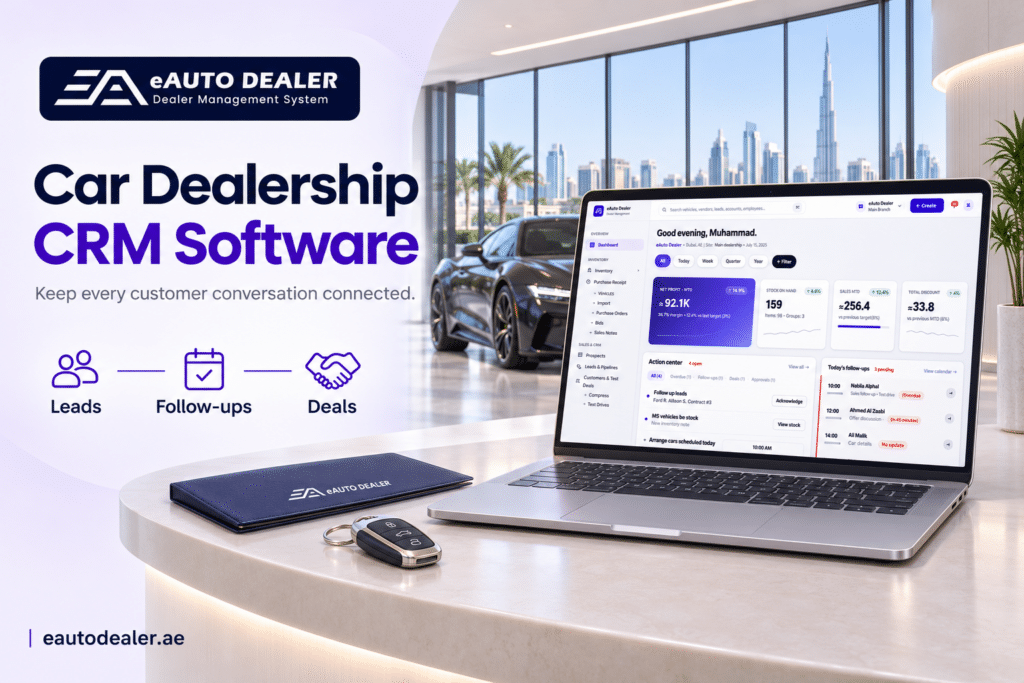

Selling a vehicle involves several stages, from receiving the first customer enquiry to arranging a showroom visit, discussing prices, completing paperwork, and finalizing the transaction. Managing each stage manually can become difficult when a dealership handles multiple enquiries and customers at the same time.
A Car Dealership CRM Software helps organize this journey by bringing customer information, sales activities, follow-ups, and opportunity tracking into one system. It allows sales representatives to understand customer requirements, monitor each enquiry, and maintain communication throughout the buying process. For dealerships, a structured CRM workflow can reduce missed opportunities, improve team coordination, and provide better visibility into sales performance.
What is Car Dealership CRM Software?
Car dealership CRM software is a customer relationship management solution designed to support the sales and customer management requirements of automotive businesses. It helps dealerships record enquiries, maintain customer profiles, track vehicle interests, manage sales opportunities, and organize follow-up activities.
Unlike a basic contact database, an automotive CRM focuses on the steps involved in selling vehicles. It gives sales teams a structured way to manage potential buyers and maintain records of their interactions with the dealership.
Depending on the platform, its features may include:
- Customer enquiry and lead management
- Customer profiles and communication history
- Vehicle preferences and requirements
- Lead assignment and sales pipeline tracking
- Follow-up reminders and task management
- Appointment and showroom visit records
- Quotations and sales activity tracking
- Sales performance reports
The purpose is to make customer management more organized and help representatives maintain a consistent process from the first interaction to the final sale.
Understanding the Complete Car Sales Process
A vehicle purchase rarely happens through a single conversation. Customers usually research different models, compare prices, ask questions, visit showrooms, and discuss payment options before making a decision.
For a dealership, managing this journey requires accurate customer information and timely communication.
A typical car sales process includes:
- Receiving an enquiry from a potential buyer.
- Recording customer details and vehicle requirements.
- Assigning the enquiry to a sales representative.
- Contacting the customer and understanding their needs.
- Sharing suitable vehicle options and arranging a viewing.
- Preparing a quotation and discussing pricing.
- Following up on the customer’s decision.
- Finalizing the sale and updating the relevant records.
- Maintaining the customer relationship after the purchase.
CRM software helps dealerships organize these activities so that sales representatives can see what has happened, what needs attention, and which opportunities are still active.
9 Ways Car Dealership CRM Software Helps Manage the Sales Process
1. Captures Customer Enquiries from Different Sources
The sales process begins when a potential buyer shows interest in a vehicle. Enquiries may come through a dealership website, phone call, social media, online listing, or direct showroom visit.
When enquiries are recorded in different places, sales representatives may struggle to track them consistently. Some details might remain in emails, while others are saved in personal notes or spreadsheets.
A CRM system provides a structured place to record and organize customer enquiries. Depending on available integrations, it may also help collect leads from connected channels.
This gives the sales team a clearer view of incoming opportunities and helps reduce the risk of overlooking potential buyers.
2. Maintains Complete Customer Profiles
Knowing what a customer wants is essential for providing useful assistance. A buyer may be interested in a particular vehicle model, manufacturing year, mileage range, budget, or set of features.
CRM software allows representatives to maintain customer details and record relevant preferences. It can also store previous conversations, enquiry history, and notes from showroom visits.
With organized profiles, employees do not need to repeatedly ask customers for information they have already provided. They can use the available history to make conversations more relevant and efficient.
3. Assigns Leads to the Right Sales Representatives
When several employees handle customer enquiries, dealerships need a clear process for assigning responsibilities.
Without lead assignment, two representatives might contact the same buyer, while another enquiry receives no attention.
A CRM system can help managers assign leads to specific employees and track their progress. Depending on the software, assignments may be based on availability, showroom location, vehicle category, or internal sales responsibilities.
This improves accountability and makes it easier for managers to review how enquiries are being handled.
4. Tracks Every Opportunity Through the Sales Pipeline
A sales pipeline shows the current position of each customer opportunity. Instead of treating every enquiry as an immediate sale, representatives can monitor how buyers progress through different stages.
A dealership may use stages such as:
- New enquiry
- Initial contact
- Customer requirements confirmed
- Vehicle options shared
- Showroom visit scheduled
- Quotation provided
- Negotiation in progress
- Sale completed
- Opportunity lost
CRM software helps employees update these stages as conversations develop. Managers can review the pipeline to identify active deals, delayed opportunities, and enquiries that need additional attention.
5. Organizes Showroom Visits and Appointments
A customer may want to inspect a vehicle, take a test drive, or discuss available options before making a purchase decision.
If appointment details are maintained in separate calendars or messages, sales teams may find it difficult to coordinate schedules.
CRM functionality can help record appointments, assign tasks, and maintain notes about customer visits. This allows representatives to prepare before the customer arrives and follow up after the meeting.
For dealerships with multiple sales representatives, organized appointment records can also support better coordination.
6. Manages Quotations and Price Discussions
Pricing is an important part of the vehicle buying process. Customers may ask for different vehicle options, compare offers, or negotiate before confirming their purchase.
CRM software can help representatives maintain records of quotations and related sales discussions, depending on the available features. Keeping these details connected with the customer profile makes it easier to review previous offers and understand the current status of an opportunity.
When connected with inventory and pricing information, the system may also help employees work with more relevant vehicle details.
7. Schedules Follow-Ups at the Right Time
Many customers do not make a purchase decision during their first interaction. They may need additional time to compare vehicles, discuss the purchase with family members, or arrange their budget.
Without a proper follow-up process, representatives may forget to contact interested buyers.
CRM software helps teams schedule reminders, assign follow-up tasks, and record communication updates. This makes it easier to maintain contact at appropriate stages without depending entirely on memory.
Consistent follow-ups can help dealerships maintain customer interest and give buyers the information they need to make a decision.
8. Connects Sales Activities with Vehicle Inventory
A customer enquiry is useful only when the dealership can respond with relevant vehicle information. Sales representatives need to know whether a vehicle is available, reserved, or already sold.
When CRM works alongside inventory management, employees can connect customer requirements with dealership stock information, depending on the system’s integration.
This can help representatives:
- Review vehicles that match customer preferences.
- Check relevant vehicle details and specifications.
- Respond to availability questions more confidently.
- Track customer interest in specific vehicles.
- Reduce confusion caused by outdated stock information.
For automotive dealerships, this connection is important because customer enquiries and vehicle availability directly influence the sales process.
9. Monitors Sales Results and Team Performance
Dealership managers need to understand how effectively their sales teams are handling enquiries and converting opportunities.
CRM reporting can provide information about lead sources, follow-up activity, pipeline stages, completed sales, and individual employee performance.
Useful reports may include:
- Total enquiries received
- Leads assigned to each representative
- Customer follow-up activity
- Showroom appointments
- Quotations shared
- Won and lost opportunities
- Lead conversion rates
- Sales performance by period
These reports help managers identify where the sales process is working well and where additional attention may be needed.
Manual Sales Management vs CRM-Based Sales Management
Some dealerships still depend on spreadsheets, notebooks, and separate communication tools to manage customers. These methods may work for a small number of enquiries, but they can become difficult to coordinate as sales activity increases.
|
Sales Activity |
Manual Management |
CRM-Based Management |
|
Enquiry records |
Separate sheets and messages |
Centralized lead records |
|
Customer history |
Manually collected |
Organized customer profiles |
|
Lead assignment |
Informal communication |
Assigned responsibilities |
|
Sales pipeline |
Manually updated lists |
Structured opportunity stages |
|
Follow-ups |
Personal reminders |
Scheduled tasks and reminders |
|
Appointment records |
Separate calendars |
Connected activity records |
|
Sales reporting |
Manual calculations |
CRM reports and dashboards |
|
Team monitoring |
Limited visibility |
Activity and pipeline tracking |
CRM software does not remove the need for good sales practices. It provides a structured environment in which representatives can follow those practices more consistently.
Why Automotive CRM Is Different from General CRM Software
A general CRM system may be suitable for businesses that mainly manage contacts, communication, and sales opportunities. However, car dealerships have additional requirements because their sales process revolves around individual vehicles.
Automotive CRM should support the connection between customer preferences and vehicle information.
For example, a customer may contact a dealership looking for a specific model, year, mileage range, and budget. The sales representative needs to record those requirements and identify suitable vehicles.
A dealership-focused CRM can provide a more relevant workflow by supporting:
Vehicle-Specific Customer Requirements
Representatives can record which vehicle types, models, specifications, and price ranges interest each buyer.
Enquiry and Inventory Coordination
When CRM is connected with inventory, sales teams can compare customer requirements with available stock information.
Multiple Sales Opportunities
A customer may be interested in more than one vehicle. CRM helps maintain records of different options and related conversations.
Dealership Sales Activities
The system can support tasks such as showroom appointments, quotations, negotiations, and sales follow-ups.
These automotive-focused functions make CRM more relevant to the daily work of car dealerships.
Benefits of Managing the Complete Sales Journey in One CRM
Using CRM throughout the sales process can improve more than just customer record management. It can help dealerships create a consistent approach across their sales teams.
Key benefits include:
- Fewer missed enquiries: Centralized lead records make incoming opportunities easier to track.
- More consistent communication: Representatives can review previous conversations before contacting customers.
- Improved accountability: Lead assignments make responsibilities clearer.
- Better pipeline visibility: Managers can see which opportunities are progressing and which need attention.
- Organized customer information: Vehicle preferences and enquiry history remain easier to access.
- Efficient follow-up management: Scheduled reminders help representatives manage pending communication.
- More informed sales decisions: Reports provide useful information about customer activity and sales performance.
- Stronger customer experience: Organized records help employees provide more relevant assistance.
The results depend on the quality of the CRM, the accuracy of the information entered, and how consistently employees use the system.
How CRM Integration with Other Dealership Functions Improves Sales Management
CRM becomes more useful when it works with other dealership operations. Customer management is connected to vehicle stock, purchasing, quotations, accounting, and reporting.
CRM and Inventory Management
Inventory integration helps representatives review available vehicles while handling customer enquiries. This can reduce delays when buyers ask about specific models or vehicle specifications.
CRM and Accounting
When sales and accounting functions are connected, relevant customer and transaction details can move into the financial workflow. This may help reduce duplicate data entry and support more organized invoice and payment records.
CRM and Purchasing
Information about customer demand can help dealerships understand which types of vehicles attract interest. When considered alongside purchasing and stock reports, this information may support better inventory planning.
CRM and Reporting
Combining sales activity with other dealership information can give managers a broader view of business performance.
An integrated system helps reduce the separation between customer-facing activities and back-office operations.
What Should Car Dealers Look for in CRM Software?
Choosing the right CRM requires understanding the dealership’s sales process and operational requirements. A system should support the way the team works rather than create unnecessary steps.
Before selecting software, consider these features:
- Lead capture: Check how the system records enquiries from different channels.
- Customer profiles: Make sure it stores contact information, preferences, and interaction history.
- Lead assignment: Review how managers distribute enquiries among sales representatives.
- Pipeline customization: Confirm that sales stages can match your dealership’s process.
- Follow-up management: Look for reminders, tasks, and activity tracking.
- Vehicle inventory connection: Check whether CRM can access relevant stock information.
- Reporting tools: Review lead, conversion, and employee performance reports.
- Integration capabilities: Consider how the CRM connects with accounting and other dealership functions.
- Ease of use: Make sure employees can learn and use the system comfortably.
- Support and scalability: Review training, implementation assistance, and future growth options.
For UAE dealerships, it is also useful to consider multi-branch requirements, data security, and the provider’s ability to support local business operations.
How eAuto Dealer Supports Dealership Sales and Customer Management
For car dealerships, managing customer enquiries effectively requires coordination between sales activities and other operational functions.
eAuto Dealer UAE provides a dealership management solution with relevant capabilities for sales and CRM, vehicle inventory, purchasing, accounting, and reporting.
Its dealership-focused approach can help businesses organize customer information, manage sales activities, and maintain better visibility across related operations.
For example, sales teams can use CRM-related functions to manage enquiries and follow-ups, while inventory information can support discussions about vehicle availability. Connected dealership functions can also help businesses maintain more organized records across departments.
When evaluating eAuto Dealer, dealerships should review the available modules and how they fit their current sales process, customer management requirements, and business structure.
Common CRM Mistakes That Can Affect the Car Sales Process
Even with suitable software, dealerships may struggle to achieve good results if customer information is not maintained properly or employees do not follow a consistent process.
Avoid these common mistakes:
- Not updating lead status: Outdated pipeline information makes it difficult to understand which opportunities are active.
- Recording incomplete customer details: Missing vehicle preferences or contact information can affect future communication.
- Delaying follow-ups: Interested customers may lose attention if representatives do not respond at appropriate times.
- Ignoring lead assignments: Unclear responsibilities can cause duplicate communication or unattended enquiries.
- Using CRM only as a contact list: The system should support the complete sales workflow, not just store phone numbers.
- Overlooking employee training: Representatives need to understand how to record activities and update customer records.
- Not reviewing reports: Managers should regularly use CRM information to identify delays and improve sales processes.
Final Thoughts
Managing the complete car sales process requires more than collecting customer names and contact numbers. Dealerships need to track enquiries, understand vehicle requirements, organize appointments, prepare quotations, maintain follow-ups, and monitor sales opportunities. When these activities are managed manually, important details can become difficult to track as the number of customers increases.
Car Dealership CRM Software provides a structured way to manage each stage of the customer journey. By connecting lead management, customer profiles, sales pipelines, follow-ups, and relevant dealership functions, it helps teams maintain better visibility and work more consistently. For dealerships looking to improve their sales operations, choosing an automotive-focused CRM can support a more organized process from the first enquiry to the final vehicle sale.
Frequently Asked Questions (FAQs)
1. What is car dealership CRM software?
Car dealership CRM software is a customer relationship management solution designed for automotive businesses. It helps manage customer enquiries, contact records, vehicle preferences, sales opportunities, follow-ups, and communication history.
2. How does CRM software manage the complete car sales process?
It helps dealerships record enquiries, assign leads, maintain customer profiles, track sales stages, arrange appointments, manage quotations, schedule follow-ups, and monitor completed or lost opportunities.
3. Why is CRM important for car dealerships?
CRM helps dealerships organize customer information and maintain consistent communication. It also provides better visibility into sales opportunities, follow-up activities, and team performance.
4. What is the difference between automotive CRM and general CRM?
General CRM software manages customer relationships across different industries. Automotive CRM is designed around dealership workflows and can support vehicle-specific enquiries, inventory coordination, showroom activities, and vehicle sales.
5. Can CRM software track vehicle enquiries?
Yes. CRM software can record customer interest in specific vehicle models, specifications, budgets, and other requirements. This information helps representatives understand what potential buyers are looking for.
6. How does CRM help car sales representatives?
It gives representatives organized access to customer records, enquiry history, pending tasks, and sales opportunities. This helps them manage conversations and follow-ups more effectively.
7. Can CRM software improve lead conversion?
CRM can support lead conversion by helping sales teams respond to enquiries, prioritize opportunities, maintain follow-ups, and monitor the sales pipeline. Actual conversion results also depend on customer demand, pricing, service quality, and sales practices.
8. Does dealership CRM software connect with inventory management?
Some automotive CRM platforms integrate with inventory management. This allows sales representatives to review relevant vehicle information and availability while handling customer enquiries.
9. What reports should a car dealership CRM provide?
Useful reports may include total enquiries, lead sources, assigned leads, follow-up activities, showroom appointments, pipeline stages, conversion rates, and individual sales performance.
10. How should a dealership choose the right CRM system?
A dealership should review lead management, customer profiles, sales pipeline tracking, follow-up reminders, vehicle inventory integration, reporting, ease of use, security, and available support before selecting a CRM solution.