
Why Waterproofing Fails on Weak Roof Screeds
Most roofs in Pakistan have a cement-sand screed laid over the RCC slab to create slope. On many sites, this screed is mixed lean, laid quickly and cured poorly in summer heat. The result is a surface that looks solid but powders when you scratch it.
Any coating applied on such a surface bonds to the loose top layer, not to sound material. When the roof heats and cools, or when water gets behind the coating, the weak layer breaks away and takes the coating with it.
The same problem appears in other places:
- Old and carbonated concrete that has lost strength near the surface over the years
- Dusty industrial and warehouse floors that keep shedding powder
- Weathered cement plaster on facades that chalks when touched
- Precast elements and fair-faced concrete that need conditioning before a sealer or coating
Removing and relaying a screed is expensive and slow. A concrete densifier treats the existing surface instead.
What is Hydrobloc SD 730?
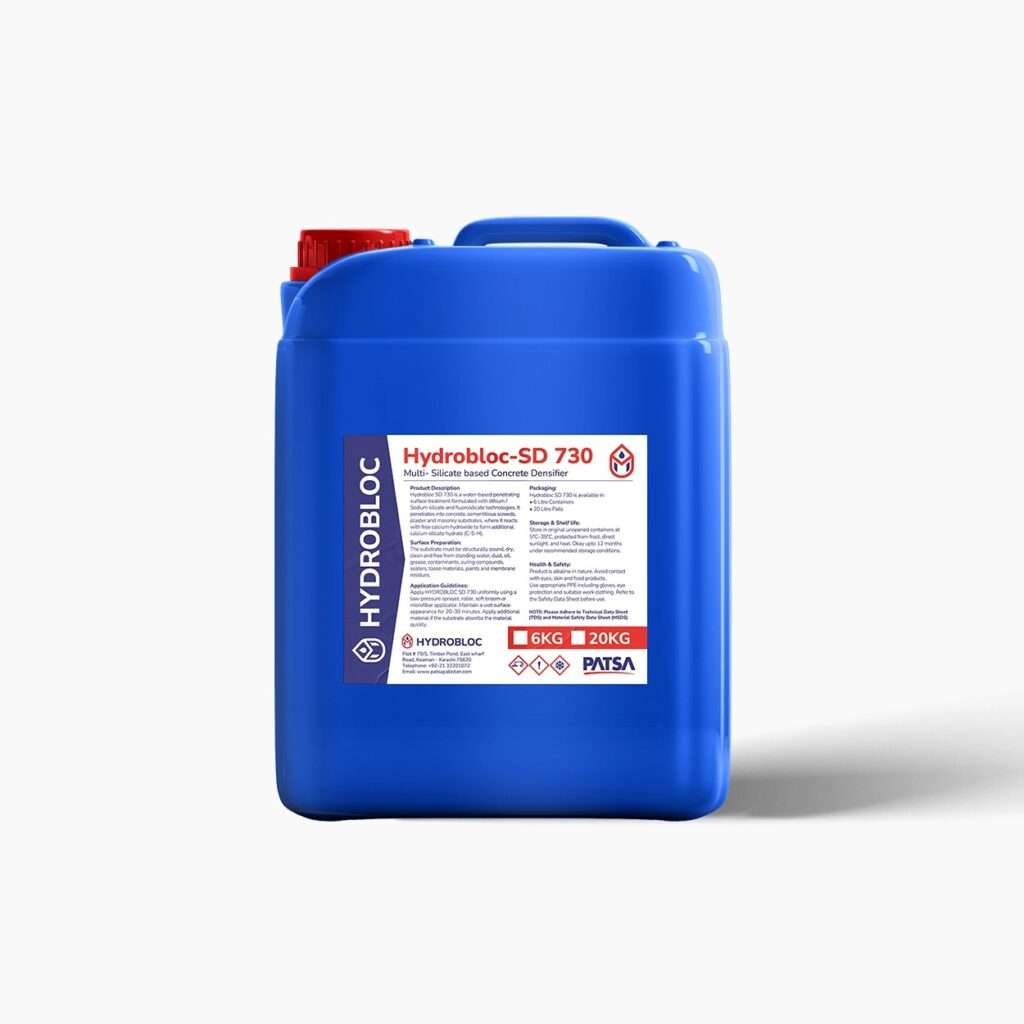
Hydrobloc SD 730 is a multi-silicate concrete densifier. It is a water-based penetrating surface treatment made with lithium/sodium silicate and fluorosilicate technologies.
It soaks into concrete, cementitious screeds, plaster and masonry. Inside the surface, it reacts with free calcium hydroxide and forms additional calcium silicate hydrate (C-S-H), which is the compound that gives cement its strength. More C-S-H in the pores means a denser, harder and more durable surface.
SD 730 is not a film-forming coating. It becomes part of the substrate and does not significantly change how the surface looks. It is also not a standalone waterproofing system. Its job is to make the base stronger so the waterproofing on top can perform.
Key features and benefits
- Deep penetrating densification
- Improves surface hardness and abrasion resistance
- Reduces dusting and chalking
- Lowers water absorption and permeability
- Improves cohesion of the substrate
- Improves adhesion of the coatings applied afterwards
- Breathable, VOC-free and easy to apply
- Suitable for interior and exterior use
Where to Use Hydrobloc SD 730
- Weak or dusty concrete surfaces, carbonated concrete and aged RCC structures
- Dusty roof screeds, cement-sand screeds and weak protection screeds
- Fair-faced and architectural concrete, precast elements
- Cement plaster facades
- Industrial floors, warehouse floors, parking decks and service areas
The TDS also recommends SD 730 before acrylic waterproofing coatings, cementitious waterproofing systems, epoxy primers, elastomeric coatings, silane/siloxane sealers and protective coating systems.
How to Apply Hydrobloc SD 730
1. Prepare the surface
The substrate must be structurally sound, dry and clean. Remove standing water, dust, oil, grease, curing compounds, old sealers, paint and membrane residues. Take off loose particles, laitance and crumbling material by mechanical brushing, grinding, vacuuming or high-pressure water cleaning, then let the surface dry.
2. No mixing needed
SD 730 is a ready-to-use liquid. Stir it lightly if needed.
3. Apply
- Apply evenly with a low-pressure sprayer, roller, soft broom or microfiber applicator.
- Keep the surface looking wet for 20–30 minutes.
- Add more material where the surface absorbs it quickly.
- Let it penetrate. Avoid puddles.
- Once absorption is complete, remove the excess with a squeegee, damp mop or microfiber cloth. Do not let excess dry as a film on top.
Do not apply on frozen surfaces, during rain, on painted or sealed surfaces, or where water ponds.
Frequently Asked Questions
Q) What does a concrete densifier do?
It penetrates the surface and reacts with free lime in the concrete to form extra C-S-H, making the surface denser and harder. Hydrobloc SD 730 reduces dusting by up to 90%.
Q) Is Hydrobloc SD 730 a waterproofing product?
No. It lowers water absorption by 35–60%, but the TDS states it is not a standalone waterproofing system. Use it as preparation under a waterproofing coating.
Q) Can I apply waterproofing directly after SD 730?
Wait at least 24 hours at 25°C. On weak roof screeds, apply UniPrime or the specified primer before the waterproofing system.
Q) Will SD 730 change the colour of my concrete?
It is colourless and non-film-forming, so it does not significantly change the surface appearance.
Q) Can I use SD 730 on a painted surface?
No. It must penetrate the substrate, so paint, sealers and membrane residues must be removed first.
Conclusion
No waterproofing coating can be stronger than the surface it sits on. When roof screeds, old concrete or warehouse floors are weak and dusty, Hydrobloc SD 730 strengthens them from within, cuts dusting by up to 90% and improves the bond of the next layer. It is a small step that protects your investment in waterproofing. Order Hydrobloc SD 730, browse the Surface Treatments range, or send a photo of your surface to the PATSA team on WhatsApp (+92 300 2288788) for advice.