
Introduction
The 2048 game is a popular number-based puzzle game that combines mathematics, logical thinking, planning, and entertainment. Since its introduction in 2014, it has attracted millions of players around the world because of its simple rules and challenging gameplay. Although the game appears easy at first, achieving a high score requires careful thinking, patience, and strategic decision-making. The main objective is to combine numbered tiles on a grid until a tile with the value of 2048 is created. However, reaching this goal is not as simple as it sounds. Every movement changes the arrangement of the board, and one careless decision can make it difficult or even impossible to continue playing successfully.
The popularity of 2048 demonstrates how a simple idea can become an engaging digital experience. Unlike many modern video games that require advanced graphics, complicated controls, or expensive equipment, 2048 can be played on a basic computer, smartphone, or tablet. Its straightforward design makes it suitable for people of different ages and backgrounds. At the same time, its mathematical structure provides an interesting challenge for players who enjoy solving problems. This essay explores the history, rules, mathematical foundations, strategies, benefits, challenges, and educational value of the 2048 game.
1. History and Development of the 2048 Game
The 2048 game was created by Italian developer Gabriele Cirulli in March 2014. He developed it as a personal project and released it as a free browser-based game. The original version was inspired by earlier puzzle games, particularly Threes!, which also involved combining numbered tiles. Cirulli designed 2048 to be simple, accessible, and enjoyable without requiring players to pay for it.
The game became extremely popular shortly after its release. Its success spread rapidly through social media, online gaming communities, and word-of-mouth recommendations. Many people enjoyed sharing their scores and challenging friends to achieve the 2048 tile. The game’s popularity also encouraged developers to create mobile applications and different versions with alternative designs and features.
One important reason for its success was its accessibility. Players did not need to create an account, purchase expensive equipment, or learn complicated instructions. They could simply open the game and start playing. The original version was also open-source, allowing other developers to study its code and create their own variations.
Over time, 2048 became more than just a casual puzzle. It developed into an example of how effective game design can combine simplicity and complexity. Its rules are easy to understand, but the challenge increases as players attempt to manage more tiles and limited space.
2. Basic Rules and Gameplay
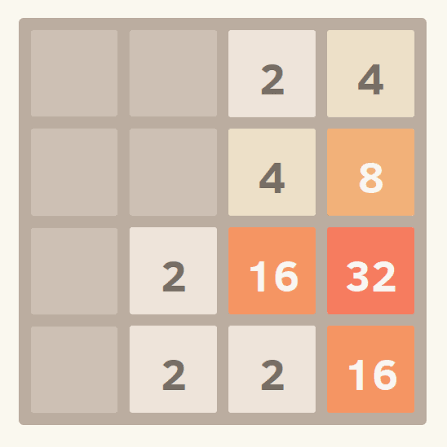
The traditional 2048 game is played on a square grid containing sixteen spaces arranged in four rows and four columns. At the beginning of the game, two numbered tiles usually appear on the board. Most tiles contain either the number 2 or 4.
The player controls the tiles using four possible movements: up, down, left, and right. Whenever a direction is selected, all movable tiles slide as far as possible toward that side of the grid.
When two tiles with identical numbers collide during a movement, they combine into a single tile whose value is twice the original number. For example, two tiles containing 2 combine to create 4, while two tiles containing 8 combine to create 16.
After each valid move, a new tile usually appears in an empty space. This new tile generally has a value of 2 or, less frequently, 4. As the game continues, the board gradually becomes more crowded.
The main objective is to create a tile containing the number 2048. However, players can continue playing after reaching this milestone in versions that support continued gameplay.
The game ends when there are no empty spaces and no adjacent tiles with matching values that can be combined. At this point, the player has no available moves.
Although these rules are relatively simple, the game requires players to think several steps ahead. Every movement affects the entire board, making each decision important.
3. Mathematical Foundations of 2048
Mathematics is one of the most important elements of the 2048 game. The numbers on the board follow a pattern based on powers of two. Each successful combination doubles the value of a tile.
The sequence of numbers commonly found in the game is:
2, 4, 8, 16, 32, 64, 128, 256, 512, 1024, and 2048.
This sequence can be expressed mathematically as:
Therefore, the number 2048 is equal to:
This means that eleven powers of two are required to reach the target value from the starting value of 2.
The process of combining tiles also demonstrates exponential growth. Each time two identical tiles merge, their value doubles. For example:
-
Two 2 tiles produce 4.
-
Two 4 tiles produce 8.
-
Two 8 tiles produce 16.
-
Two 16 tiles produce 32.
-
Two 32 tiles produce 64.
This pattern continues until the player reaches 2048.
Another interesting mathematical feature is conservation of the total numerical value. When two tiles combine, their values are added together. For example, combining two 16 tiles produces a 32 tile. The total value remains 32 before and after the combination.
The appearance of new tiles increases the total numerical value on the board. Consequently, the game combines addition, multiplication, powers, and probability in an interactive environment.
These mathematical principles make 2048 an enjoyable way to explore numerical patterns and basic arithmetic.
4. Strategies for Winning the Game
Although luck plays a role in 2048 because new tiles appear in different locations, successful players rely heavily on strategic planning. Developing an effective strategy can greatly improve the chances of reaching the target.
Keeping the largest tile in one corner
One of the most popular strategies is to keep the largest tile in a fixed corner, such as the bottom-right or bottom-left corner. This approach helps organize the board and prevents the largest tile from moving randomly.
Players then arrange smaller tiles around the largest tile in descending order. This creates a structured pattern that makes combinations easier.
Choosing a preferred direction
Another useful strategy is to select two main movement directions and avoid unnecessary movements in the opposite directions. For example, a player who keeps the largest tile in the bottom-right corner might mainly use the right and down movements.
This reduces the possibility of accidentally moving the largest tile away from its intended position.
Planning several moves ahead
Players should not focus only on the immediate result of a movement. Instead, they should consider how the board might look after the next two or three moves.
For example, moving a row of tiles to the left might create an immediate combination, but it could also separate two important tiles that would otherwise combine later.
Maintaining empty spaces
Empty spaces are extremely valuable in 2048. They provide room for movement and allow new tiles to appear without blocking important combinations.
Players should avoid filling the board unnecessarily. Combining smaller tiles whenever possible helps maintain enough empty spaces for future movements.
Combining smaller tiles first
Another effective approach is to organize smaller tiles before attempting to combine larger ones. This creates a more orderly board and makes it easier to build larger numbers gradually.
Overall, the best strategy involves balancing short-term combinations with long-term planning.
5. The Role of Logic and Problem-Solving
The 2048 game is not simply about moving numbers randomly. It is a puzzle that requires logical thinking and problem-solving skills.
Every move presents a decision. Players must examine the current arrangement of tiles, identify possible combinations, and predict the consequences of different movements.
For example, a player may have three possible choices: move left, move down, or move right. Each choice produces a different arrangement of the board. The player must determine which movement creates the greatest opportunity for future combinations.
This process is similar to solving mathematical problems. A person identifies the available information, evaluates different possibilities, and selects the most appropriate solution.
The game also encourages flexible thinking. Sometimes a strategy that works well at the beginning becomes ineffective later because the board becomes crowded. Players must recognize these changes and adjust their approach.
In addition, 2048 encourages players to learn from mistakes. When an unsuccessful move causes the board to become disorganized, players can examine what happened and avoid making the same decision in future games.
For these reasons, 2048 can be considered an enjoyable exercise in logical reasoning and decision-making.
6. Educational Benefits of the 2048 Game
The 2048 game offers several educational benefits, particularly for students who want to improve their mathematical and analytical abilities.
First, it strengthens basic arithmetic skills. Players repeatedly add numbers and recognize numerical relationships when combining tiles. This provides a practical way to understand doubling and multiplication.
Second, the game introduces exponential patterns. Since each tile represents a power of two, players become familiar with the concept of exponential growth. They can observe how numbers increase rapidly through repeated doubling.
Third, 2048 encourages concentration. Players must pay attention to the position and value of each tile. Losing focus for even a moment can result in an unsuccessful movement.
Fourth, the game develops planning skills. Players learn that successful outcomes often require preparation and patience rather than immediate action.
Fifth, it can encourage persistence. Reaching 2048 may take several attempts, and players often need to experiment with different strategies before achieving success.
The game may also be used as an educational activity in classrooms. Teachers can introduce it during mathematics lessons to demonstrate powers of two, addition, multiplication, and basic probability.
However, it is important to remember that playing 2048 does not automatically guarantee significant improvements in intelligence or academic performance. Its educational value depends on how players approach the game and whether they reflect on the mathematical and logical processes involved.
7. Probability and Randomness in 2048
An important feature of 2048 is the element of randomness. After a valid movement, a new tile appears in an empty position. In the original game, the new tile is generally a 2, while a 4 appears less frequently.
This random element makes every game different. Even when players follow the same strategy, the positions of newly generated tiles can create different situations.
Probability therefore influences the outcome of the game. Players cannot completely control where new tiles appear, but they can control how they arrange the existing tiles.
For example, a player who maintains several empty spaces has more flexibility when a new tile appears. On the other hand, a player who fills nearly every space may struggle when a new tile blocks an important combination.
Randomness makes the game unpredictable and prevents it from becoming a completely repetitive activity.
The relationship between strategy and probability is one of the reasons 2048 remains interesting. Players must make the best possible decisions despite having incomplete control over future events.
8. Challenges and Difficulties Faced by Players
Despite its simple appearance, 2048 can become increasingly difficult as the game progresses.
One major challenge is limited space. The board contains only sixteen positions, and each new tile occupies an empty position. As the number of tiles increases, available movement becomes restricted.
Another difficulty is maintaining the correct order of numbers. Players often need to arrange tiles in a specific pattern so that larger values can be combined efficiently. A single unexpected movement can disrupt this arrangement.
A third challenge involves making decisions under pressure. When only one or two empty spaces remain, players may feel forced to make quick decisions. However, rushing often leads to mistakes.
The random appearance of new tiles creates additional uncertainty. A new tile may appear in a position that blocks an important movement or separates two tiles that could otherwise combine.
Finally, reaching 2048 requires patience. Some games end quickly because of poor decisions or unfavorable tile placement. Players may need to restart several times before achieving their goal.
These difficulties demonstrate that success depends on a combination of planning, adaptability, and careful decision-making.
9. Psychological and Entertainment Value
The 2048 game is popular not only because of its mathematical elements but also because it provides an enjoyable psychological experience.
One important factor is the satisfaction of combining tiles. Watching two smaller numbers merge into a larger number creates a feeling of progress and achievement.
The game also provides immediate feedback. Every movement changes the board, allowing players to see the results of their decisions instantly.
Another important feature is its simple design. The absence of complicated stories, characters, or controls allows players to concentrate entirely on the puzzle.
2048 can also provide a short recreational activity during breaks or free time. A single game can be played in a relatively short period, making it suitable for casual entertainment.
However, players should maintain a healthy balance between gaming and other responsibilities. Although 2048 can be enjoyable, spending excessive time playing any game may interfere with studying, working, sleeping, or other activities.
Therefore, the game is most beneficial when treated as a form of entertainment rather than an activity that replaces important daily responsibilities.
10. Technology and Different Versions of 2048
The development of 2048 also demonstrates the influence of modern technology on digital entertainment.
The original game was designed for web browsers and could be played without installing complicated software. Its simple interface made it compatible with different devices.
As its popularity increased, developers introduced mobile versions for smartphones and tablets. These versions often included touch controls, score tracking, animations, and additional features.
Many variations of 2048 have also appeared. Some versions use larger grids, while others introduce different numerical systems, themes, or special gameplay rules.
For example, certain versions allow players to use grids larger than four by four. This provides more space and changes the difficulty of the puzzle. Other versions replace traditional numbers with images, symbols, or themed objects.
These variations demonstrate the flexibility of the original concept. The basic idea of combining matching elements can be adapted to create many different experiences.
The game is also an interesting example for computer science students. Its development involves concepts such as arrays, algorithms, random number generation, conditional statements, and user interaction.
Programmers can study how the game checks for possible movements, identifies matching tiles, combines values, and determines whether the game has ended.
11. The Importance of 2048 in Game Design
The success of 2048 provides valuable lessons about effective game design.
One important lesson is that a game does not need complicated graphics to become popular. A simple concept with engaging mechanics can attract a large audience.
Another lesson is the importance of easy-to-understand rules. New players can begin playing almost immediately without reading lengthy instructions.
The game also demonstrates the importance of gradual difficulty. The early stages are relatively easy because the board contains only a few tiles. As the game continues, the number of tiles increases, and the player must make more complicated decisions.
This gradual increase in difficulty encourages players to continue improving their skills.
Furthermore, the scoring system provides a clear way to measure progress. Players can compare their results, set personal goals, and attempt to achieve higher scores.
The combination of simplicity, challenge, feedback, and replayability explains why 2048 became such a successful puzzle game.
12. Future Possibilities of the 2048 Game
Although 2048 is already a successful game, its basic concept offers many possibilities for future development.
One possibility is the introduction of artificial intelligence. AI systems can analyze the board, evaluate possible movements, and recommend strategies. This could help beginners understand the game and allow advanced players to study more complicated techniques.
Another possibility is the development of educational versions. These versions could introduce mathematical challenges involving fractions, multiplication, algebra, or other numerical concepts.
Multiplayer features could also make the game more interactive. Players might compete to achieve the highest tile or complete a puzzle in the shortest time.
Additionally, developers could create versions with customizable board sizes, difficulty levels, and visual themes.
However, future versions should preserve the qualities that made the original game popular: simplicity, accessibility, and enjoyable gameplay.
Conclusion
In conclusion, the 2048 game is much more than a simple digital puzzle. It is an engaging combination of mathematics, logic, probability, strategy, and entertainment. Created by Gabriele Cirulli in 2014, the game became popular because of its straightforward rules and challenging gameplay.
Through the process of combining numbered tiles, players explore powers of two, addition, multiplication, and exponential growth. They also develop opportunities to practice logical reasoning, concentration, planning, and problem-solving.
Although randomness plays an important role, successful gameplay depends largely on the player’s ability to organize tiles, preserve empty spaces, and make thoughtful decisions. The challenges of limited space and unpredictable tile placement make every game a unique experience.
Furthermore, 2048 demonstrates that successful digital entertainment does not always require advanced technology or complicated designs. A simple idea, when developed effectively, can provide hours of enjoyment and meaningful intellectual challenges.
The game 2048 also has educational potential because it introduces mathematical concepts in an interactive and enjoyable way. Its adaptability has encouraged the development of numerous versions and applications.
Ultimately, 2048 is a valuable example of how mathematics and entertainment can work together. It teaches players that patience, planning, and persistence are essential for achieving difficult goals. Whether played for relaxation, education, or competition, 2048 remains an excellent puzzle that challenges the mind while providing an enjoyable gaming experience.