

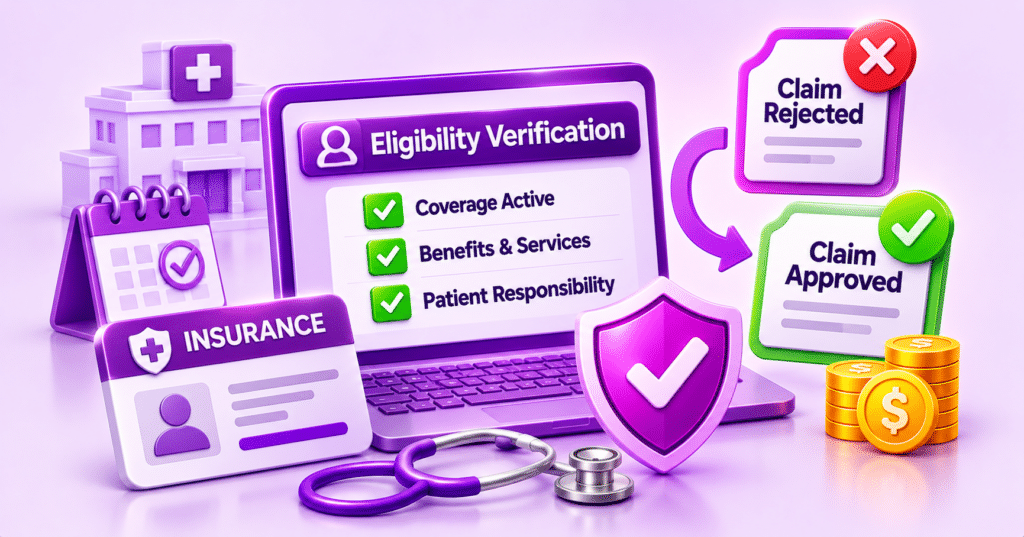

For a healthcare practice, the Role of Patient Eligibility Verification in Preventing Claim Rejections is not an abstract billing concern. It affects the handoffs between clinical work, patient information, payer rules, and the money ultimately collected. The useful question is where the process breaks and what evidence would show that a correction worked.
Eligibility is a time-sensitive check
Insurance information collected at booking can be obsolete by the date of service. Coverage may begin, terminate, or change to another product while the appointment remains scheduled.
Verify close enough to the visit to identify changes, and recheck when the patient reports new employment, insurance, or subscriber details.
Know what an eligibility response does and does not say
An electronic eligibility inquiry can confirm enrollment details and sometimes benefit information. It may not establish medical necessity, authorization status, or final claim payment.
Staff should document the response date, payer, plan, and any limitations instead of telling patients that an active policy guarantees coverage.
Check the fields that cause rejections
Review member and group identifiers, subscriber name and relationship, date of birth, payer selection, service date, and provider network participation.
A typo in a subscriber number can cause an immediate front-end rejection; a wrong plan selection can lead to a more complicated downstream denial.
Handle inactive or conflicting coverage
When a payer reports inactive coverage, contact the patient and verify whether another policy is primary. Resolve discrepancies before filing whenever possible.
If the visit proceeds, communicate financial expectations using the practice’s policy and applicable rules. Do not silently convert an insurance question into an unexpected patient bill.
Track verification exceptions
Measure the share of visits verified before service, the volume of unresolved eligibility exceptions, and eligibility-related rejections after billing.
Use exception trends to improve scripts, registration fields, and staff training. Rechecking every account is less useful than fixing recurring failure points.
A realistic practice scenario
Consider a fictional practice that notices repeated exceptions related to check the fields that cause rejections. Rather than submitting every account again, the team isolates affected claims, checks the source documents, and determines which step introduced the discrepancy. It then corrects the accounts using the payer’s applicable procedures and updates the workflow that produced the errors. This illustration is hypothetical, not a reported client outcome.
Where outsourced billing support fits
A medical billing partner can help monitor claim status, maintain exception queues, analyze rejection and payment patterns, and coordinate corrections with practice staff. Clinical decisions, documentation integrity, payer requirements, and provider oversight remain essential. VerifiMed offers outsourced medical billing, coding, denial management, A/R follow-up, credentialing, and revenue cycle management services.Practices that need additional operational capacity may work with a Medical Billing Company such as VerifiMed for claim follow-up, exception monitoring, and billing coordination while clinical and coverage decisions remain with the appropriate professionals.
Read eligibility responses beyond the active flag
An active policy response is only the start of verification. Staff may still need to confirm the benefit category, plan network, effective dates, deductible, copayment, coordination of benefits, and any service-specific authorization requirements. Eligibility transactions do not guarantee payment. A patient can be enrolled on the visit date while the proposed procedure is excluded or subject to medical-necessity review.
Build a repeatable pre-visit process: identify the payer and product, confirm subscriber details, submit the eligibility inquiry, and flag any missing or conflicting response. For procedures with special rules, verify the specific benefit and referral or authorization requirements through the payer’s accepted channel. Keep the response date and reference number where available. That record helps explain what the team knew when the service was scheduled.
When coverage changes between scheduling and service, recheck near the appointment rather than relying on an old verification. Patients may switch employers, products, or primary coverage. A daily exception report can identify appointments with inactive coverage, mismatched identifiers, or uncertain network status. Route those cases to trained staff for resolution and communicate any estimated patient responsibility according to applicable requirements and practice policy.
Practical review checklist
Assign a clear owner to the workflow, document the evidence required to close an exception, and set a review cadence appropriate to the volume of affected claims.
Separate problems that staff can correct immediately from those requiring payer clarification, clinical documentation, system configuration, or contractual interpretation.
Retest the process after any change. Compare the same measures over a consistent period, and keep examples of resolved cases to support training and quality review.
A final operational safeguard
A policy is only effective when staff can see the next action on an actual account. Record the reason a claim or encounter is held, the supporting evidence, the date of the most recent payer response, and the person responsible for follow-up. This makes work transferable between shifts and helps managers distinguish a one-time exception from a systemic defect. Review closed items as well as open ones: a resolved claim can still reveal an upstream error worth preventing. If a proposed correction affects coding, clinical necessity, coverage, or contract interpretation, involve the appropriate qualified reviewer before changing the record or resubmitting.
A coverage-change example
A patient schedules a diagnostic procedure while insured through one employer but changes plans before the service date. An eligibility check at scheduling can be accurate and still become outdated. The pre-visit team should recheck the current plan, confirm network participation and any service-specific authorization rules, and notify scheduling of unresolved questions. After the visit, the claim should use the coverage in effect on the date of service rather than the policy originally entered. This scenario illustrates why eligibility verification is a timed process rather than a one-time checkbox. The practice should also preserve evidence of the checks and communicate financial expectations carefully.
Final Words
The central lesson of the role of patient eligibility verification in preventing claim rejections is that reimbursement performance depends on the details of the underlying workflow. Focus on the specific exceptions described above, verify changes against actual claim outcomes, and keep patient billing accurate throughout the process.
FAQs
1. What should a practice know about eligibility is a time-sensitive check?
Insurance information collected at booking can be obsolete by the date of service. The best next step is to check actual account records and the relevant payer rules before changing the workflow.
2. What should a practice know about know what an eligibility response does and does not say?
An electronic eligibility inquiry can confirm enrollment details and sometimes benefit information. The best next step is to check actual account records and the relevant payer rules before changing the workflow.
3. What should a practice know about check the fields that cause rejections?
Review member and group identifiers, subscriber name and relationship, date of birth, payer selection, service date, and provider network participation.. The best next step is to check actual account records and the relevant payer rules before changing the workflow.