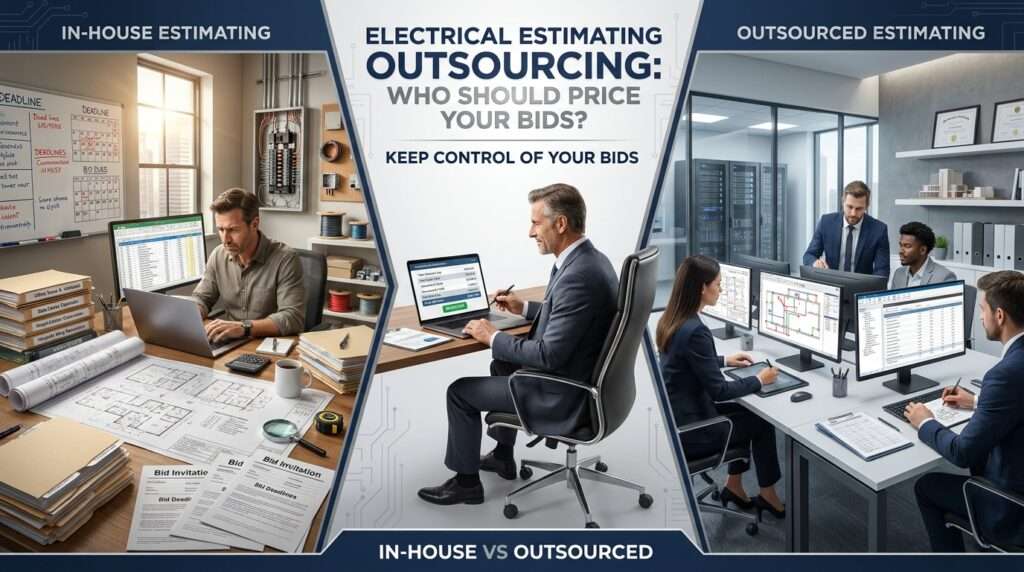

Six electrical bid invitations arrive on Monday. Three are due Friday, two require detailed commercial takeoffs, and one involves unfamiliar lighting controls.
Your estimator already has active projects to support. Hiring another employee might solve the capacity problem, but will there be enough estimating work to justify that position next month?
This is where electrical estimating outsourcing becomes a practical business decision. The real question isn’t simply whether outsourcing costs less than hiring. It’s which parts of the estimating process your company can delegate without losing control of pricing, scope, and final bid decisions.
The First Question: Where Is Your Estimating Bottleneck?
Before hiring or outsourcing, identify what’s slowing down your bids.
Electrical estimating typically involves several activities:
- Reviewing drawings, specifications, and addenda.
- Measuring conduit, wiring, fixtures, and equipment.
- Preparing material schedules and supplier requests.
- Calculating labor hours.
- Comparing vendor and subcontractor quotations.
- Applying overhead, profit, and risk allowances.
- Preparing and approving final proposals.
Not every activity requires the same level of company-specific knowledge.
For example, a properly defined electrical takeoff services assignment can produce measurable material quantities while your internal estimator concentrates on supplier pricing and bid strategy.
However, delegating measurements still requires clear instructions and a quality-review process.
Scenario: Six Electrical Bids, One Estimator
Consider a hypothetical electrical contractor receiving six bid opportunities in one week.
The company estimates the required work as follows:
Activity | Estimated hours |
Drawing reviews | 8 |
Material takeoffs | 22 |
Labor and material pricing | 12 |
Final reviews and proposals | 6 |
Total | 48 |
These hours are illustrative, not an industry benchmark.
If the internal estimator has only 25 hours available for new bids, the company faces a 23-hour capacity gap.
Outsourcing the 22 hours of material takeoffs could substantially reduce the backlog.
But the contractor would still need to review the external work, resolve missing information, and approve the final bids.
This illustrates an important distinction: outsourcing can increase estimating capacity without automatically transferring responsibility for the finished proposal.
When Keeping Estimating In-House Makes Sense
An in-house estimator becomes especially valuable when the contractor receives a steady volume of bids throughout the year.
Internal estimators understand the company’s preferred suppliers, labor productivity, crew capabilities, project history, and pricing strategy.
They can also coordinate directly with project managers and field supervisors.
Keeping estimating in-house may be appropriate when projects require constant collaboration, the workload is predictable, or company-specific knowledge is difficult to transfer.
However, maintaining additional permanent capacity involves salary, benefits, software, training, and management expenses—even during quieter bidding periods.
When Outsourcing Is the Better Fit
Outsource electrical estimating services may suit contractors experiencing irregular bid volume or temporary workload increases.
For example, an electrical subcontractor might comfortably handle residential projects internally but need support measuring a large commercial electrical package.
External estimators can assist with conduit quantities, lighting fixtures, branch circuits, electrical equipment, and other defined scopes.
The contractor should confirm whether the assignment includes quantities only, labor calculations, material pricing, or a complete estimate.
An outsourced takeoff is not automatically a finished bid.
The Hybrid Approach: Divide the Work Without Losing Control
A hybrid estimating arrangement combines external estimating assistance with internal decision-making.
Consider this division of responsibilities:
External estimating team:
- Review assigned drawings and specifications.
- Prepare material quantity takeoffs.
- Organize electrical items by system or category.
- Document assumptions, exclusions, and discrepancies.
- Deliver editable measurement reports.
Internal contractor:
- Confirm supplier and subcontractor pricing.
- Adjust labor productivity for actual crew conditions.
- Evaluate project risks and contractual requirements.
- Apply company overhead and profit.
- Approve and submit the final bid.
This arrangement can preserve company control while increasing production capacity.
The responsibilities should be documented rather than assumed.
Who Determines Electrical Labor Costs?
Labor pricing is one of the most important decisions in an electrical estimate.
Two contractors installing the same conduit system may experience different labor requirements because of crew experience, site access, installation height, congestion, and construction sequencing.
The National Electrical Contractors Association’s 2025–2027 labor estimating reference provides experience-based information for typical electrical and communications installations.
These labor units can support estimating, but contractors should evaluate how well they reflect actual project conditions.
An outsourced estimating provider should understand which labor assumptions the contractor wants applied and document any adjustments.
Test Outsourcing Before Making It a Permanent Arrangement
Rather than transferring every bid immediately, select one project with a clearly defined scope.
Provide the latest drawings, specifications, relevant addenda, required reporting format, and expectations for questions and revisions.
After receiving the estimate, evaluate:
- Were quantities traceable to the drawings?
- Were major electrical components included?
- Were assumptions and exclusions documented?
- How much internal review and correction was required?
- Did the arrangement genuinely improve available bidding capacity?
The answers provide a stronger basis for deciding whether to outsource future projects than advertised turnaround times or low prices alone.
Build an Estimating Process That Fits Your Workload
Electrical contractors don’t always need to choose between a permanent estimator and a fully outsourced department.
The appropriate arrangement depends on workload, trade complexity, internal expertise, and how much pricing responsibility the business wants to retain.
All State Estimation provides electrical estimating and quantity takeoff support for contractors across the United States.
If your electrical bid schedule is becoming difficult to manage, share your project drawings and estimating requirements with All State Estimation to discuss a suitable scope of outsourced support.