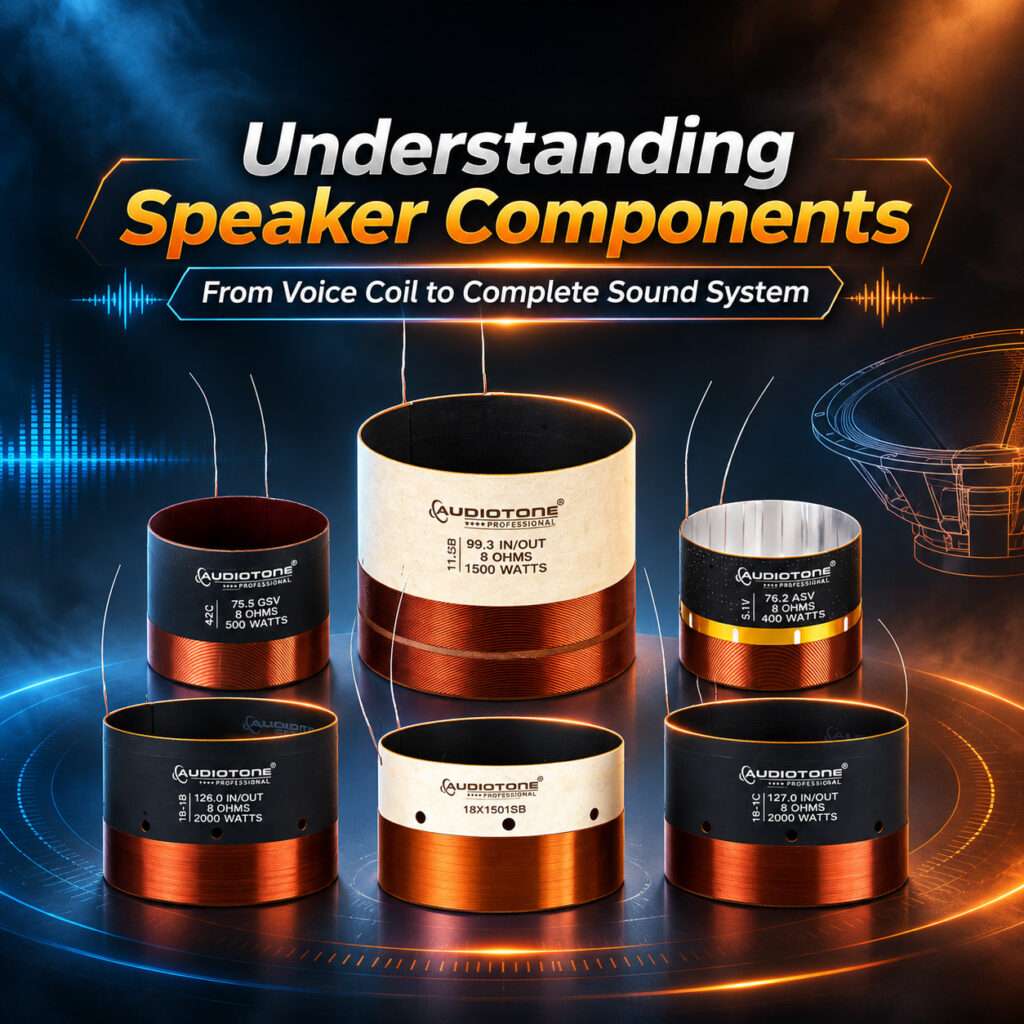

Exploring the Technology Behind Professional Speakers with Audiotone
Behind every powerful sound system is a combination of engineering, technology and precision manufacturing. Whether it is a DJ setup, live concert, auditorium or professional PA system, the quality of sound depends on how different speaker components work together.
At Audiotone, we understand that a high-performance loudspeaker is not just about power output. Every component, from the voice coil to the speaker cone, plays an important role in delivering clear, balanced and reliable sound.
Let’s understand the technology behind the major components of a professional speaker.
1. Voice Coil – The Heart of a Speaker
The voice coil is one of the most important parts of a loudspeaker. It consists of copper or aluminium wire wound around a cylindrical former. When an electrical audio signal passes through it, a magnetic field is generated. Its interaction with the permanent magnet creates movement, allowing the speaker cone to produce sound.
Voice coil design directly influences power handling, heat management and speaker performance. At Audiotone, component quality is an important consideration when developing reliable professional audio products.
2. Magnet – The Driving Force
The magnet creates the permanent magnetic field required for voice coil movement. Its interaction with the electrical current in the voice coil generates the force that drives the speaker.
Commonly used magnet types include ferrite, neodymium and alnico. Each offers different characteristics in terms of weight, magnetic strength, cost and application.
The complete magnet assembly plays an important role in speaker efficiency, sensitivity and performance.
3. Speaker Cone – Converting Movement into Sound
The speaker cone is responsible for moving air and creating sound waves. As the voice coil moves, the cone follows its movement, producing pressure variations that our ears recognise as sound.
Paper, polypropylene, carbon fibre and composite materials are commonly used in cone manufacturing. The selection depends on the speaker’s application, weight, stiffness and acoustic requirements.
Proper cone design helps achieve controlled movement and balanced sound reproduction.
4. Speaker Driver – Bringing Components Together
A speaker driver is an electroacoustic component that converts electrical energy into sound. It combines essential parts such as the voice coil, magnet, cone and suspension system.
Different drivers serve different purposes:
- Woofer: Reproduces low-frequency bass.
- Midrange Driver: Handles vocals and middle frequencies.
- Tweeter: Reproduces high-frequency details.
- Compression Driver: Commonly used in professional PA systems and line arrays.
Choosing the right driver is essential for developing an effective sound system.
5. Spider, Surround and Basket – Maintaining Stability
The spider keeps the voice coil centred, while the surround connects the cone to the speaker frame and allows controlled movement. The basket holds the assembly together and provides structural support.
These components help maintain alignment, mechanical stability and long-term reliability.
Why Speaker Component Quality Matters at Audiotone
At Audiotone, we believe that dependable sound performance starts with understanding the engineering behind every component. Material selection, precision assembly, quality inspection and performance testing are important stages in professional speaker manufacturing.
Every component must work in coordination to deliver the expected sound quality