
The easiest way to make a room picture look tidy is to remove things. The harder part is knowing when to stop. Clear every table, straighten every surface and replace the ordinary furniture, and the image may become neater while losing the reason anyone would spend time there.
For an everyday scene, a fan, a bag of wool or a couple of cups can matter more than another decorative cushion. Before editing, I find it useful to ask a different question: which objects interrupt the picture, and which objects explain it?
Decide what the room is saying
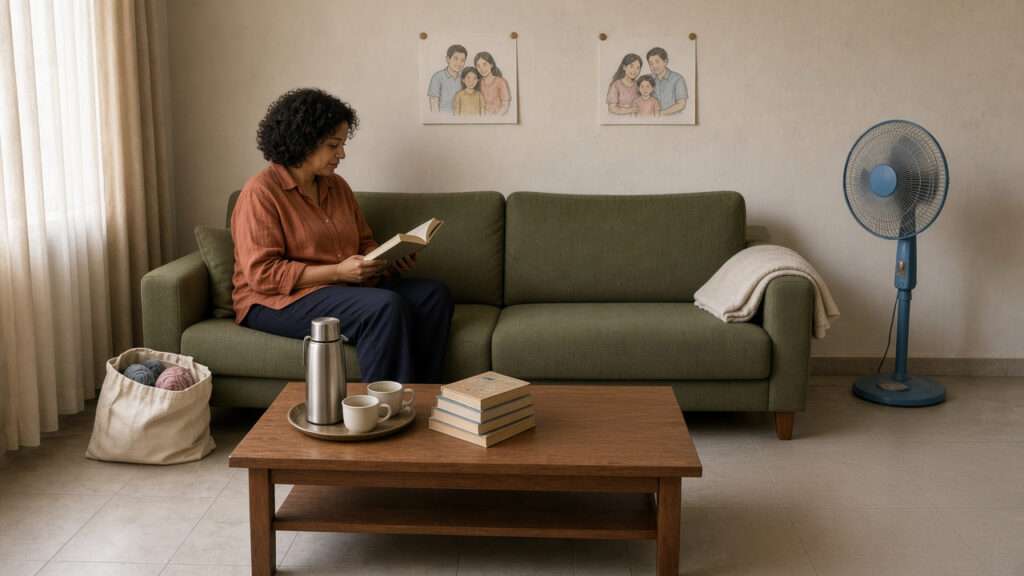
I created a fictional living-room image around a quiet reading moment. A woman in a rust-orange shirt sits on an olive sofa with an open book. Soft light enters from the left. The room has ordinary furniture, a blue pedestal fan, family drawings pinned to the wall and a bag of knitting wool beside the sofa.
The starting image also contains bright snack packets, a plastic bottle and two open cardboard boxes. Those objects give the eye several competing places to go. The boxes make unpacking feel like another possible subject, while the shiny packaging draws attention toward the front of the table.
My aim was to bring attention back to the woman reading, not to give her a different home. That distinction supplied a stopping point: remove the competing objects, but keep the things that make the room feel used and personal.
Sort objects by purpose, not by how ordinary they look
Before writing the edit, I divided the visible objects into three groups: keep, remove and move only if necessary. This is a picture-making decision, not a judgement about how somebody should keep their home.
Describe the intended moment in one sentence before making that list. “A woman takes a reading break with tea nearby” gives you a reason to retain the book and cups. “An empty room ready for new occupants” would lead to a different edit.
The tea flask, two cups and books belonged in the keep group. They give the table a purpose beyond filling empty space. The folded throw suggests comfort; the wool bag suggests another activity within reach. The fan and drawings help the room remain particular rather than becoming a generic furniture display.
The packets, bottle and boxes went into the remove group because they competed with this reading scene. In a picture about moving house or sharing snacks, I might make a different choice. An object’s role depends on the story, not on whether it would appear in a polished interiors photograph.
The third group is useful when an object matters but its position causes a problem. A bag might need moving out of a doorway rather than deleting. I did not request any such move here: the objects I wanted to retain already had workable positions.
Ask for a specific edit, not a better-looking home
I uploaded the original image to Grok Image 2.0 in Image editing mode, using Standard quality and the same 16:9 framing. Rather than asking it to “clean up the room,” I named the removals and the everyday objects that should remain. This was the complete submitted prompt:
Edit this reference image with a selective tidy-up, not a room redesign. Remove only the two bright snack packets and the clear plastic water bottle from the coffee table, and remove both empty cardboard delivery boxes from the front-right floor. Reconstruct the exposed wooden tabletop and tile floor naturally. Keep the adult woman reading the same open book, her rust-orange shirt, navy trousers, face, hair, hands and seated pose. Retain the olive sofa, folded throw, stainless-steel tea flask, both cream cups and their tray, the stack of paperback books, blue pedestal fan, tote bag with visible knitting wool, and the two pinned family drawings. These ordinary objects are part of the room’s lived-in story, not clutter to erase. Preserve their recognizable positions, the window light, curtains, wall, furniture proportions, viewpoint and wide 16:9 framing as closely as possible. Do not replace the furniture, add luxury decor, brighten or restyle the room, smooth away normal wear, add text or extra people. Return one complete edited image.
The instruction about exposed surfaces matters too. Removing packaging reveals wood; removing boxes reveals floor tiles. Those areas need to continue naturally into their surroundings. A clean-looking patch would still draw attention if it interrupted the table edge or the floor’s perspective.
Look at what remains, not just what disappeared
In the returned image, the packets, bottle and boxes are gone. The cleared tabletop gives the tea things and books more space, while the right-hand floor no longer carries a second cluster of large shapes. The woman remains seated with her book, and the fan, wool bag and pinned drawings are still visible.
To me, the scene now reads more clearly as a reading break. It is still furnished for use: there is something to read, something to drink, a throw to reach for and another activity waiting nearby. The improvement comes from choosing which details carry the scene, rather than removing detail everywhere.
Some retained details changed, including the arrangement of the book stack and the shape of the folded throw. The result is therefore not an untouched original with a few objects erased. For this fictional composition, those differences do not overturn the intended reading moment. A job requiring exact possessions or an unaltered documentary record would need a different standard.
Stop before the room loses its character
Compare the two images at the same size, first as whole scenes and then around the edited surfaces. If an important object disappears, make the next request about that specific loss. If the table edge breaks, address that reconstruction instead of asking for another general tidy-up. These are possible next steps, not additional revisions I performed here.
Before keeping the result, check:
- Does the main activity attract attention without needing an explanation?
- Have the chosen distractions disappeared without leaving obvious gaps?
- Do the retained objects still explain how the room is used?
- Are the person, furniture and relationships still recognizable?
- Would removing anything else make the picture clearer, or merely emptier?