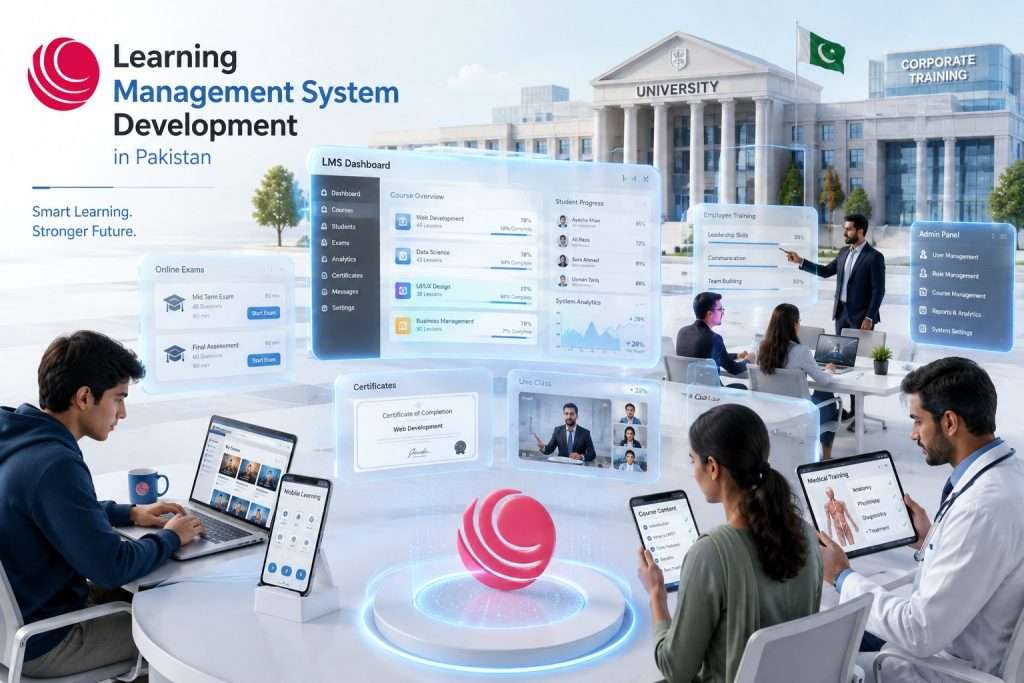

An organization can have great teachers, skilled trainers, expert employees, and valuable course material—but without the right digital platform, managing all of it can become difficult. This is where Learning Management System Development becomes important.
A modern LMS can bring courses, students, teachers, employees, exams, certificates, attendance, video lessons, assignments, payments, reports, and communication into one centralized platform.
For universities and colleges, it can become the digital backbone of online education. For hospitals and medical institutes, it can support staff training and professional education. For companies, it can manage employee onboarding, compliance training, certifications, and internal learning.
In Pakistan, organizations are increasingly looking beyond basic course platforms. They want custom Learning Management Systems that match their own workflows, branding, users, integrations, and business goals.
What Is Learning Management System Development?
Learning Management System Development is the process of designing and building software that allows an organization to create, deliver, manage, monitor, and evaluate learning or training programs online.
Instead of using separate tools for courses, exams, student records, video lessons, certificates, and reports, an LMS brings these functions together.
A typical LMS can include:
- Student or learner registration
- Course and lesson management
- Teacher and instructor accounts
- Admin dashboards
- Online video and document learning
- Assignments and quizzes
- Online examinations
- Question banks
- Attendance tracking
- Progress monitoring
- Certificates
- Notifications
- Discussion and communication tools
- Payment integration
- Reports and analytics
- Mobile applications
- CRM or ERP integration
The exact system depends on the organization. A university LMS may need thousands of students and complex academic workflows, while a corporate LMS may focus more on employee training, onboarding, compliance, and performance.
Why Organizations Need a Custom Learning Management System
Buying a ready-made LMS can look simple at first. The problem appears when the organization starts trying to change the system around its own processes.
A university may need a connection with its student information system. A hospital may need department-based training and certification. A technical institute may need practical course tracking. A company may require employee hierarchies, HR integration, and compliance reports.
This is where Custom LMS Development becomes valuable.
A custom platform can be designed around your organization instead of forcing your organization to change its processes around generic software.
The Problem With a One-Size-Fits-All LMS
A generic LMS may provide useful features, but it may not provide the exact workflow your organization needs.
Common challenges include:
- Limited customization
- Unnecessary features
- Difficult third-party integrations
- Restricted branding
- Limited reporting
- Poor scalability
- Complicated administration
- Higher long-term costs for advanced customization
A custom system gives you greater control over the platform’s functionality, design, integrations, users, and future development.
LMS Development in Pakistan: What Organizations Should Look For
The demand for LMS development in Pakistan is not limited to schools and universities.
A professional LMS development company should understand different sectors and their unique learning requirements.
Universities and Colleges
Universities may require:
- Student portals
- Faculty dashboards
- Course registration
- Semester management
- Online lectures
- Assignments
- Online exams
- Grade management
- Attendance
- Question banks
- Certificates
- Department-level administration
- Academic reporting
A university may also require integration with existing student management or ERP systems.
Hospitals and Medical Institutes
Healthcare organizations can use an LMS for:
- Staff training
- Medical education
- Nursing education
- Clinical training
- Compliance programs
- Online assessments
- Certification
- Continuing professional development
- Training records
This makes a healthcare LMS different from a traditional university platform.
Technical and Vocational Institutes
Technical institutes can use an LMS to deliver structured training programs, practical learning resources, assessments, and certifications.
The platform can support different departments, instructors, batches, courses, and learner groups.
Businesses and Large Enterprises
Companies can use an LMS for:
- Employee onboarding
- Product training
- Sales training
- Compliance training
- Technical training
- Leadership development
- Internal certification
- Knowledge management
- Employee assessments
For large organizations, an Enterprise LMS Development approach can provide role-based access, organizational hierarchies, advanced reporting, integrations, and scalable infrastructure.
Learning Management System Development Courses: What Should an LMS Teach?
When organizations search for learning management system development courses, they may be looking for training on how LMS platforms are built, configured, managed, or used.
From a software development perspective, an LMS development project normally covers several technical and functional areas.
Developers may work with:
- Front-end web technologies
- Back-end application development
- Databases
- APIs
- Authentication systems
- Cloud hosting
- Mobile application development
- Video delivery
- Payment gateways
- Analytics
- Security
- Third-party integrations
For organizations buying an LMS, however, the technical stack should not be the only consideration.
The more important question is:
Can the platform solve our actual learning and management problems?
That is why requirements analysis should come before development.
Learning Management System Development Examples
Real-world learning management system development examples can look very different depending on the organization.
Example 1: University LMS
A university could have:
Admin → Faculty → Departments → Teachers → Courses → Students
Students log in to view lectures, submit assignments, attempt examinations, check results, and track their academic progress.
Teachers manage course content, assignments, attendance, quizzes, and grades.
Administrators can monitor activity across departments.
Example 2: Hospital Training LMS
A hospital may organize users by:
Hospital → Departments → Doctors/Nurses/Staff → Training Programs → Assessments → Certifications
The LMS can record which employees completed mandatory training and when their certifications expire.
Example 3: Corporate LMS
A company could create:
Company → Departments → Employees → Training Programs → Assessments → Certificates
New employees can complete onboarding courses, while existing employees can take product, technical, compliance, and leadership training.
These examples show why a custom LMS should be designed around business requirements rather than simply copied from another platform.
Top 10 Learning Management Systems
Organizations researching the Top 10 learning management systems will find many established platforms in the market. Some well-known examples include:
- Moodle
- Canvas LMS
- Blackboard Learn
- D2L Brightspace
- TalentLMS
- Docebo
- Absorb LMS
- Open edX
- SAP SuccessFactors Learning
- Google Classroom
This should not be treated as a universal ranking because the best platform depends on the organization’s size, budget, integrations, security requirements, learning model, and customization needs.
For some institutions, an open-source platform may be suitable. Others may need a completely customized system.
Custom Learning Management System Project PDF: What Should It Include?
People searching for a Custom Learning Management System project PDF are often looking for project documentation, architecture examples, requirements, features, or development guidance.
A professional LMS project document should normally describe:
1. Project Objectives
What problem will the LMS solve?
2. User Roles
For example:
- Super Admin
- Institution Admin
- Teacher
- Student
- Employee
- Instructor
- Department Manager
3. Functional Requirements
The document should explain courses, exams, assignments, attendance, certificates, reporting, notifications, and other required features.
4. Technical Architecture
This can include:
- Front-end
- Back-end
- Database
- APIs
- Cloud infrastructure
- Authentication
- Security
5. Integration Requirements
Examples include:
- ERP
- CRM
- HR systems
- Payment gateways
- Zoom
- Google Meet
- SMS
- Single Sign-On
6. Mobile Application
For organizations with mobile learners, Android and iOS applications can provide access to courses, quizzes, videos, assignments, and notifications.
LMS Mobile App Development
Modern learners expect to access education from smartphones.
That makes LMS Mobile App Development an important part of many LMS projects.
A mobile LMS can provide:
- Course access
- Video lessons
- Mobile quizzes
- Assignments
- Push notifications
- Progress tracking
- Certificates
- Announcements
- Secure login
- Offline content support
A web LMS and mobile application should ideally communicate with the same centralized backend so that learner activity stays synchronized.
For example, MAGMA3C describes mobile LMS solutions with iOS and Android support, offline learning, real-time synchronization, push notifications, mobile quizzes, and secure login options.
What Makes the Best Learning Management System?
The best learning management system is not necessarily the platform with the largest number of features.
It is the system that fits the organization’s actual requirements.
A good LMS should be:
Easy to use
Students, teachers, employees, and administrators should not need extensive technical knowledge.
Scalable
The platform should be capable of supporting growth in users, courses, content, and activity.
Secure
User information, examination data, credentials, and organizational content require strong security controls.
Mobile-friendly
Learners should be able to access important features from smartphones and tablets.
Customizable
Organizations should be able to adapt workflows, branding, roles, and features.
Integration-ready
An LMS should be capable of communicating with other systems through APIs or integrations.
Analytics-driven
Administrators should be able to understand enrollment, completion, assessment performance, engagement, and other useful metrics.
Is MAGMA3C the Best Learning Management System Development Partner?
Rather than asking whether one company is universally the “best,” organizations should evaluate an LMS development partner based on experience, technical capability, customization, support, and understanding of their industry.
MAGMA3C is a Pakistan-based software company offering LMS development alongside web and app development and other digital solutions. Its LMS offering includes custom roles, branded interfaces, third-party integrations, analytics, student portals, teacher/admin panels, online examinations, certifications, and mobile applications.
Its published LMS portfolio includes projects associated with organizations such as Punjab University, GCWUS, Bradford Learning, DIMS Online, PAC Institute, and Noor University.
For organizations considering a custom LMS in Pakistan, you can explore the dedicated [LMS Development in Pakistan service page] for more information about available features and development options. LMS Development in Pakistan by MAGMA3C
How Much Does Learning Management System Development Cost?
There is no single price for Learning Management System Development.
The cost depends on factors such as:
- Number of users
- Number of roles
- Web or mobile requirements
- Course management
- Online examinations
- Payment integration
- Video hosting
- CRM/ERP integration
- Reporting requirements
- Custom UI/UX
- Security requirements
- Cloud infrastructure
- Maintenance and support
A basic training LMS can be much simpler than a university-wide system serving thousands of students.
The best approach is to first create a requirements document and then request a project estimate based on those requirements.
Key Takeaways
- Learning Management System Development involves building a platform to deliver, manage, and track learning.
- A custom LMS can serve universities, colleges, hospitals, medical institutes, technical institutes, businesses, and large enterprises.
- Custom LMS Development provides greater control over workflows, branding, integrations, and scalability.
- University LMS requirements can differ significantly from corporate or healthcare LMS requirements.
- Mobile LMS applications can extend learning beyond desktop computers.
- Online examinations, analytics, certificates, reporting, and integrations can turn an LMS into a complete digital learning ecosystem.
- The right LMS should be selected according to organizational requirements rather than feature count alone.
- Pakistan-based organizations can build customized LMS platforms around their existing academic or business workflows.
Frequently Asked Questions
What is Learning Management System Development?
Learning Management System Development is the process of designing and building software that allows organizations to create, deliver, manage, monitor, and evaluate online learning and training programs.
How much does LMS development cost in Pakistan?
The cost depends on the required features, number of users, integrations, mobile applications, security requirements, infrastructure, and level of customization. A requirements analysis is normally needed before providing an accurate quotation.
Can an LMS be developed for a university in Pakistan?
Yes. A university LMS can include student and faculty portals, course management, assignments, examinations, attendance, grading, certificates, reporting, notifications, and integration with existing academic systems.
Can hospitals use a Learning Management System?
Yes. Hospitals and medical institutes can use LMS platforms for employee training, medical education, compliance programs, assessments, certifications, and continuing professional development.
What is the difference between a custom LMS and a ready-made LMS?
A ready-made LMS provides predefined features and workflows. A custom LMS is developed around the organization’s specific requirements, branding, user roles, integrations, workflows, reporting, and future expansion plans.
Build a Custom LMS for Your Organization
Your organization does not have to force its learning process into a generic platform.
Whether you are a university, college, hospital, medical institute, technical training center, school, corporation, or large enterprise, a properly designed LMS can bring your entire learning operation into one connected digital environment.
From student portals and online examinations to employee training, mobile learning, certifications, analytics, and enterprise integrations, the right platform can make learning easier to manage and easier to scale.
If you are planning a Learning Management System Development project in Pakistan, start with your requirements, define your user roles, identify the integrations you need, and choose a development partner that can support the platform beyond its initial launch.
You can also explore more technology and business articles through GuestPost.com’s latest articles for additional digital insights. GuestPost.com.pk Latest Articles
Contact Us
Website: magma3c.com
Email: [email protected]
WhatsApp: 03306246232
Ready to build your custom LMS? Contact MAGMA3C today and discuss your university, healthcare, training, corporate, or enterprise LMS requirements.