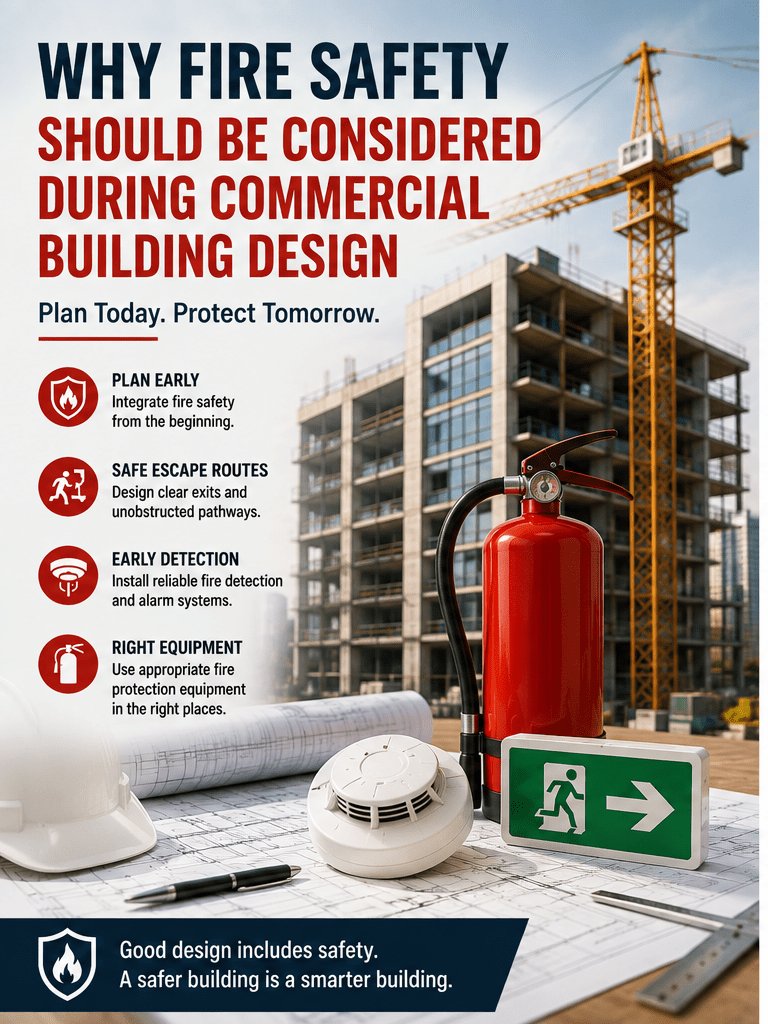

When a new commercial building is being planned, most of the attention naturally goes toward structure, appearance, space, cost, and energy efficiency. Fire safety can sometimes become something that is discussed later, once the main design is already complete.
That approach can create unnecessary problems.
Fire protection works best when it is considered from the beginning of a project. The location of exits, alarm systems, firefighting equipment, emergency lighting, access routes, and other safety features can all affect how a building is designed and used.
For architects, developers, contractors, and property owners, thinking about fire safety early can make a building safer and can also prevent expensive changes later.
Fire Safety Starts With the Building’s Purpose
A building’s purpose has a major influence on its fire risks.
An office may contain computers, electrical equipment, paper, furniture, and a staff kitchen. A warehouse may hold large quantities of packaging, textiles, chemicals, or other combustible materials. A restaurant has cooking equipment and oils, while a manufacturing facility may have machinery, fuel, chemicals, and high-temperature processes.
Because the risks are different, the fire protection strategy should not simply be copied from another building.
Before construction or major renovation begins, project teams should consider what activities will take place inside the property and what materials or equipment will be present.
This helps determine the type and location of fire detection, firefighting, and evacuation systems required.
Plan Escape Routes Early
One of the most important parts of fire safety is also one of the simplest: people need a safe way out.
Emergency exits and escape routes should be considered as part of the original building layout. They should remain accessible and should lead people away from danger rather than creating unnecessary bottlenecks.
The number and arrangement of exits will depend on factors such as building size, occupancy, layout, and local requirements.
It is also important to think about how people actually move through a building. A technically available exit may not be very useful if it is difficult to find, regularly blocked, or positioned in an area where people are unlikely to reach it quickly.
Clear signage, emergency lighting, and well-planned circulation areas can all support evacuation.
Fire Detection Provides Valuable Time
A fire does not need to become large before it becomes dangerous. Smoke can spread rapidly, particularly through enclosed spaces and building services.
Fire detection systems are therefore an important part of modern building design.
Depending on the property, a system may include smoke detectors, heat detectors, manual call points, alarm sounders, control panels, and other components.
Larger buildings may use addressable systems that can provide more detailed information about the location of an activated detector.
The important point is that detection should be planned around the building rather than added as an afterthought. Detector placement, wiring routes, equipment locations, and access for future maintenance should all be considered during design.
Firefighting Equipment Needs Accessible Locations
Fire extinguishers are among the most familiar pieces of fire safety equipment, but their placement deserves careful consideration.
An extinguisher hidden behind furniture or stored inside an inaccessible room does not provide much practical protection. Equipment needs to be visible, accessible, properly identified, and suitable for the fire risks present in the area.
Different extinguishing agents have different applications. Water, foam, carbon dioxide, dry chemical powder, and other types should be selected according to the hazards involved.
For larger buildings, the fire protection strategy may also include hose reels, hydrant systems, sprinkler systems, or specialized suppression systems.
Professional fire protection providers such as Flame Defender can help businesses and project teams evaluate fire safety equipment and protection requirements as part of a wider safety strategy.
Special Areas May Need Special Protection
Not every room in a commercial property carries the same level or type of risk.
A server room, electrical room, commercial kitchen, laboratory, storage area, and manufacturing floor may require different protection measures.
For example, sensitive electronic equipment may require a suppression method that is different from the approach used in a warehouse containing ordinary combustible materials.
This is why fire risk assessment is so important. Instead of choosing equipment based only on what is commonly used, the design team can consider the actual hazards of each space.
Building Materials Also Matter
Fire safety is not limited to alarms and extinguishers.
The materials used in a building can influence how fire and smoke behave. Walls, ceilings, doors, insulation, partitions, furnishings, and other components may have specific fire-performance characteristics.
Fire-resistant doors, for example, can help limit the spread of fire and smoke between certain areas when properly specified and installed.
The objective is not simply to stop every fire immediately. A well-designed building can help contain fire and smoke long enough for occupants to evacuate and emergency responders to act.
Do Not Forget Emergency Access
Fire safety planning should consider not only the people inside the building but also emergency responders.
Large commercial properties need suitable access for firefighting vehicles and emergency personnel. Building entrances, access roads, fire service connections, hydrants, and other relevant infrastructure should be considered during planning.
The easier it is for emergency teams to reach the affected area, the better the chances of an effective response.
This is particularly important for large industrial facilities, warehouses, shopping centres, hotels, and multi-storey properties.
Maintenance Should Be Considered During Design
A common mistake is to think only about how equipment will be installed and not how it will be maintained.
Fire safety systems need inspection, testing, repairs, and sometimes replacement throughout their service life.
Detectors need access for testing. Fire alarm panels need suitable locations. Extinguishers need to remain accessible. Pumps, valves, suppression systems, and other equipment need appropriate maintenance space.
If maintenance access is ignored during the design stage, routine servicing can become unnecessarily difficult.
A good building design therefore considers the entire life of the fire protection system, not just the day it is installed.
Staff Training Completes the System
Even the best-designed building still depends on people.
Employees should know what the fire alarm means, where the exits are located, how emergencies are reported, and where they should assemble after evacuation.
Selected staff may also receive training in the safe use of portable extinguishers, but fighting a fire should never take priority over personal safety.
Regular drills can help employees become familiar with evacuation routes and reveal practical problems that were not obvious during design.
Fire Safety Is Part of Good Building Design
Fire protection should not be viewed as an extra feature added after the building is finished.
It is part of responsible design.
When architects, engineers, contractors, developers, and property owners consider fire risks from the beginning, they can create buildings where detection, evacuation, firefighting, emergency access, and maintenance work together.
The result is not simply a building that contains more fire equipment. It is a building designed with safety in mind.
That difference matters. A fire extinguisher can help control a small fire, but a complete fire safety strategy can provide something even more valuable: time.
And during a fire, every extra minute can matter.