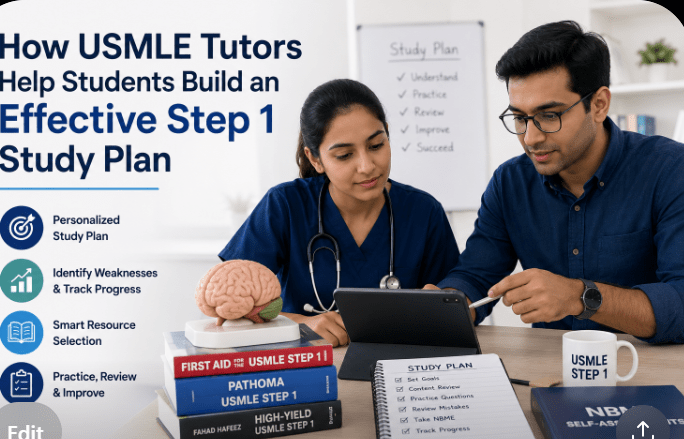

How USMLE Tutors Help Students Build an Effective Step 1 Study Plan
Preparing for USMLE Step 1 requires more than collecting popular resources and studying for long hours. Medical students must understand foundational sciences, apply concepts to clinical scenarios, interpret complex question stems, and maintain consistent performance under timed conditions.
The challenge is rarely a complete lack of effort. More often, students struggle because they do not know what to study first, how much time to allocate to each subject, or when to move from content review to question-based learning.
Experienced USMLE Tutors can help students turn an overwhelming preparation process into a structured, measurable study plan. Instead of following a generic schedule, students receive guidance based on their current knowledge, available preparation time, learning style, and assessment performance.
Why Step 1 Requires a Structured Study Plan
Step 1 evaluates whether candidates can understand and apply scientific concepts related to health, disease, and treatment. Its content is organized across organ systems, foundational disciplines, and physician competencies. Many questions require students to interpret data, images, pathology findings, and clinical information rather than simply recall isolated facts.
This integrated format creates several planning challenges. A student may understand physiology but struggle to connect it with pathology. Another may know the content but lose points by misreading question stems or changing correct answers.
A useful study plan must therefore address four areas:
-
Foundational medical knowledge
-
Clinical application of basic science
-
Question-solving technique
-
Exam stamina and time management
Generic schedules often assign the same resources and daily workload to every student. Effective planning begins by identifying what an individual student actually needs.
How USMLE Tutors Build Personalized Step 1 Plans
1. Establishing a Realistic Performance Baseline
A tutor should not create a schedule based only on a student’s preferred exam date. The first step is to evaluate current readiness.
This may involve reviewing:
-
Previous NBME or school examination results
-
Question-bank performance
-
Strong and weak organ systems
-
Accuracy in timed and untimed blocks
-
Study habits and resource usage
-
Previous Step 1 preparation attempts
The NBME Comprehensive Basic Science Self-Assessment can help students establish a baseline, identify weaker content areas, track performance across assessments, and evaluate their estimated probability of passing. However, NBME explains that this probability is an estimate rather than a guarantee of future performance.
A baseline assessment prevents students from spending equal time on unequal problems. For example, a learner who consistently misses renal physiology questions may need concept rebuilding, while a student missing questions across several systems may have a broader reasoning or test-taking issue.
2. Setting Achievable Milestones
Once the baseline is clear, the preparation period can be divided into smaller phases.
A structured Step 1 plan may include:
-
Foundation phase: Repairing major knowledge gaps
-
Integration phase: Connecting physiology, pathology, pharmacology, and microbiology
-
Question-intensive phase: Increasing timed question practice
-
Readiness phase: Completing assessments and full-length simulations
-
Final review phase: Revising high-priority weaknesses without introducing excessive new material
Milestones should be based on demonstrated progress, not just calendar dates. Completing a resource does not automatically mean the material has been mastered. Tutors can use question accuracy, retention, assessment trends, and reasoning quality to determine whether a student is ready to progress.
3. Selecting Resources Without Creating Overload
Many students use too many books, videos, flashcard decks, and question banks simultaneously. This creates fragmented learning and makes it difficult to revise material consistently.
One important role of USMLE Tutors is helping students distinguish between essential resources and optional supplements. A focused plan may include:
-
One central review resource
-
One primary question bank
-
A limited number of targeted videos
-
Flashcards for retention
-
Official USMLE practice materials
-
Periodic NBME self-assessments
The ideal combination depends on the learner. A student with weak fundamentals may require more guided content review, while someone with a strong academic foundation may benefit from earlier question-bank integration.
Effective USMLE Tutoring should simplify preparation rather than add more resources to an already crowded schedule.
4. Balancing Content Review With Practice Questions
Students commonly make one of two mistakes: spending weeks passively reviewing content before answering questions, or completing large question volumes without carefully analyzing mistakes.
A better plan connects content learning with question practice from the beginning.
For example, after reviewing cardiovascular physiology and pathology, a student can complete a focused block of related questions. The results reveal whether the concepts can be recognized and applied in exam-style scenarios.
As preparation progresses, question blocks should become increasingly mixed and timed. This transition helps students move from subject recognition to integrated decision-making.
A tutor can determine when a student should use focused blocks, mixed blocks, untimed learning sessions, or timed simulations. That decision should reflect the student’s preparation stage rather than a fixed formula.
5. Turning Incorrect Answers Into Actionable Feedback
Incorrect questions are valuable only when students understand why they missed them.
Each error can be classified as:
-
Knowledge gap
-
Misinterpretation of the question
-
Failure to recognize a clinical clue
-
Difficulty connecting concepts
-
Poor time management
-
Premature answer selection
-
Unnecessary answer changing
This classification helps tutors identify recurring patterns. If a student repeatedly knows the underlying concept but misreads the final sentence, reviewing more content will not solve the problem. The plan must include question-reading and decision-making practice.
A useful error log should record the tested concept, reason for the mistake, correct reasoning process, and review date. The objective is not to copy long explanations but to prevent the same error from recurring.
6. Adjusting the Plan for IMGs and Busy Students
International Medical Graduates and working doctors may face additional challenges, including unfamiliarity with NBME-style questions, differences in medical curricula, clinical responsibilities, family commitments, and time-zone limitations.
A realistic plan must reflect these constraints. Assigning ten study hours daily to someone working in a hospital is not sustainable.
USMLE Tutors can help such students build schedules around available study periods. A working candidate may use shorter weekday sessions for questions and review, followed by longer weekend blocks for assessments and deeper content revision.
Consistency is generally more practical than repeatedly creating ambitious schedules that cannot be maintained.
7. Using Assessments to Update the Schedule
A Step 1 study plan should not remain unchanged throughout the preparation period.
NBME self-assessments provide performance information across content areas and allow students to compare progress over time. This data can guide decisions about where to increase study time and whether the planned exam date remains appropriate.
Assessment review should examine more than the overall result. Students should evaluate:
-
Performance by organ system
-
Repeatedly weak disciplines
-
Timing problems
-
Incorrect answers caused by avoidable mistakes
-
Changes since the previous assessment
If progress stalls, the solution may involve changing the study method, reducing resource overload, revisiting foundational concepts, or increasing guided question review.
Preparing for the Actual Testing Experience
Step 1 preparation should also include familiarity with the official interface and testing conditions.
For exams administered on or after May 14, 2026, Step 1 uses fourteen 30-minute blocks within an approximately eight-hour testing session. Candidates should use the updated interactive testing experience to understand the current software and block structure.
Students should gradually practice:
-
Completing timed mixed blocks
-
Managing breaks strategically
-
Maintaining concentration across multiple blocks
-
Recovering after a difficult question
-
Avoiding excessive time on one item
-
Using the official testing interface
USMLE provides more than 100 sample Step 1 questions in PDF and interactive formats. These materials can help candidates become familiar with official question presentation and testing functionality.
What an Effective Weekly Plan May Include
A balanced weekly schedule could contain:
-
Daily question-bank practice
-
Focused review of weak systems
-
Active recall or flashcard revision
-
Detailed analysis of incorrect answers
-
One longer timed session each week
-
Regular review of the error log
-
Scheduled rest and recovery
The exact question volume should depend on the student’s available time and review quality. Completing fewer questions with careful analysis can be more useful than rushing through large blocks without understanding the reasoning.
Conclusion
An effective Step 1 study plan is not simply a list of resources and deadlines. It is a flexible system that connects baseline performance, focused content review, question practice, assessment data, and exam-day preparation.
USMLE Tutors can support this process by identifying weaknesses, organizing priorities, monitoring progress, and adjusting the schedule when performance data changes. The most valuable tutoring does not replace independent study. Instead, it helps students use their study time more deliberately and develop the reasoning skills required for Step 1.
With a focused plan, appropriate resources, and regular performance review, students can approach their preparation with greater clarity and avoid many of the common mistakes that lead to wasted time and unnecessary stress.
Frequently Asked Questions
1. When should students start working with USMLE Tutors?
Students may benefit from tutoring when they are unsure how to structure preparation, repeatedly underperform on assessments, struggle with question interpretation, or have limited time before their planned exam date. Starting earlier can provide more time to identify and address foundational weaknesses.
2. How long should a Step 1 study plan be?
The appropriate timeline depends on baseline knowledge, daily availability, previous preparation, and assessment performance. Some students require a shorter dedicated period, while others need several months to rebuild foundational concepts. The schedule should be based on readiness rather than an arbitrary number of weeks.
3. Can USMLE Tutoring help students with low NBME performance?
Tutoring may help students analyze why their performance is low and create a targeted improvement plan. The tutor should examine content gaps, reasoning patterns, timing, resource use, and study consistency rather than focusing only on the assessment result.
4. How often should students take NBME self-assessments?
There is no universal schedule. Assessments should be spaced far enough apart to allow meaningful improvement and close enough to monitor readiness. Taking assessments too frequently without addressing identified weaknesses may provide little additional value.
5. Do USMLE Tutors replace independent studying?
No. Tutoring should provide structure, feedback, accountability, and targeted instruction, but students must still complete independent content review, question practice, and revision. The strongest plans combine guided support with consistent self-directed study.