
Wisdom is one of the greatest blessings a person can receive. In Islam, Hikmat is more than intelligence or knowledge. It is the ability to understand situations correctly, make balanced decisions, and apply Islamic teachings in the most appropriate way. A knowledgeable person may know many facts, but a wise person knows how and when to act upon that knowledge.
The Quran and Sunnah repeatedly emphasize the value of wisdom because it helps believers live according to the guidance of Allah while dealing with different people, circumstances, and challenges. Every Muslim, whether a student, teacher, scholar, businessperson, or parent, benefits from developing Hikmat in everyday life.
This article explains the meaning of Hikmat, its significance in Islam, and how practical wisdom enables Muslims to make sound decisions according to the Quran and Sunnah.
Understanding the Meaning of Hikmat
The Arabic word Hikmat is commonly translated as wisdom. However, its Islamic meaning is much deeper than ordinary wisdom. It combines knowledge, insight, understanding, sound judgment, and the ability to act correctly according to the situation.
A person who possesses Hikmat does not simply speak or act without thought. Instead, every decision is based on knowledge, patience, justice, and awareness of its consequences. This balance between knowledge and action is one of the defining characteristics of Islamic wisdom.
Islam teaches that true wisdom is not measured by age, wealth, or status. Rather, it is reflected in a person’s ability to choose what is right while remaining within the limits set by Allah.
Hikmat in the Light of the Quran and Sunnah
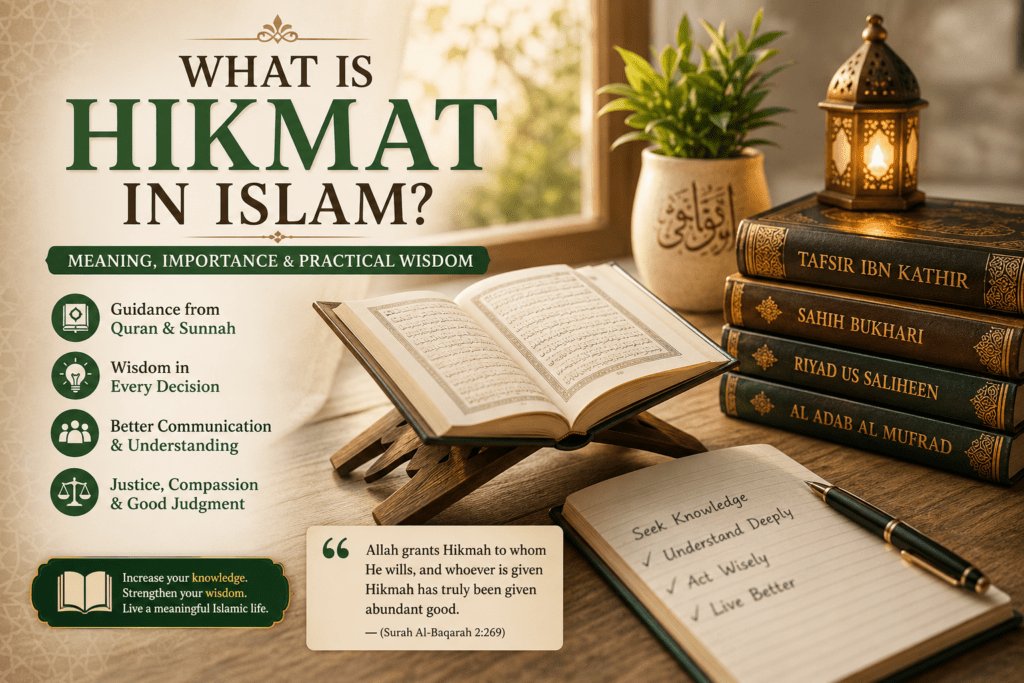
The Quran presents Hikmat as a precious gift granted by Allah to whom He wills. Throughout Islamic teachings, wisdom is closely connected with revelation, guidance, and understanding.
The teachings of the Prophet Muhammad ﷺ demonstrate Hikmat in every aspect of life. Whether dealing with family matters, community affairs, education, leadership, or conflict resolution, he always chose the most appropriate approach according to the situation.
This shows that Islamic wisdom is not merely theoretical knowledge. Instead, it is the practical application of divine guidance with patience, mercy, fairness, and intelligence.
For Muslims today, following the Quran and Sunnah remains the most reliable path toward acquiring Hikmat.
Characteristics of a Person with Hikmat
Islamic wisdom can often be recognized through a person’s character and behavior. Someone who possesses Hikmat usually demonstrates several important qualities:
- Makes thoughtful decisions instead of acting emotionally.
- Speaks with kindness and respect.
- Understands the needs of different people.
- Chooses the right words at the right time.
- Solves problems peacefully whenever possible.
- Balances justice with compassion.
- Follows Islamic principles before personal opinions.
These qualities help build stronger families, healthier communities, and better relationships while maintaining obedience to Allah.
Why Hikmat Is Essential in Everyday Life
Hikmat influences nearly every aspect of a Muslim’s daily life. It helps people communicate effectively, resolve disagreements wisely, make responsible financial decisions, raise children with compassion, and respond patiently during difficult situations.
For example, inviting others toward Islam requires more than simply presenting information. It requires understanding the listener, choosing appropriate language, respecting circumstances, and delivering the message with kindness. This practical application of knowledge is one of the clearest examples of Hikmat.
Similarly, teachers, parents, community leaders, and business professionals all benefit from wisdom because successful leadership depends not only on knowledge but also on sound judgment and good character.
The Relationship Between Knowledge and Hikmat
Knowledge and Hikmat are closely connected, but they are not the same. A person may possess extensive knowledge yet struggle to apply it wisely. On the other hand, someone with Hikmat knows how to use knowledge in a way that benefits individuals and society.
Islam encourages believers to seek knowledge continuously, but it also teaches that knowledge should be accompanied by sincerity, humility, patience, and good character. These qualities transform knowledge into wisdom. This is why many Islamic scholars emphasized that true learning is reflected not only in what a person knows but also in how they behave and make decisions.
When knowledge is guided by Hikmat, it becomes a source of positive change rather than conflict or misunderstanding.
How Muslims Can Develop Hikmat
Developing Hikmat is a lifelong journey. Islam provides practical guidance that helps believers strengthen wisdom through faith, learning, and righteous actions.
Some practical ways to develop Hikmat include:
Study the Quran Regularly
The Quran is the primary source of guidance. Reading it with understanding helps believers develop wisdom and make better decisions according to Islamic teachings.
Learn Authentic Hadith
The Sunnah of Prophet Muhammad ﷺ provides practical examples of wisdom in communication, leadership, family life, and daily interactions. Studying authentic Hadith allows Muslims to understand how wisdom is applied in real situations.
Practice Patience
Many poor decisions are made in moments of anger or haste. Patience allows a person to think clearly before speaking or acting.
Seek Knowledge from Reliable Sources
Learning from qualified scholars and authentic Islamic books strengthens understanding and protects people from misinformation. Reading reliable Islamic books PDF collections or trusted digital Islamic libraries can also support continuous learning when authentic sources are chosen.
Reflect Before Acting
Islam encourages believers to think about the consequences of their words and actions. Careful reflection is one of the strongest signs of Hikmat.
Common Misconceptions About Hikmat
Many people misunderstand the concept of Hikmat. One common misconception is that wisdom means remaining silent in every situation. In reality, Hikmat teaches Muslims to know when to speak and when to remain silent, depending on what brings benefit and prevents harm.
Another misunderstanding is that wisdom means compromising Islamic teachings to satisfy others. Islam does not define Hikmat as abandoning principles. Instead, it means presenting the truth with kindness, justice, and good manners while remaining faithful to the guidance of the Quran and Sunnah.
Some also assume that Hikmat belongs only to scholars. Although scholars possess deep knowledge, every Muslim can strive to develop wisdom by increasing knowledge, improving character, and applying Islamic teachings in daily life.
The Importance of Hikmat in Modern Life
Today’s world presents Muslims with many personal, social, and professional challenges. Decisions often require careful thinking, balanced judgment, and responsible action. Hikmat helps believers respond wisely instead of reacting emotionally.
Whether discussing family matters, resolving disagreements, educating children, managing finances, or interacting with people from different backgrounds, Islamic wisdom encourages fairness, patience, respect, and thoughtful communication.
Hikmat also plays an important role in sharing Islamic knowledge. Effective Islamic education is not only about delivering information but also about understanding people’s circumstances and communicating with compassion and clarity.
Conclusion
Hikmat is one of the most valuable qualities encouraged by Islam. It combines knowledge, understanding, sound judgment, and righteous action. The Quran and Sunnah teach that wisdom is a gift that enables believers to make balanced decisions while remaining committed to the guidance of Allah.
Developing Hikmat requires continuous learning, sincere worship, patience, and good character. By studying authentic Islamic sources and applying their teachings in everyday life, Muslims can strengthen their ability to make wise decisions and contribute positively to their families, communities, and society.
Ultimately, Hikmat is not measured by how much a person knows, but by how wisely that knowledge is practiced.
Frequently Asked Questions
What is the meaning of Hikmat in Islam?
Hikmat refers to wisdom, sound judgment, and the ability to apply knowledge correctly according to the guidance of the Quran and Sunnah.
Is Hikmat different from knowledge?
Yes. Knowledge provides information, while Hikmat is the ability to apply that knowledge wisely in different situations.
How can a Muslim develop Hikmat?
A Muslim can develop Hikmat by studying the Quran, learning authentic Hadith, seeking knowledge from reliable scholars, practicing patience, and reflecting before making decisions.
Why is Hikmat important in everyday life?
Hikmat helps Muslims make balanced decisions, solve problems peacefully, communicate effectively, and apply Islamic teachings with wisdom and good character.