
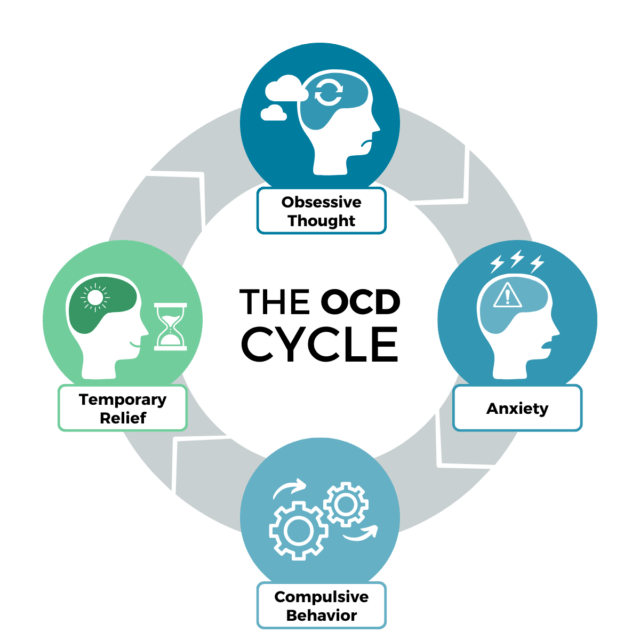

You can get lasting relief from OCD by working with a therapist who uses evidence-based approaches like exposure and response prevention (ERP) and targeted medication management when needed. A qualified OCD therapist helps you identify patterns, reduce compulsions through gradual exposure, and build practical skills so anxiety loses its control over your life.
If you want to understand how therapy works, what treatment options actually help, and how to find a specialist who understands OCD’s specific challenges, this article walks you through those exact steps. Expect clear guidance on what effective therapy looks like, how to choose a clinician, and what to expect when you start treatment.
Understanding OCD and Therapeutic Approaches
You will learn what core symptoms and diagnostic markers to watch for, which treatments have the strongest evidence, and how the leading therapy (CBT with ERP) works in practice.
Common Symptoms and Diagnosis
You may experience persistent, unwanted thoughts (obsessions) such as fears about contamination, harm, symmetry, or taboo impulses. These obsessions are intrusive and cause anxiety or distress that you find hard to dismiss.
Compulsions follow to reduce that distress—these can be visible behaviors (repeated checking, excessive washing) or covert acts (mental rituals, counting, repeating phrases). Compulsions often give short-term relief but increase overall symptom severity over time.
Clinicians diagnose OCD based on pattern, duration, and impact: obsessions and/or compulsions that are time-consuming (typically >1 hour/day), cause marked distress, and impair work, relationships, or daily functioning. Differential diagnosis checks for related conditions (e.g., generalized anxiety, tic disorders, depression) and for medication- or substance-induced symptoms.
Evidence-Based Treatment Methods
Two first-line treatments have the strongest empirical support: specific forms of psychotherapy and serotonergic medication. Psychotherapy typically means cognitive-behavioral approaches centered on exposure and response prevention (ERP). Medications are usually selective serotonin reuptake inhibitors (SSRIs) at doses often higher than for depression.
When you weigh options, note these facts:
- ERP has the largest effect sizes in trials for reducing obsessions and compulsions.
- SSRIs can reduce symptom severity and are useful when therapy access is limited or symptoms are severe.
- Combined treatment (ERP + SSRI) may help some people who don’t fully respond to one modality.
Specialist care matters: an OCD-trained therapist tailors hierarchies, monitors avoidance, and adjusts techniques for subtypes (contamination, checking, “Pure O”). If symptoms persist, options include higher SSRI dosing, alternative medications, or referral for neuromodulation/DBS in rare, treatment-refractory cases.
Cognitive Behavioral Therapy Explained
CBT for OCD uses two main techniques: exposure and response prevention (ERP) and cognitive restructuring. ERP systematically exposes you to triggers that provoke obsessions while preventing the rituals that usually follow.
You work with a therapist to build a hierarchy of fears, starting with lower-distress exposures and progressing to more challenging situations. Sessions include in-office practice and between-session assignments to generalize gains to daily life.
Cognitive techniques target beliefs that maintain OCD—overestimation of threat, inflated responsibility, and intolerance of uncertainty. Your therapist helps you test predictions and shift unhelpful thinking while ERP reduces the need to rely on rituals.
Finding and Working With a Specialist
You will learn how to choose a qualified OCD specialist, what a typical course of sessions looks like, and how to maintain gains over time. The details that follow focus on concrete steps, session structure, and practical supports.
Seeking a Qualified Mental Health Professional
Look for clinicians who list Exposure and Response Prevention (ERP) and cognitive-behavioral therapy (CBT) as core treatments on their profiles. Check credentials: licensed psychologist, clinical social worker (LCSW/LMSW), psychiatrist, or licensed professional counselor (LPC) with specialized OCD training or IOCDF/recognized certifications.
Use specialty directories (IOCDF, national therapist finders) and filter by ERP experience, insurance accepted, telehealth availability, and whether they treat your specific OCD subtype (contamination, harm, symmetry, intrusive thoughts).
Prepare a short set of screening questions before contacting a clinician:
- Do you use ERP as the first-line treatment for OCD?
- How many OCD cases have you treated in the past year?
- Do you offer structured homework and measurable progress checks? Ask about session length, frequency, cancellation policy, and whether the clinician collaborates with prescribers if medication might help.
What To Expect from Sessions
Initial intake will gather symptom history, functional impact, and safety concerns in 1–2 sessions. Expect standardized measures (Y-BOCS or OCI-R) to quantify severity and track change.
Therapy focuses on graded exposure tasks you commit to between sessions, with the therapist coaching through response prevention and cognitive strategies as needed.
Typical structure:
- 10–15 minutes review of homework and symptoms
- 30–40 minutes guided exposure planning or in-session exposure
- 5–10 minutes assigning homework and measuring distress You should track observable goals (time spent on rituals, SUDS ratings) and review progress every 4–8 weeks. Medication discussions occur if symptoms limit engagement; coordination with a psychiatrist improves outcomes.
Long-Term Recovery and Support
Plan for relapse prevention from the start: a written hierarchy of vulnerabilities, warning signs, and specific coping steps. Maintain periodic “booster” sessions after acute treatment—monthly or quarterly—to reinforce skills and adjust exposures.
Build a support network that understands ERP demands: involve family in one to two sessions if reassurance-seeking is part of the compulsion pattern. Use patient-facing tools like exposure logs, habit trackers, and SUDS charts to objectively monitor progress.
Consider additional resources:
- Peer support groups for lived-experience strategies
- Online ERP-guided platforms for homework structure
- Medication review every 6–12 months if prescribed You should expect improvement within weeks to months but plan for targeted follow-ups and continued practice to sustain gains.