
Laboratory containers are the backbone of every efficient lab, enabling safe storage, handling, and transportation of chemicals, samples, and biological materials. Whether you’re working in research, healthcare, or industrial testing, choosing the right containers is essential for maintaining accuracy, safety, and organization.
What Are Laboratory Containers?
Laboratory containers are specially designed vessels used to store, mix, measure, and transport substances in a controlled environment. These containers are available in various materials such as glass, plastic, and metal, each suited for different applications and chemical compatibility.
From bottles and carboys to tubes and jars, modern laboratories rely heavily on containers to maintain workflow efficiency and sample integrity.
Importance of Laboratory Containers in Lab Supplies
Laboratory containers play a critical role in the broader category of lab supplies, ensuring:
- Safe chemical storage to prevent leaks and contamination
- Accurate measurements during experiments
- Efficient organization in busy lab environments
- Compliance with safety standards
High-quality lab supplies, including racks, dispensers, and storage systems, work together with containers to improve reproducibility and precision in scientific research.
Types of Laboratory Containers
Understanding the different types of laboratory containers helps you select the right solution for your needs.
1. Glass Containers (Laboratory Glassware)
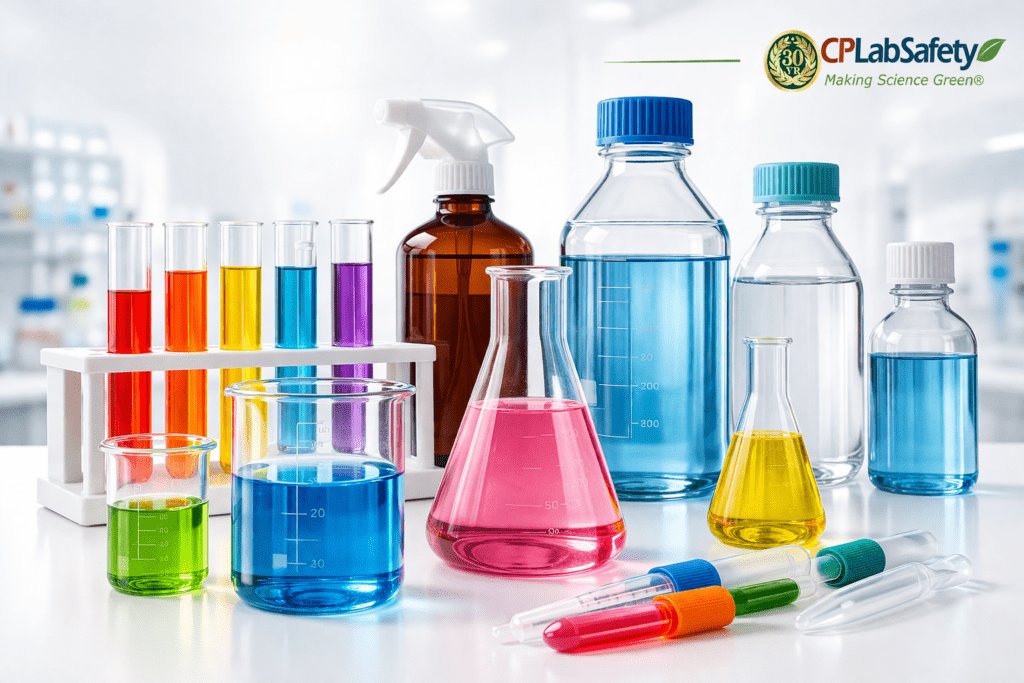
Glass containers are widely used due to their chemical resistance and transparency.
- Beakers
- Flasks (Erlenmeyer, volumetric)
- Culture tubes
- Reagent bottles
These are ideal for heating, mixing, and observing reactions.
2. Plastic Containers
Plastic laboratory containers are lightweight, durable, and often more cost-effective.
- HDPE and LDPE bottles
- Polypropylene containers
- Carboys for large-volume storage
- Sample containers
They are commonly used for storage and transport due to their leak-proof and impact-resistant properties.
3. Disposable Labware
Disposable labware is essential for preventing cross-contamination.
- Disposable filter funnel
- Petri dishes
- Pipette tips
- Culture tubes
These single-use items are widely used in microbiology and clinical labs where sterility is critical.
4. Specialized Containers
Some containers are designed for specific lab applications:
- Culture tubes for biological samples
- Cryogenic containers for low-temperature storage
- Amber bottles for light-sensitive chemicals
- Centrifuge tubes for sample separation
These specialized solutions enhance safety and experimental accuracy.
Choosing the Right Laboratory Containers
Selecting the right laboratory containers depends on several factors:
1. Material Compatibility
Different chemicals react differently with materials. Glass offers high resistance, while plastics like polypropylene are suitable for many general applications.
2. Storage Requirements
Consider temperature, light sensitivity, and volume. For example, amber containers are used for light-sensitive substances.
3. Reusability vs. Disposable
Reusable containers are cost-effective, while disposable labware ensures sterility and convenience.
4. Volume and Capacity
From small culture tubes to large carboys, choosing the correct size improves workflow efficiency.
Role of Laboratory Containers in Lab Organization
Efficient lab organization depends heavily on proper storage systems. Containers, when paired with racks, bins, and labeling systems, help:
- Reduce clutter
- Improve accessibility
- Enhance workflow efficiency
- Minimize contamination risks
Modern lab supplies include advanced storage solutions like racks and boxes designed to support various container types.
Applications of Laboratory Containers
Laboratory containers are used across multiple industries:
1. Research Laboratories
Used for chemical reactions, sample storage, and analysis.
2. Healthcare and Clinical Labs
Essential for storing biological samples, reagents, and specimens.
3. Pharmaceutical Industry
Used in drug development, testing, and quality control.
4. Educational Institutions
Widely used in teaching laboratories for experiments and demonstrations.
Benefits of High-Quality Laboratory Containers
Investing in high-quality laboratory containers offers several advantages:
- Improved safety and compliance
- Enhanced durability and longevity
- Better experimental accuracy
- Reduced risk of contamination
Reliable containers are a key part of a well-equipped lab, alongside laboratory glassware, disposable labware, and other essential lab supplies.
Conclusion
Laboratory containers are fundamental to any laboratory environment, supporting safe storage, precise measurements, and efficient workflows. From laboratory glassware like beakers and flasks to disposable labware such as filter funnels and culture tubes, every container plays a vital role in maintaining lab performance.
Choosing the right containers based on material, application, and storage needs ensures not only safety but also accuracy and productivity. When combined with high-quality lab supplies, laboratory containers become the cornerstone of a well-organized and efficient laboratory.
FAQs
1. What are laboratory containers used for?
Laboratory containers are used for storing, mixing, measuring, and transporting chemicals and samples in a lab setting.
2. What materials are used for laboratory containers?
Common materials include glass, plastic (HDPE, LDPE, polypropylene), and sometimes metal, depending on the application.
3. What is the difference between reusable and disposable labware?
Reusable labware can be cleaned and sterilized for repeated use, while disposable labware is designed for single use to prevent contamination.
4. Why are culture tubes important in laboratories?
Culture tubes are used to grow, store, and transport biological samples, especially in microbiology and clinical research.
5. What is a disposable filter funnel used for?
A disposable filter funnel is used for filtration processes, helping separate solids from liquids while maintaining sterility.