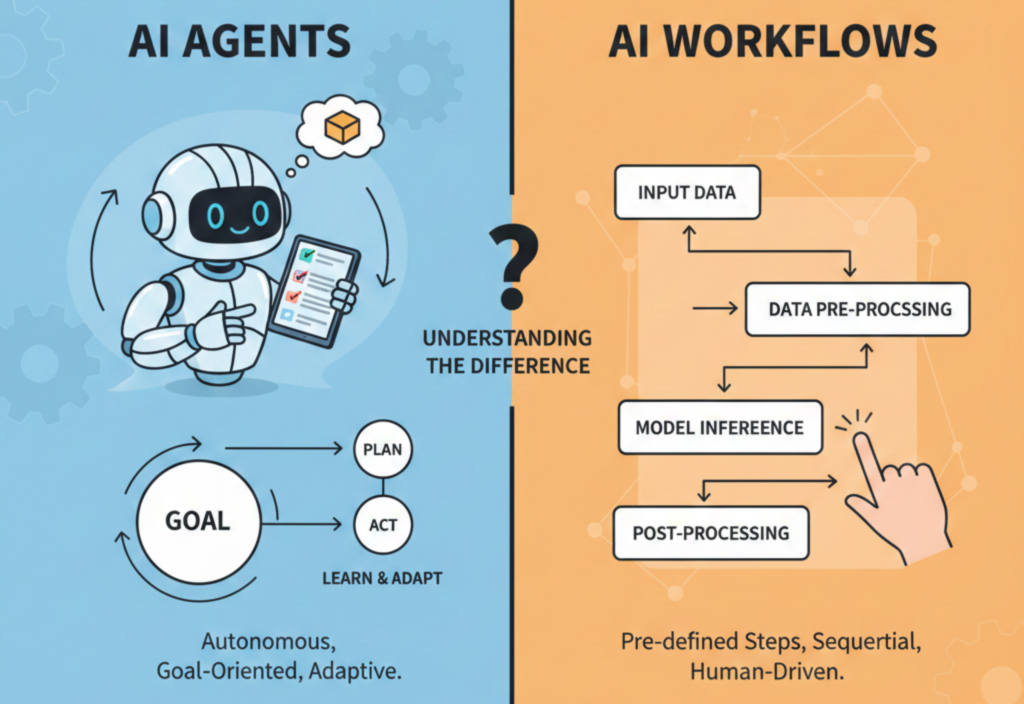

Understanding the difference between AI agents vs workflows is crucial for anyone implementing AI in business or technology. While both involve AI, they serve different purposes: agents act autonomously and make decisions, whereas workflows follow structured steps to automate processes efficiently. Knowing the distinction helps organizations maximize AI’s potential while avoiding confusion and inefficiency.
What Are AI Agents?
AI agents are intelligent systems that can operate independently, make decisions, and even learn from data over time. They are designed to perform tasks on behalf of users, often interacting with humans or other systems autonomously.
Key Features:
-
Autonomy: Operate without constant human supervision
-
Decision-making: Analyze data and choose actions
-
Adaptability: Improve performance with learning
Examples:
-
Chatbots answering customer queries
-
Virtual assistants like Siri or Alexa
-
AI recommendation engines
What Are AI Workflows?
AI workflows are structured sequences of steps designed to automate processes. Unlike agents, workflows do not make independent decisions—they follow predefined rules or integrate AI tools to achieve specific goals.
Key Features:
-
Task automation for repetitive work
-
Sequential execution of steps
-
Integration of AI models or tools
Examples:
-
Automated invoice processing
-
Customer support ticket routing
-
AI-powered data analysis pipelines
Key Differences Between AI Agents and Workflows
| Feature | AI Agents | AI Workflows |
|---|---|---|
| Autonomy | High; operates independently | Low; follows structured steps |
| Decision-making | Independent | Rule-based or sequential |
| Adaptability | Learns and improves over time | Fixed steps; may integrate AI but not adaptive |
| Purpose | Acts on behalf of users | Automates processes efficiently |
| Examples | Chatbots, virtual assistants, recommendation engines | Invoice processing, approval pipelines, data workflows |
When to Use AI Agents vs Workflows
-
AI Agents:Â Ideal for tasks requiring autonomous decision-making, adaptability, and interaction. Examples: customer support bots, AI-driven recommendation systems.
-
AI Workflows:Â Best for structured, repetitive tasks that require efficiency and consistency. Examples: automated reporting, data pipelines, approval workflows.
Conclusion
Knowing the difference between AI agents vs workflows is key to implementing AI effectively. Agents provide autonomy and decision-making capabilities, while workflows optimize structured processes. By combining both strategically, organizations can maximize efficiency, improve productivity, and leverage AI intelligently.