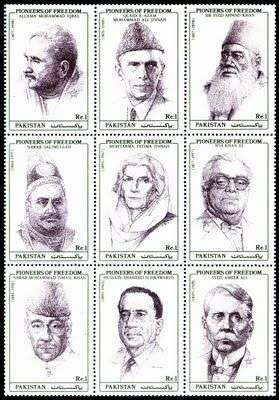

The creation of Pakistan in 1947 was not the result of a single individual’s struggle, but the outcome of decades of intellectual, political, and social efforts by visionary leaders who laid the foundations of Muslim nationalism in South Asia. While Quaid-e-Azam Muhammad Ali Jinnah stands at the center of this historic movement, the success of Pakistan was equally shaped by earlier pioneers whose ideas, sacrifices, and leadership prepared the Muslim community for an independent homeland.
This article explores the contributions of key pioneers of Pakistan, including Sir Syed Ahmad Khan, Allama Muhammad Iqbal, Liaquat Ali Khan, and other influential figures. It highlights how their roles collectively transformed a marginalized community into a politically conscious nation capable of achieving statehood.
1. Sir Syed Ahmad Khan: The Intellectual Pioneer
The roots of the Pakistan Movement can be traced back to the aftermath of the War of Independence in 1857. Among the earliest and most influential pioneers was Sir Syed Ahmad Khan, whose vision reshaped Muslim political thinking in British India.Following 1857, Muslims faced severe political, economic, and educational decline. Sir Syed recognized that survival under British rule required intellectual reform rather than confrontation. He emphasized modern education, rational thinking, and political pragmatism.
The establishment of the Muhammadan Anglo-Oriental College at Aligarh in 1875 became the cornerstone of Muslim revival. This institution produced a new generation of educated Muslim leaders who later played central roles in politics, administration, and law.
Sir Syed also introduced the idea that Muslims were a distinct political community with separate interests from Hindus. His opposition to the Indian National Congress stemmed from his belief that representative democracy under a Hindu majority would marginalize Muslims. This idea later evolved into the Two-Nation Theory.
2. Allama Muhammad Iqbal: The Ideological Architect
While Sir Syed laid the educational foundation, Allama Muhammad Iqbal provided the ideological framework for Pakistan. A philosopher, poet, and thinker, Iqbal used poetry and philosophy to awaken political consciousness among Muslims.
In his famous Allahabad Address of 1930, Iqbal proposed the idea of a separate Muslim state in north-western India. This was the first formal articulation of a territorial Muslim homeland.
Iqbal believed that Islam was not merely a religion but a complete social and political system. He argued that Muslims could only preserve their identity and values through political autonomy. His poetry emphasized selfhood (*khudi*), unity, and resistance to intellectual slavery.
Though Iqbal did not live to see Pakistan’s creation, his ideas deeply influenced Muslim leadership, particularly Quaid-e-Azam Muhammad Ali Jinnah.
3. Quaid-e-Azam Muhammad Ali Jinnah: The Political Pioneer
Among all pioneers, Quaid-e-Azam Muhammad Ali Jinnah emerged as the decisive leader who transformed ideology into reality. Initially a strong advocate of Hindu-Muslim unity, Jinnah gradually became convinced that Muslim rights could not be protected within a united India.
As leader of the All-India Muslim League, Jinnah reorganized the party into a mass political force. His leadership during critical moments such as the Lahore Resolution of 1940, constitutional negotiations, and the 1946 elections proved instrumental.
Jinnah’s political strategy was rooted in constitutionalism, negotiation, and legal reasoning. Despite facing opposition from both the British government and the Indian National Congress, he remained steadfast in his demand for Pakistan.
His ability to unite diverse Muslim groups religious scholars, landlords, professionals, and students was unprecedented. Without Jinnah’s leadership, the Pakistan Movement would likely have fragmented.
4. Liaquat Ali Khan: The Organizational Pillar
While Jinnah provided leadership, Liaquat Ali Khan ensured organizational strength. As the first Secretary-General of the Muslim League and later Pakistan’s first Prime Minister, Liaquat Ali Khan played a crucial role in mobilization and administration.
He was instrumental in managing party affairs, drafting policy frameworks, and negotiating with British officials. During the critical years of 1946–47, Liaquat Ali Khan handled complex constitutional discussions while maintaining party unity.
After independence, he focused on stabilizing the new state and laid down the Objectives Resolution, which shaped Pakistan’s constitutional direction.
5. Other Key Contributors to the Pakistan Movement
The success of Pakistan was also shaped by numerous other pioneers:
Chaudhry Rahmat Ali, who coined the name “Pakistan†in 1933 Maulana Muhammad Ali Jauhar, who mobilized Muslim masses
Begum Ra’ana Liaquat Ali Khan, who worked for women’s political participation
Fatima Jinnah, who supported Quaid-e-Azam morally and politically
Their collective efforts strengthened the movement at both grassroots and leadership levels.
6. The Collective Struggle and Final Achievement
The Pakistan Movement was not sudden; it was the result of sustained struggle over decades. Educational reform, political organization, ideological clarity, and mass mobilization worked together to make independence possible.
The 3 June Plan of 1947 and the subsequent partition of British India marked the culmination of these efforts. On 14 August 1947, Pakistan emerged as an independent state fulfilling the vision of its pioneers.
7. Conclusion
The creation of Pakistan was a collective achievement shaped by visionary pioneers who worked across generations. Sir Syed Ahmad Khan awakened Muslim consciousness, Allama Iqbal gave ideological direction, Quaid-e-Azam provided political leadership, and Liaquat Ali Khan ensured organizational strength.
Understanding the role of these pioneers is essential for appreciating Pakistan’s historical foundations. Their sacrifices remind future generations that nations are not built overnight but through sustained vision, unity, and determination.
References
Ahmad, K. (1998). The Making of Pakistan. Oxford University Press.
Burke, S. M., & Ziring, L. (1990). Pakistan’s Foreign Policy. Oxford University Press.
Iqbal, M. (1930). Presidential Address at Allahabad.
Jinnah, F. (1987). My Brother. Quaid-i-Azam Academy.
Lapierre, D., & Collins, L. (1975).Freedom at Midnight. Harper & Row.
Author Bio
Huzaifa Ibrahim is a 3rd-semester Software Engineering student at UET Taxila. Alongside his technical studies, he has a strong academic interest in Pakistan Studies and modern South Asian history. His research focuses on the ideological and political foundations of Pakistan and the role of Muslim leadership in British India. Through his writing, he aims to present historical narratives in a clear, research-based, and engaging academic style.
for more guest posting site click here